

Why Does Brand Consistency Matter in the AI Era?
AI significantly increases the speed at which content can be created. Marketing departments are now able to create blog posts, email campaigns, landing pages, and social media posts within minutes. However, when content is created quickly without any control, it can result in inconsistent messages.
When brands implement AI without direction, they risk their messages sounding bland or disconnected. A consistent message will promote familiarity and, as such, will promote trust.
For example, even major brands like Coca-Cola are turning to AI for marketing innovation as traditional growth strategies slow, highlighting how large companies are adopting AI while still needing to maintain a consistent brand voice and messaging.
Some benefits of consistency are:
- Strengthens brand recognition
- Builds confidence in your audience
- Helps avoid multiple messages
- Maintains tone and clarity across all channels
Tools to help monitor this:
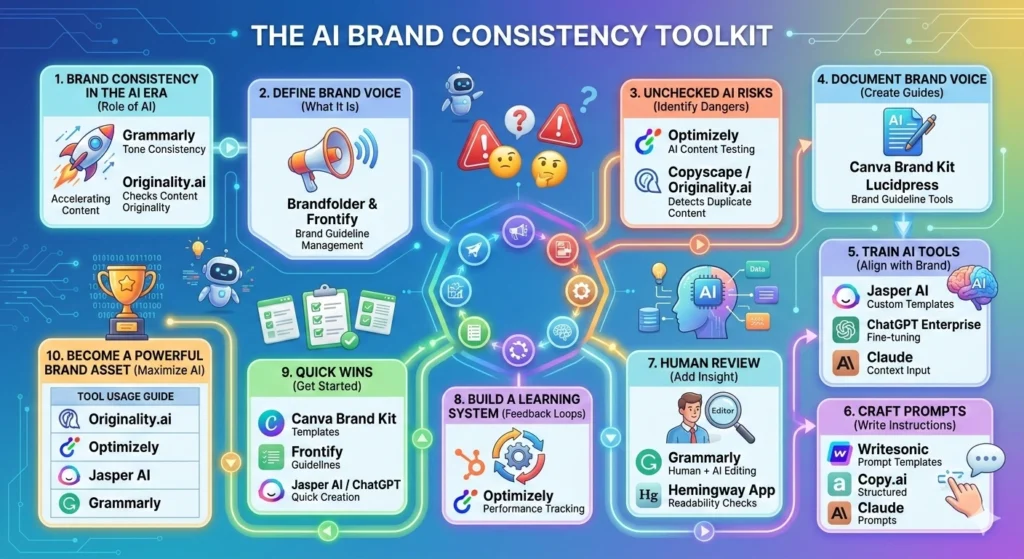
- Grammarly: AI writing assistant for tone, clarity, and grammar checks.
- Originality.ai: AI content detection and originality verification tool.
What Is Brand Consistency and Why Is It Important?
Brand consistency is executing a unified representation of your brand across all platforms with respect to how you represent yourself through your voice, tone, and messaging.
Brand consistency is made up of:
- A defined brand voice
- Clear tone guidelines
- Structured style guidelines
- Unified messaging towers
When brands are consistent in their communications with their audiences they can achieve recognition. Over time this allows for instant recognition by audiences based on certain patterns of language associated with their brand, as well as developing strong emotional memory.
For example:
- Trust-based brands utilize language patterns focused on reassurance and clarity.
- Prestigious brands utilize language patterns of refinement and authority.
- Passion-based brands utilize language patterns of heightened energy and expressiveness.
When AI operates consistently with these language patterns it enhances brand identity; conversely, when AIs do not follow these patterns, they confuse the audience.
To centralize brand assets and guidelines, teams use the following:
- Brandfolder: Digital asset management platform for brand control.
- Frontify: Centralized brand guideline and collaboration platform.
Consistency builds familiarity. Familiarity builds loyalty.
What Are the Risks of Unchecked AI Content?
AI generates material rapidly, but it also produces inconsistencies when left without supervision.
Unmoderated AI content typically leads to:
- A single generic message across all channels,
- Improper tone across all channels,
- Repetitive phrasing across all channels,
- Messages that do not align with brand values across all channels.
The result is an audience that does not connect with the brand and, worse, may question its credibility.
For example, if a mystery-based company creates a sense of mystery through its positioning, AI producing very direct, aggressive material undermines that positioning. Or if the company produces very energetic products based on God in a manner consistent with its God positioning, producing flat or corporate material by AI reduces how much emotion that will be evoked.
To decrease the risk of these types of issues, marketers will utilize the following:
- Copyscape: A plagiarism detection tool for duplicate content checks.
- Originality.ai: AI content detection and originality verification tool.
Thus, marketing teams can easily monitor AI output instead of blindly using the output generated from AI. This becomes especially important in emerging areas like AI influencer marketing, where brands must balance automation with emotional authenticity to avoid sounding robotic or disconnected.
How Can You Document Your Brand Voice Effectively?
You must first define your brand voice clearly. If you do not have documented rules for it, AI will not be able to adhere to those rules.
An effective brand voice guide includes the following:
- Tone traits.
- Emotional positioning.
- Do’s and Don’ts.
- Preferred vocabulary.
- Formatting guidelines.
- Examples of previously successful content.
Additionally, define the types of dominant fascination language your company uses:
- Power as a lead.
- Innovation as a way to differentiate yourself.
- Passion to attract.
- Prestige to create authority.
- Documenting all of these will help AI to replicate them with accuracy and consistency.
Brands develop a brand documentation structure with:
- Canva Brand Kit: Design platform with built-in brand kit management.
- Marq: Brand templating software for consistent design execution.
Clear brand documentation helps to minimize confusion and create a cohesive vision.
How Do You Train AI Tools to Align With Your Brand?
Once you’ve documented your AI tools, it’s time to train them specifically to be successful.
Instead of giving your AI vague prompts, try doing the following:
- Provide examples of high-performing brands that fit your brand
- Specify how you want the AI to sound
- Explain how you want the AI to convey emotion
- Describe what you expect from the target audience
- Provide specific boundaries for messaging
All of the following platforms allow for some customization of this type:
- Jasper: AI content creation tool with custom brand voice training.
- ChatGPT Enterprise: Enterprise AI platform with advanced customization controls.
- Anthropic’s Claude: AI model supporting detailed context-driven instructions.
Example: A marketer can provide Claude with detailed brand guidelines and tone examples. The result is an output from the AI that is more closely aligned to the intended voice.
Consistent training leads to consistency at scale. To get started with AI and understand its broader role in marketing workflows, you can follow this comprehensive guide on how to use AI in marketing.
How Do You Craft Prompts for Consistent AI Content?
When strong prompts are given, there will be strong structure-based output.
Every good prompt will have the following included in the prompt:
- Target audience
- Content goal
- Desired tone
- Emotional Positioning
- Format Requirements
For example, you might tell AI:
- To sound trustworthy with a tone of reassurance.
- To have a confident voice that sounds powerful in nature.
- Use ideas related to forward-thinking when creating content based on innovation.
Tools that can help:
- Writesonic: AI writing tool with structured prompt templates.
- Copy.ai: AI copywriting platform for marketing content workflows.
By utilizing structured prompts, teams are able to decrease tone drift and increase efficiency when creating materials.
Why Is Human Review Still Essential for AI Content?
AI creates draft content; however, humans ensure the integrity of a brand’s image.
An editor will help to ensure:
- That the tone matches the brand’s usage policies and guidelines.
- That the messaging corresponds to the company’s strategy.
- The emotional signals conveyed through the content are congruent.
- That the level of clarity and quality of the final product is at an acceptable level.
Example: If your brand creates credibility using Trust, a human editor will check that the piece does not contain exaggerated claims about the product. If your brand reflects prestige, an editor will adjust the wording so that it continues to demonstrate authority.
Additionally, working with AI draft content is often combined with the use of:
- Grammarly: AI writing assistant for tone, clarity, and grammar checks.
- Hemingway Editor: A Readability tool that simplifies complex writing.
Combining human supervision with AI content creation will help speed up AI production. To maintain authentic and emotionally engaging content, many marketers combine AI productivity with human creativity, as outlined in this guide on humanised AI marketing.
How Can You Build a Learning Content System With AI?
To maximize the effectiveness of AI utilization, you must use feedback loops when constructing a learning model.
Therefore, you need to:
- Track engagement metrics
- Measure conversions
- Monitor readable content.
- Identify tone inconsistencies.
- Adjust prompts accordingly to provide improved output.
Over time, you will determine which emotional positionings work best. For example, authoritative messaging (power) may result in conversion, while trust messaging (reassuring) may result in retention.
To improve content performance, you and your team will use:
- HubSpot: CRM and marketing analytics platform for performance tracking.
- Optimizely: AI-powered experimentation and content optimization platform.
Continuous refinement for long-lasting alignment will help. As marketing workflows evolve, leading companies like WPP and Adobe are expanding partnerships to drive agentic AI workflow automation in marketing, showing how automation and consistency can work hand in hand.
What Quick Wins Can You Apply Today for Consistent AI Content?
There are four effective ways to achieve consistency right away:
- Standardize your prompt templates
- Include reminders of your brand voice within all of your creative briefs
- Provide a basic checklist to review all work
- Train your staff on proper brand alignment
Other helpful tools:
- Canva Brand Kit: A design platform that contains everything needed to manage a brand kit
- Frontify: A centralized place to house your brand guidelines and collaborate with others on your brand
- Jasper: An AI content creation system that allows for custom training to align with any brand’s voice
- ChatGPT: An AI-powered conversational model that can be used to create multiple types of content, create prompts, and establish brand-aligned marketing workflows.
Implementing small systems will create immediate clarity.
How Can AI Become a Powerful Brand Asset?
AI can either weaken your brand or strengthen it, depending on how intentionally you use it. When you document your voice clearly, define emotional positioning, and guide AI with structured prompts, you ensure consistency at scale. Tools like Grammarly, Jasper, Optimizely, and Originality.ai help teams protect tone and originality while producing content faster.
However, human review remains essential. Editors refine nuance, maintain emotional alignment, and prevent tone drift. When brands combine strategy, systems, and oversight, AI becomes a powerful brand asset that drives recognition, trust, and long-term growth.
