
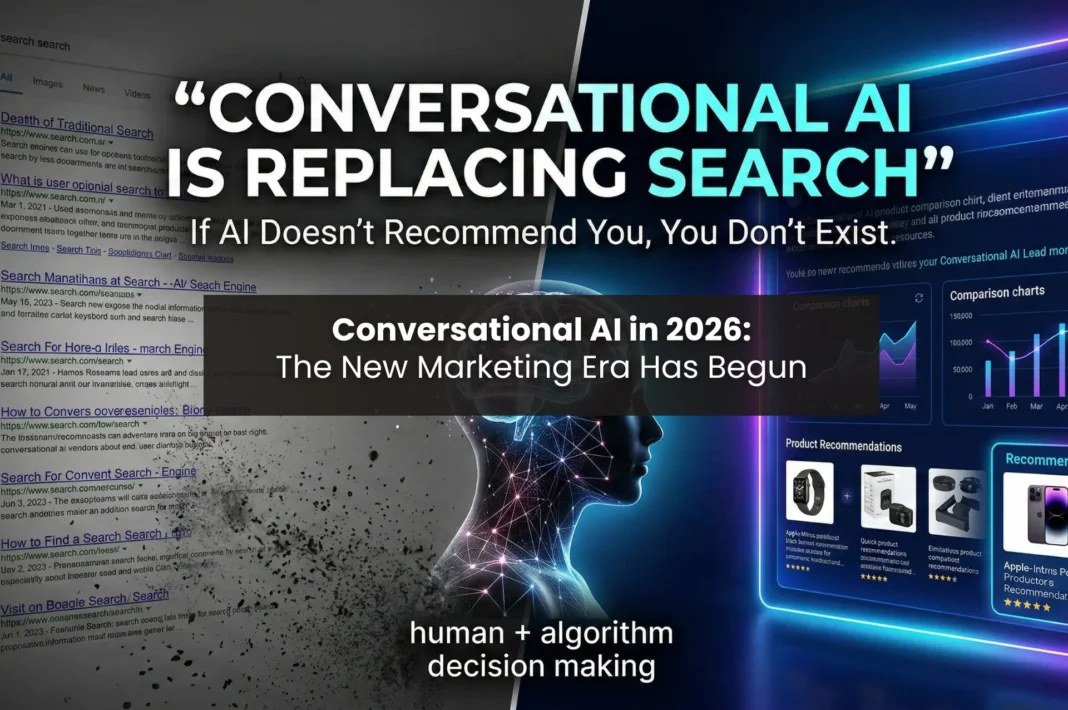
For fifteen plus years, we optimized our websites, our product pages, our blog pages etc. for the search engines. We would focus on rankings, CTR’s and traffic funnels.
In 2026, there has been a major noticeable shift in how modern marketing is approached. As discussed in Harvard Business Review’s analysis of AI’s dual impact on marketing, instead of evolving slowly, the shift from traditional marketing to modern marketing, happened all at once.
And now? With Conversational AI into the picture, the marketing funnel has been compressed into a single answer.
What is Conversational AI?
Conversational AI refers to the AI systems that interact in natural language to provide recommendations, answers, and personalized suggestions in real time. Instead of delivering a list of links, like the search engines, it delivers a response that has specific recommendations according to the question asked. Sometimes it will provide you with a decision based on your data and what you have asked out of it, without having you to open separate links and create comparisons yourself.
This is a huge shift, and that one shift changes everything.
Traditional Marketing Was Built on Search. That Era Is Closing.
For the past twenty years, digital marketing was dependent on top of the funnel (TOFU) awareness, search engine visibility, organic and paid clicks and website conversions.
We would ask a search engine for a product, it would deliver lists, the users then clicked on the lists and after that, brands would compete for position. This system was messy, but also easier and simpler.
But with the introduction of Conversational AI, you do not get 10 blue links anymore. You get one combined answer, which includes a recommended product, a curated shortlist, a summarised comparison, or a decision shortcut (which is not good for the marketers).
It all comes down to less clicking, fewer site visits and more zero click experiences. As for organic SEO traffic? The shift has already begun in 2026.
How Conversational AI Is Replacing Traditional Search
To understand how conversational AI is replacing traditional search, let’s break down the traditional search model.
For example: Earlier, if I had to buy 500gms of protein according to my specific fitness goal, I would type “best powder protein to lose weight” in a search engine. The engine then would give me ranked pages with 10 options on each page and then I would evaluate which option suits me the best.
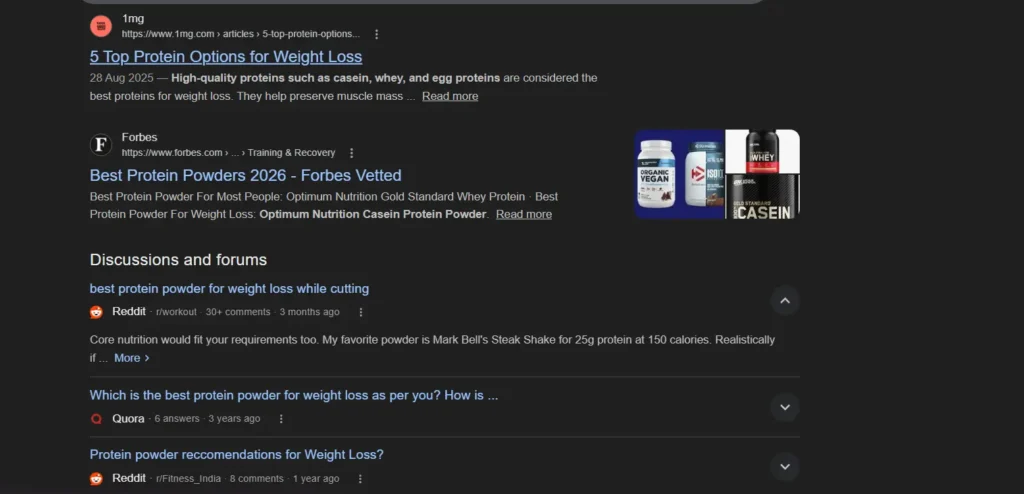
But now, with conversational AI model the above query looks like this:
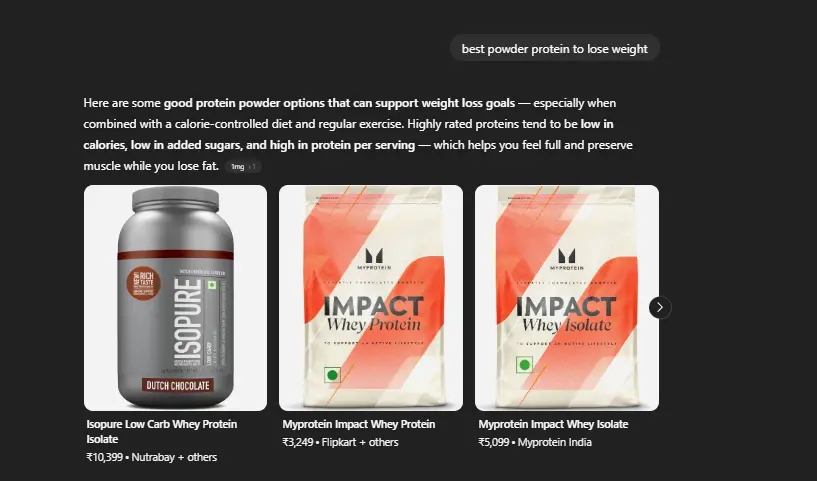
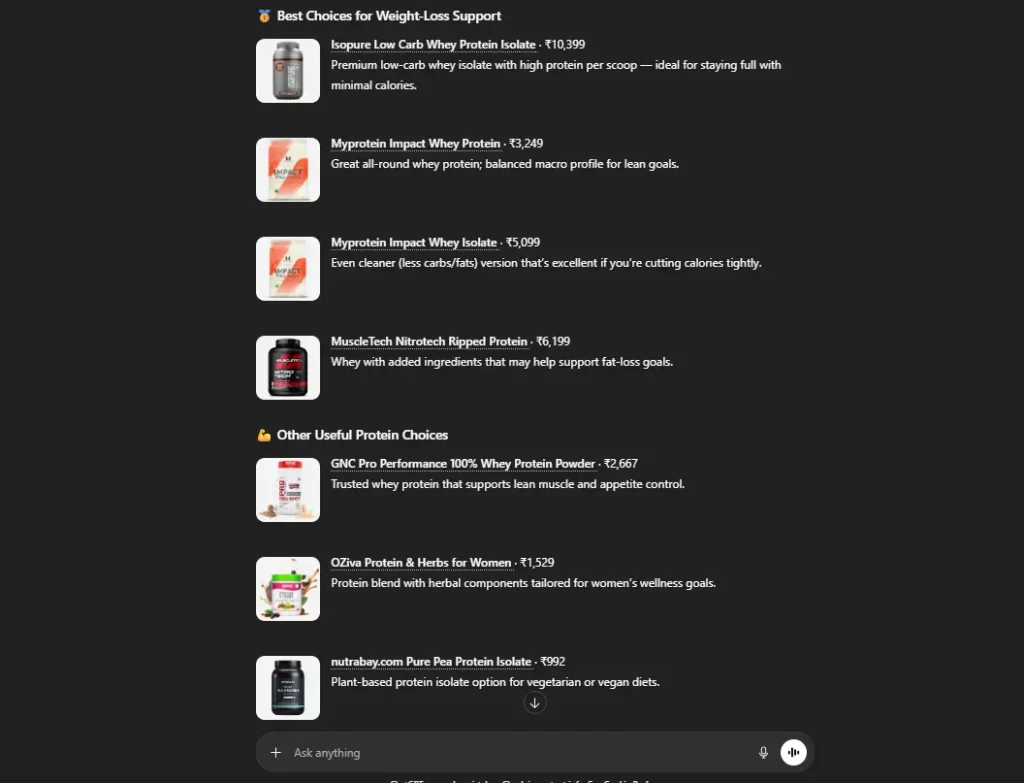

Can you spot the shift?
The user now gets one structured answer. Which just means that if you are a brand, or a service or a startup, and you are not integrated inside the AI’s combined knowledge layer, you practically don’t exist in that decision moment.
This is where Conversational AI visibility replaces traditional ranking obsession.
What Is GEO (Generative Engine Optimization)?
Generative Engine Optimization or GEO, is the practice of optimizing your content and digital presence in a way that the AI systems include, reference, or recommend your brand in their generated responses.
Key Differences Between SEO and GEO
| SEO | GEO |
| Optimize for rankings | Optimize for inclusion in AI responses |
| Keywords dominate | Entities + clarity dominate |
| Clicks are metric | Mentions & synthesis visibility matter |
| Traffic-focused | Influence-focused |
Real GEO Implementation Steps (2026 Guide)
To incorporate best GEO practices in your content, focus on these pointers:-
- Create definition first content blocks so that AI systems can pick them up
- Use structured schema markups like FAQ, Product, Organization etc. – AI systems prefer structural clarity over long form writing that includes extra information.
- Build consistent entity signals across platforms
- Write answer ready paragraphs (2–3 sentence clarity chunks)
- Reduce redundancy and Increase precision.
Measurable GEO KPIs
It is important to measure the KPI’s once you have incorporated the above GEO practices in your content.
- AI citation frequency – How many times an AI system has mentioned your content/parts of your content
- Brand inclusion in AI generated comparisons – Has the AI system incorporated your brand in its comparison lists
- Conversational AI referral traffic – How much traffic is getting directed towards your brand from the AI systems
- Prompt based brand discovery testing – Whether an AI system is referring to your brand when asked about products in your niche
Your marketing team needs to start testing whether the AI tools are describing your brand weekly or not. Otherwise you will be behind.
What Happens When AI Influences Buying Decisions?
Let’s talk about the real shift which has silently become one of the biggest reasons in how humans make decisions now. And most marketing executives are still underestimating it.
Let’s go back to the example above, where a user wants to buy a protein powder to lose weight. If you notice the output given by the AI, you can see that there’s –
- Curated product options
- Brands filtered out
- Pricing compared automatically
In some cases, these AI agents can also complete transactions on behalf of their users.
In 2026, the ‘customer’ is no longer completely human. Rather, it’s a human + algorithm.
So simply put, if an AI agent shortlists a list of 5 brands for the user, and if you’re not in that list, then the user may not even get to know that you exist in the same market.
That’s a loss.
Human vs AI Customer Segmentation
Unlike earlier, we now have two buyer categories-:
1. Human-Led Buyers – These buyers have emotional triggers, are loyal to some specific brands, can have community influence and showcase social proof.
2. AI-Influenced Buyers – These require data consistency, structured product clarity, transparent pricing and clear feature differentiation.
Hence, your marketing strategy should serve both the audiences with different visibility logic.
What Marketers Must Do Next
This isn’t a guide. If you look at any smart marketers 2026 dashboard, you will see that they’ve already started optimizing their content. Here’s how you can do it too-:
1. Optimize for AI Visibility (GEO)
AI systems prioritize clarity over creativity.
- Add clear definition sections
- Write comparison friendly content
- Include measurable claims
- Reduce vague language
2. Build Structured Knowledge Layers
Use schema properly because structured data helps AI systems extract meaning faster.
- FAQ schema
- Product schema
- Organization schema
- Review schema
3. Invest in Conversational Assets
If your content cannot be quoted cleanly in a 3-sentence AI response then rewrite it.
- Create answer blocks
- Use TL;DR summaries
- Create definition sections
- Create decision frameworks
4. Rethink Measurement Models
Instead of measuring content result through traditional KPIs like:
- Traffic
- CTR
- Bounce rate
Start focussing on the emerging KPIs like:
- AI response inclusion
- Conversational discovery rate
- AI-assisted conversions
- Brand recall in AI environments
Tools and Tactical Moves (Practical Layer)
As a marketer, you should start structurally positioning your brand immediately. It might feel overwhelming right now, that’s why here are 5 effective implementations you can start with.
- In your weekly calendar, block 2 hours for running your specific brand queries across all the major conversational AI tools
- Start monitoring the AI product comparisons for visibility gaps in the output
- The long form content should be structured wherein the AI agent can extract informational chunks
- Keep the information precise and not ambiguous. AI penalizes that, and your content will be nowhere on the web.
Why Human Connection Still Wins
The one thing that differs humans from machines is that humans can ‘feel.’
Humans can create shared memories, or get nostalgic and become a part of the community. That’s why brands that still have that emotional pull, that was built through trust and identity – these kinds of brands are still harder to override.
Machines can only recommend products, or services, basically anything that you ask from it. It can also help you in accelerating your decisions. But they cannot generate loyalty.
In 2026, the brands who are winning are-:
- Structuring themselves for conversational AI discovery, and
- Building human emotional impact
You have to implement both, and not just one of the above. And the brands that implement both, while still building, are the ones that will dominate the next decade.
