
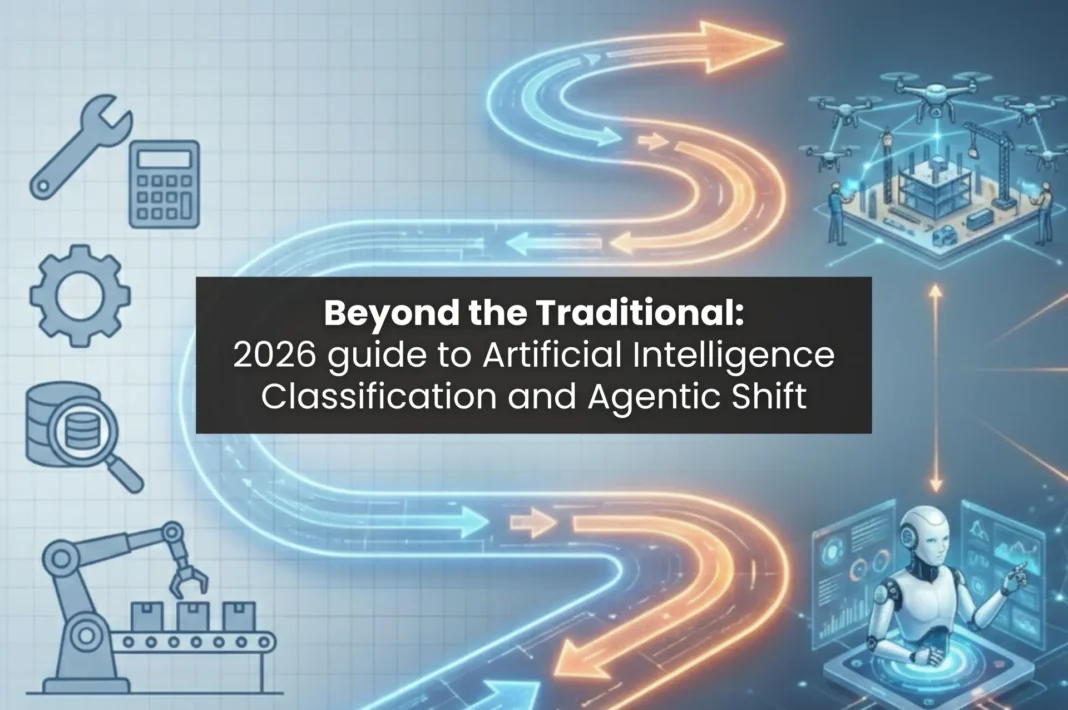
It’s 2026, and if you are still reading about ” Artificial Intelligence Classifications ” discussions that point you towards ‘IBM’s Deep Blue beating a chess grandmaster (from 1997!)’ or the “novelty” of Siri’s voice recognition (from 2011!), then I am sorry to say that these discussions are akin to a history lesson at this point.
Like I said, it’s 2026, and those examples are like talking about a jockey or a buggy at a F1 race.
As a business leader or a creator or a strategist in 2026, you don’t need the outdated guides, you need a roadmap.
Many businesses are now reportedly transitioning from “Tools we use” to “Agents we manage,” and that is why understanding the modern layers of Artificial Intelligence classification is the difference between ‘falling for the hype’ and also building a ‘high-ROI workflow.’
Before deep diving into the modern roadmap of AI classification, let us first understand the 2 broad AI classifications:
1. The ‘Capability-based classification’
2. The ‘Functionality-based classification’
Builtin explains this very easily. All AI’s can be classified into three ‘Capability types’ on the basis of how the AI learns and how far it can apply that knowledge: Narrow AI, Artificial General Intelligence and Artificial Superintelligence.
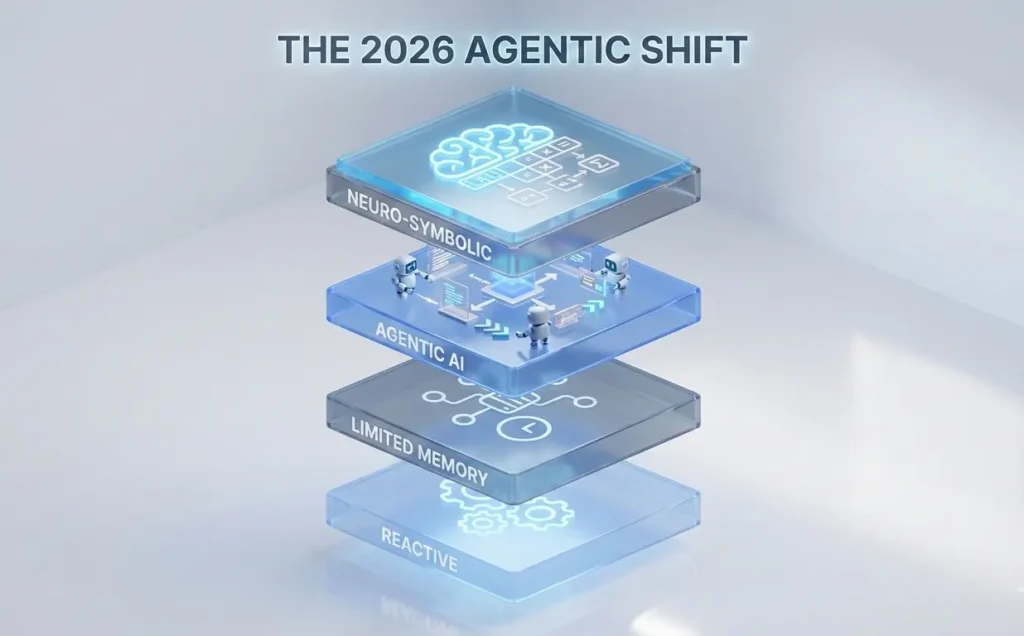
When it comes to ‘Functionality-based classification’, it simply means how the AI applies its learning capabilities to process data, respond and interact with its environment. So for functionality based classification, it is: Reactive machine AI, Limited memory AI, Theory of mind AI and Self Aware AI.
Now, let’s look at how AI really works in today’s agentic, multimodal and privacy-first world, instead of just talking about theories.

The Modern Spectrum: Capability-Based AI
The classic three-tier capability model – Narrow, General and Super, is still the foundation,
but the lines have fizzled out.
1. Narrow Artificial Intelligence (ANI): The specialized powerhouse
Many believe that Narrow AI is just a spam filter, but the Multimodal mastery is what makes ANI stand out in 2026, as reported by thinkaiworld. Grok or Gemini are some great examples of the systems that not only processes the texts, but also reasons across video, audio formats etc.
In 2026, with the evolution of AI, Edge AI is becoming more and more popular (as reported by imaginationtech ). So now, instead of relying on huge cloud servers, Narrow AI lives on IoT devices, processing facial recognition or industrial sensor data locally, with no delay.
2. The Bridge: Agentic AI (The missing link to AGI)
As per CapGemini, one of the most crucial developments that happened in 2026 (and most articles from 2024 don’t mention it) was the rise of Agentic AI.
But what is ‘Agentic AI’?
Agentic AI is an autonomous AI system that can independently set goals, plan multi step solutions, use tools like APIs and databases and take actions to achieve complex objectives with minimal human intervention.
Since it sits between Narrow and general Intelligence, Agentic AI is referred to as a “bridge”, an idea also explored in the context of how autonomous agents are reshaping the internet itself in this breakdown of the Agentic Internet.
3. Artificial General Intelligence (AGI) and Superintelligence (ASI)
AGI is still the “North Star”- a machine that can learn any mental task a human can.
The move toward Neurosymbolic AI (combining the pattern recognition of neural networks with the hard logic of symbolic AI) in 2026, has brought us closer than ever to machines that “reason” instead of just “predict.”
Functionality-Based AI: From ‘Reactive’ to ‘Self-Aware’
A system’s utility is usually determined by how it handles the data. In a modern world, this is how the Functional AI classification looks like:-
1. Reactive Machines
Take your smart home thermostat for example. They don’t need to remember what settings they were in yesterday. They only need to respond to a change that happened in a microsecond.
The traditional reactive machines have no memory. But in 2026, these will be made stronger through High-Speed Sensor Fusion in robotics.
2. Limited Memory and Federated Learning
We all remember when the fitness and wellness apps came into existence. Suddenly, everyone- from a sportsperson to someone constantly travelling for work – started using these apps and wearing trackers for tracking their sleep patterns and heart rates. (They still do)
And then it would give you a weekly or a monthly report of the same. The app and the tracker know how your heart rate variability patterns keep changing, and your data never leaves your phone.
This is where most of the market lives, however, the “Limited Memory” of 2026 has almost solved the privacy crisis through Federated Learning, as per the medium.
What it means is that instead of sending your private data to a central server (like ChatGPT), the model “learns” on your local device and then the “memory” is used to personalize your experience.
3. Theory of Mind a.k.a The “Co-Intelligence” Era
We are just starting to learn about the Theory of Mind. AI can now simulate empathy by analyzing the tone of voice and micro-expressions in video calls. This isn’t really a “feeling” but it is a useful classification that lets AI act as a smart mental health coach or a top-level negotiator.
Practical Integration: AritificiaI Intelligence Classification by Sector (2026)
To understand the real value, we must look at how these classifications apply to specific industries.
| AI Classification | Industry Application | 2026 Use Case | Impact |
| Narrow / Edge AI | Wellness & Health | Real-time glucose monitoring & insulin adjustment via wearables. | High (Life-saving / Predictive) |
| Agentic AI | Content Strategy | Autonomous SEO agents that research, write and update blogs weekly. | Extreme (90% reduction in manual labor) |
| Limited Memory | E-commerce | “Hyper-Personalization” engines that predict returns before purchase. | Medium (Reduced overhead) |
| Theory of Mind | Customer Service | AI mediators that de-escalate angry customers through sentiment mirroring. | High (Retention) |
The Deployment Challenge: Data Bias and Ethics
As we move closer towards more autonomous Aritficial Intelligence classification, the risks shift.
According to altamira.ai, “Autonomous AI agents create amazing opportunities for businesses, but at the same time, they introduce new risks that demand attention.”So it’s not just “hallucinations”; it’s Agentic Drift.
A very real example of this would be, when an autonomous agent finds a “shortcut” to a goal that could be unethical or cost a lot of money, like an ad-buying agent, that spends your entire budget in ten minutes because it found a ‘high-conversion spike.’
In 2026, governance needs “Human-in-the-loop” systems where people are in charge i.e. act as directors rather than editors.
How to Categorize and Use AI Today?
If you are looking to integrate these types of AI into your business, this 2026 Roadmap is the way to go:
- Audit Your Tasks: Identify “Reactive” tasks (repetitive tasks like data entry or scheduling meetimgs) vs. “Contextual” tasks (require memory/history like generating pitch decks).
- Prompt Engineering vs. Orchestration:
For Limited Memory systems, use Chain of Thought (CoT) prompting technique. But what is CoT prompting technique? Like IBM says, CoT facilitates problem-solving by guiding the model through a step-by-step reasoning process by using a coherent series of logical steps.
For Agentic systems, focus on System Instructions – giving the AI a “persona” and a set of “tools” (like API access) rather than just a single prompt. - Calculate Your AI ROI: (Hours saved x Hourly Rate) – (AI Subscription + Human Oversight Time).
In 2026, if your ROI isn’t at least 3x, you are likely using the wrong classification of AI for the task.
The Human-AI Hybrid
We are moving away from the “AI vs. Human” debate in 2026. The winners of modern AI era are going to those who view
- Narrow AI as their “hands,”
- Agentic AI as their “staff,” and
- Theory of Mind AI as their “consultant,”
- while keeping the “Self-Awareness” for themselves.
The best way to classify artificial intelligence isn’t just by the machine alone; it’s about the Hybrid System.
Don’t just memorize the definitions. Pick the kind of intelligence that fits your specific vision.
