
From Creation to Action: Understanding Agentic AI vs Generative AI
AI is developing at an ever-accelerating pace, and today, one of the most significant changes we are witnessing is the development of agentic AI, which represents the next generation of artificial intelligence systems that not only produce content but also take actions designed to achieve their objectives. A thorough understanding of agentic versus generative artificial intelligence is critical to those wishing to understand how automation, productivity, and decision-making will be impacted in the years to come.
Organizations that seek to grow their operational size, increase their efficiency, and decrease the time that employees spend doing their work will find it very important to understand the differences between Generative and Agentic Artificial Intelligence (AI). Generative AI enhances content creation. Agentic AI automates processes and allows users to complete their work without requiring the direct involvement of an individual. Therefore, businesses will develop different strategies to leverage, deploy, and benefit from AI in the future based on their understanding of this distinction.
What Is Generative AI?
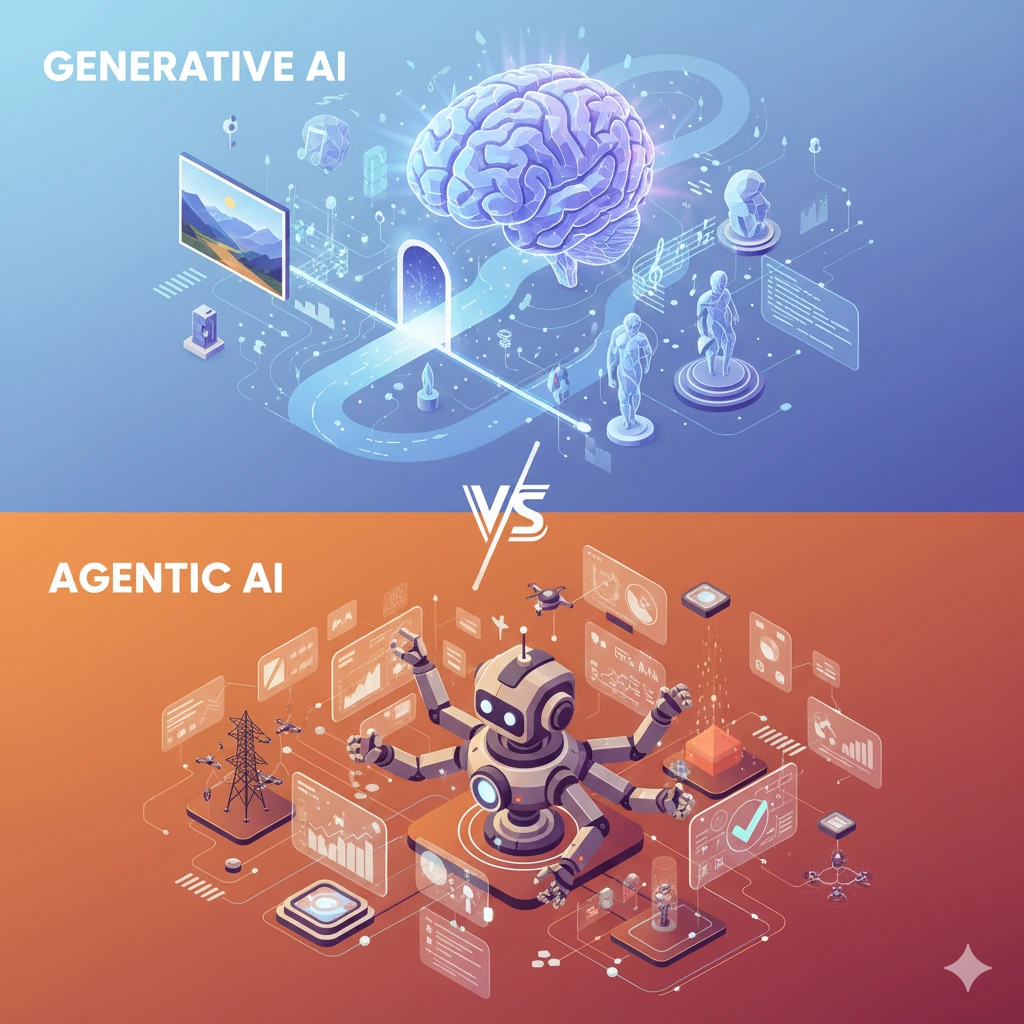
Generative AI generates new material. Text, photos, audio, videos, source code, etc.—anything a generative AI has been trained to create. Generative AI will produce something based only on the information it was trained on. It is excellent at discerning existing material patterns or trends. It can produce creative works such as novels, product design plans, etc., given the prompt it was provided with when initially created.
The Primary Strengths of Generative AI
- Good Pattern Recognition
- Greatly Prompt-Dependent
- Creates Creative Content (Stories, Designs, Code)
- Simple, turn-by-turn, Reactive
Some Common Uses of Generative AI:
- Creating and Rewriting Content
- Creating Summaries and assisting with Research
- Translating Languages and Performing Language-Related Tasks
- Generating Code
- Creating Marketing Copies and Creative Brainstorms
Generative AI is reactive; when you ask it for something, it generates a response. It doesn’t understand its end goal, nor does it plan.
What Is Agentic AI?
The next phase of artificial intelligence will be represented by an agentic AI: intelligent machines that have the ability to plan and take action on their own to perform tasks in accordance with a specific goal.
While traditional AI may take a long time to find the most appropriate action for a prompt from a human operator, agentic AI is able to make decisions and initiate action immediately based on available information, as well as adapt to new situations.
Some Examples of Features Found in Agentic AI
- Decision-making: Observing, reasoning, acting, and improving oneself.
- Autonomous: Can make independent decisions without human involvement.
- Planning: Developing plans via a systematic sequence of actions.
- Adaptive: Can adapt to changes or make corrections based on experience.
- Tool Interactions: Works with APIs, tools, and other systems.
- Long-Term Execution: Manages work over multiple minutes, hours, or even days.
Example of How an Agentic System Works
An example would be an agentic system that could plan and schedule a project, execute required steps, check for and correct errors, and keep track of progress on a task without requiring continuous human direction at each step of the process.
Core Differences Between Agentic and Generative AI
| Aspect | Generative AI | Agentic AI |
|---|---|---|
| Primary Function | To begin with, generative AI focuses on creating content such as text, images, or code based on user prompts. | In contrast, agentic AI performs multi-step tasks autonomously, moving beyond creation into execution. |
| Interaction Style | Typically, it responds to single-turn prompts and relies heavily on user direction. | Meanwhile, agentic AI operates across multiple steps, maintaining continuity without constant human input. |
| Level of Autonomy | By comparison, generative AI offers low autonomy, as it cannot take independent actions. | However, agentic AI provides high autonomy, making decisions and adjusting actions as conditions change. |
| Complexity Handling | For the most part, generative AI handles isolated tasks that do not depend on previous outputs. | On the other hand, agentic AI manages complex workflows that require planning, sequencing, and self-correction. |
| Main Benefit | Naturally, it speeds up content creation, ideation, and summarization. | Conversely, agentic AI delivers end-to-end workflow automation and intelligent orchestration. |
| Risks & Considerations | Even so, it may hallucinate or generate inaccurate content, requiring manual verification. | Nevertheless, agentic AI needs strong oversight to avoid mis-specified goals, error propagation, or security issues. |
Workflow & Use-Case Benefits
With increasing AI adoption among businesses, it is vital to comprehend the real-world advantages of generative and agentic AI services. They both have large amounts of potential to help improve operations, but in very distinct manners.
Generative AI provides value in ways that promote vision, creativity, and content generation. As a result, it provides significant time savings, increased output quality, and increased productivity due to its ability to simplify the processes of summarizing, drafting, revising, and generating new ideas.
Some of the primary benefits include:
- Speed of Content Generation
- Quality of Written and Programmed Content
- Increased efficiency of Research and Documentation
- Improved communication through organized summarization
Agentic AI’s value is in its delivery of independent serving. Agentic AI assists organizations with coordinating work between multiple tools, meeting regulatory requirements, utilizing business rules or logic in decision-making, and automating the end-to-end workflow of their business processes.
Core strengths of Agentic AI include:
- Execution of Multi-Step Workflows
- Management of Complex Inter-dependently Directed Workflows
- Ensuring Consistency and Compliance with Company Policies
- Adjusting Actions Based on Immediate Feedback
Examples of How to Make Use of Agentic AI Include:
- Due Diligence / Risk Management
- Regulatory Tracking/Monitoring
- Project Management
- Employee Onboarding Automation
Examples of How to Make Use of Generative AI Include:
- Drafting Legal Documents
- Summarizing Research Data/Materials
- Creating Preformatted Templates for Use in Emailing/Communicating
- Generating Code Snippets
Challenges & Risks
Both types of artificial intelligence provide many advantages but also create unique challenges.
Agent-Based AI Risks
- Misunderstood goals can result in unintended outcomes.
- Long workflows create a stacking of errors.
- Accountability and safety become much more complex.
- Oversight needs to be done very carefully.
Generative AI’s Risk
- Fictional or incorrect information.
- Dependence on the quality of prompts.
- Neither can evaluate complex data for accuracy.
This means that organizations require a governance framework, validation, and compliance systems prior to deploying agentic systems at a large scale.
Future Outlook & Convergence
There is a clear indication that Generative AI and Agentic AI are not going to be competing entities in the ACL (Acceptable Cumulative Loss) model; rather, they are going to converge over time. Generative AI will revolutionize and drive creativity as well as drafting and creation of content, whilst agentic AI (AI that performs work) will enable an organization to coordinate, orchestrate, and conduct work that is both planned and executed.
In addition, organizations will increasingly leverage the combination of both generative AI and agentic AI (Generative AI and Agentic AI) to bridge the gap between generating an idea and creating actionable intelligence.
In summary, organizations will need the following in the future:
- To Safely Implement AI, Stronger Governance, and Include a Risk Management Framework
- To guarantee the Effective Implementation of AI, Transparent Logging of Decision-Making Processes will be required
- An increased focus on safety and accountability systems will help mitigate errors and rebuild future trust.
- Developing hybrid workflows utilizing Generative AI and Agent-based AI will allow organizations to quickly transition between creating new content and autonomous task execution.
Why Agentic AI Is the Next Step in AI Evolution
In summary, the difference between Generative AI and Agentic AI is that one creates and the other acts. Businesses are looking for more than insights; they want systems that can reason, plan, and execute with little to no human involvement, as the world moves towards greater reliance on such systems.
Thus, companies that figure out how to use both technologies, Generative AI to generate ideas and Agentic AI to carry out ideas, will have a strong competitive edge.
So the future of AI is in the hands of the companies that adopt this approach, which will lead to both faster content creation as well as more intelligent automated workflows that can impact the real world.
To explore how these autonomous systems extend across the web, check out our detailed guide on the Agentic Internet.
