

Getting started with AI for academic research
Researchers are using AI to transform how they design and conduct studies. Many tasks that once took days, such as finding reference materials or organizing notes, can now be completed much faster with modern AI tools.
AI can extract key points from multiple research articles, summarize their findings, and even help draft sections of a research project. Follow this step-by-step guide to incorporate AI into your research.
Why AI is becoming essential in academic research today
Conducting any form of research, whether on any subject, has always been a time-consuming task that demands patience and careful observation. Gathering information from various studies and writing from scratch often proves to be a daunting task.
AI for Academic Research helps reduce repetitive tasks by summarizing studies, aiding researchers in finding information speedily, and presenting the gathered information in a better manner. It has become a necessity for the research process, as it helps researchers think and work more effectively.
How AI tools simplify the academic research workflow
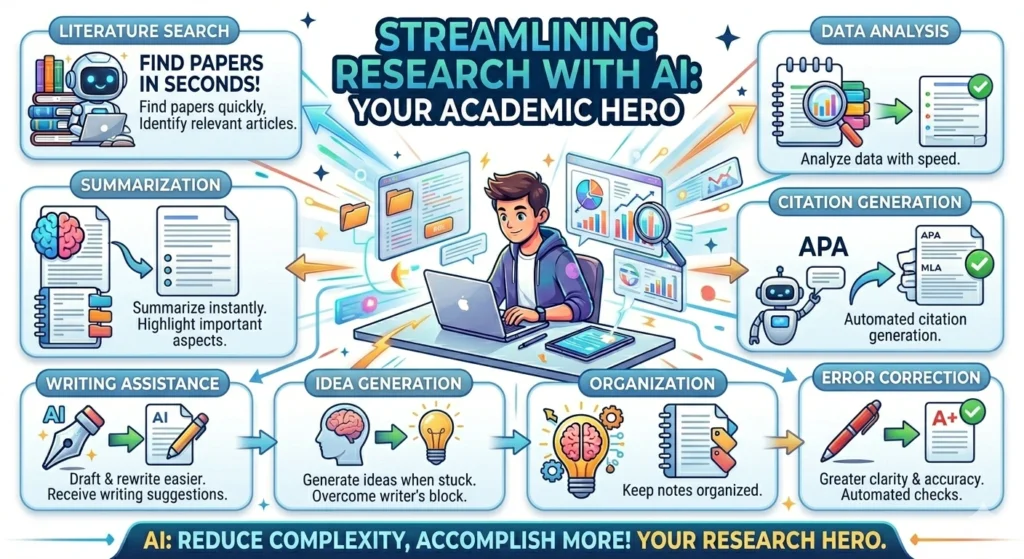
You can incorporate AI into each stage of your research process. AI will enable you to be more efficient than ever before while remaining organized.
- AI helps you search literature faster and identify relevant papers easily.
- Summarizing articles highlights the important aspects of the article in less time than reading the entire article.
- Keeping your notes organized allows for an organized and effective workflow.
- Analyzing data with speed reveals patterns and trends.
- AI assistance makes drafting and editing much easier.
- Automatic citation generation cuts down on time spent formatting citations.
- Generating ideas when you are at a standstill is possible with AI assistance.
- Error correction provides greater clarity and accuracy.
When you use AI effectively, you can turn complex research tasks into simple and manageable steps.
Which are the best AI tools for academic research you should try?
A combination of tools will provide a better experience than relying on a single tool for your research workflow.
1. ChatGPT
Description: Helps with writing, summarizing, and brainstorming.
Features: Drafting, editing, idea generation, and explaining things.
Pricing: Free and paid plans starting at $20 per month.
To get better results while writing, it is important to use the right prompts. You can check out these tips to get the absolute best out of ChatGPT to improve your outputs.
2. Elicit
Description: Focused on helping you with literature reviews and research discovery.
Features: Search for papers and see a summary of the paper, as well as extract data from the paper.
Pricing: Free and paid plans starting at $10 per month.
3. Scite
Description: Helps you verify how your research papers have been cited in other papers.
Features: Smart citations, citation context, and reliability of the citation.
Pricing: Free trial and paid plans starting at $7.99 per month.
4. Research Rabbit
Description: Helps you find and explore research papers.
Features: Recommendations on papers and visual graphs, and tracking of papers.
Pricing: Free.
5. Consensus
Description: Provides answers based on scientific research.
Features: Summaries of research and common themes.
Pricing: Free and paid plans starting at $8.99 per month.
Beyond research writing and data analysis, advanced assistants like the Claude AI coding assistant can automate complex tasks and support research workflows in unique ways.
Step-by-step guide on how to use AI in academic research
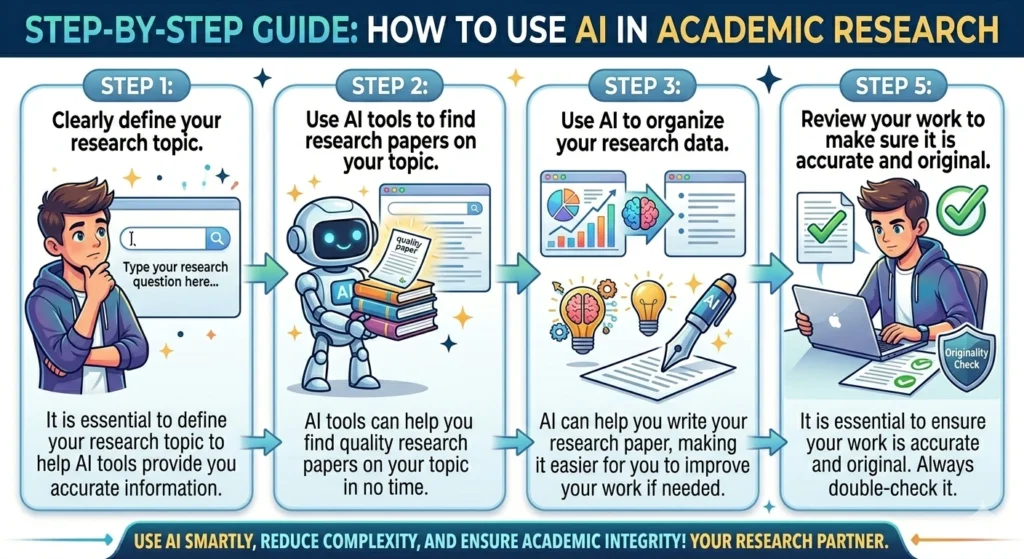
Step 1: Clearly define your research topic
It is essential to define your research topic because it helps AI tools provide you with accurate information.
Step 2: Use AI tools to find research papers on your topic
AI tools help you find relevant and high-quality research papers quickly.
Step 3: Use AI to organize your research data
AI can summarize the research papers you read, making it easier for you to comprehend the information.
Step 4: Use AI to write your research paper
AI can assist you in drafting and improving your research paper.
Step 5: Review your work to make sure it is accurate and original
It is essential to ensure your work is accurate and original, which is why you should always double-check it.
How to choose the best AI tools for academic research
- Determine your research objectives: Identify the areas where you need assistance from your research process; this could be related to sourcing literature articles, statistical analysis, or writing.
- Identify various resources/tools: Choose the best resource or tool you feel will add value to your workflow.
- Verify the results obtained from utilizing tools/resources: Use a verified source/resource for obtaining reliable information, and have a way to check the output.
- Identify features that will improve your efficiency: The ability to create summaries and citations and extract data quickly can help with your efficiency.
- Choose a resource/tool that is user-friendly: Using an easy-to-use tool will help you maintain consistency and allow your completion of work at a faster pace.
- Compare free and paid options: Start with free versions and upgrade only if you need advanced features.
- Choose resources/tools that uphold academic integrity: The ability of the tool/resource to assist in obtaining proper citations and avoiding any potential copyright infringement is necessary.
- Test a few different resources/tools before making any final decision: Testing out the various tools/resources will ensure you find one that improves your overall productivity.
What common mistakes should you avoid when using AI in research?
- Avoid relying completely on AI output: Do not rely solely on AI for information. You must always apply your own inputs.
- Failing to fact-check and verify sources: Check and verify any output from AI systems, as AI is capable of generating invalid or dated results.
- Utilizing fictitious or inaccurate citations: AI-generated source material should be treated with caution until validated.
- Ignoring plagiarism/originality issues: Plagiarism-free and properly cited output should be your final product.
- Avoiding the review and editing process: All AI-produced content should be carefully read, checked for spelling, and refined before submission.
- Utilizing vague/ambiguous prompts: The single biggest determinant of an AI output’s validity is the quality of the input prompt in question.
- Over-reliance on AI for written content: AI should only be used as a writing assistance tool; it should never replace your writing.
- Ignoring academic rules and research guidelines: Follow all rules/regulations set forth by your academic research/education institution when implementing the use of AI systems.
What the future of AI for academic research looks like
The quality of scholarly research in AI continues to develop as innovative software solutions emerge with incremental refinements and enhancements.
In the future, AI may help with deeper analysis, faster discoveries, and more advanced research support. Researchers who start using AI now will find it easier to adapt to these changes.
How you can start using AI for academic research more effectively today
Academic research can be challenging, but AI tools make the process easier and more efficient. There are now so many ways to improve your ability to handle different academic tasks electronically (e.g., reading, analyzing, writing). If you use good AI tools for academic research along with an organized approach to doing your work, you will end up with improved speed and improved quality of the work completed.
When starting, you should begin with a few small projects, try various types of AI tools, and develop an effective workflow that works for your needs. As you continue using AI, you will find that AI becomes part of your regular research process in the future.
AI is not just helping with research tasks anymore. Tools like Claude Cowork Dispatch, Anthropic’s new Claude assistant, show how AI can actively complete tasks, making research workflows even more efficient.
FAQs
Start by clearly defining your research topic or question. A focused topic helps AI tools provide more accurate and relevant results.
AI tools can scan large databases, suggest relevant studies, and provide summaries, which saves time compared to manual searching.
Yes, AI tools can organize data, highlight key insights, and identify patterns, making analysis faster and easier.
You can use AI to draft and improve your writing, but you should always review, edit, and verify the content to maintain accuracy and originality.
The final step is to review and fact-check all AI-generated content, ensure proper citations, and confirm that your work follows academic guidelines.
