
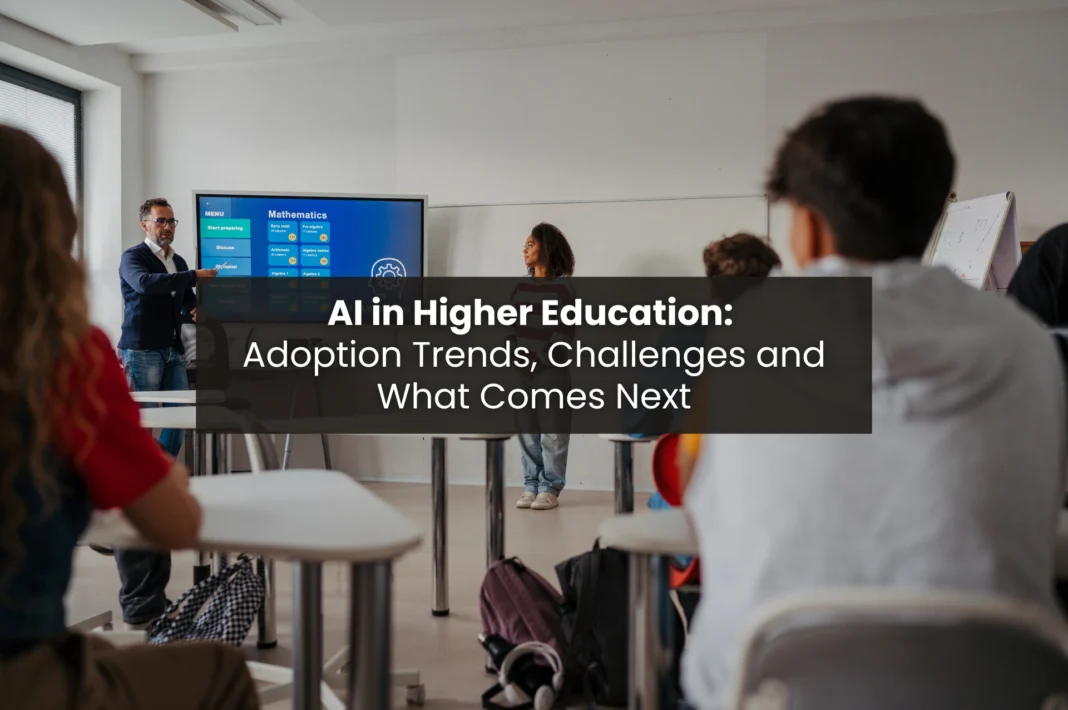
Rapid advances in artificial intelligence by world-class institutions are occurring quickly. In fact, according to the recently published report from BCC Research entitled “AI in Higher Education: Global Market,” the AI in higher education discussion has transitioned out of a futuristic context. And has become fully established through use for providing student support services, developing new curriculum, conducting academic research, and managing university functions. This current usage of AI is demonstrated through an analysis of adoption trends, policy frameworks, and institutional readiness by using data from more than twenty major universities globally.
What is the current state of AI adoption in universities?
The overall sentiment throughout the higher education sector is extremely optimistic. BCC Research’s proprietary AI Sentiment Index has an overall score of 84.82 out of 100 for the sector as a whole. The majority of academic institutions look at AI as being valuable to whatever they do (teaching, research and operations).
Many universities are not only showing enthusiasm on paper; they are also taking action. Several of the nation’s largest educational institutions have signed large-scale agreements to partner with AI companies. And many have begun using AI to serve hundreds of thousands of students simultaneously.
How are universities actually using AI on campus right now?
There are four primary places where AI is being used in universities:
- Curriculum Design: incorporating AI knowledge into multiple disciples of courses, not just computer science
- Student Services: utilizing an automated process to help provide advice, perform support queries and complete administrative processes.
- Research: utilizing AI tools to accelerate data analysis, literature reviews and develop literature outputs. For those looking to implement these technologies check our AI for academic research guide. It provides a deep dive into the specific tools and methodologies currently transforming the scholarly landscape.
- Administrative functions: simplifying the operations of a university including enrollment through resource management.
In each area, the goal of AI is identical: to provide greater productivity from existing capacities. Thereby enhancing students’ and faculty’s results.
Which universities are leading AI adoption and what does that look like?
The CSU System of California ranks among the largest systems in the US with partnerships with Amazon, Google, IBM, Microsoft, OpenAI and NVIDIA. Approximately 460,000 students are participating across all CSUs. Which is among the largest deployment of AI in education throughout the country.
BCC Research has created a report profiling over 20 leading universities worldwide and their AI strategies. With universities spread out across North America, Europe and Asia-Pacific, we’ve captured a complete picture for academics around the globe as far as how they are adopting AI now and into the future.
What is driving universities to adopt AI this quickly?
Four driving forces have created a shift towards earlier acceptance:
- Increased demand for personalized learning at scale, as AI will offer students customized content and pacing that traditional methods cannot offer.
- Decreased administrative load through automation of routine tasks so staff can focus on work of greater value.
- Competitive pressure on universities with the provision of infrastructure supported by AI that will attract prospective students and instructors at a higher rate than those without it.
- Cross-disciplinary AI literacy since employers want graduates to have some understanding of AI, and universities will be introducing it into all academic programs rather than just technology degrees.
These forces are not limited to elite universities. All sectors of higher education are being affected by them.
AI-powered learning vs. traditional models: what are universities actually gaining?
The first area where AI provides clear benefits is through its ability to allow universities to deliver personalized assistance to thousands of students simultaneously. The same was not possible from an operational standpoint until now.
The second area where AI has clear benefits is through its ability to speed up administrative processes. Previously, many of these processes could take days, and now, they can take only minutes.
The third area of benefit from AI is in respect to research outputs. Faculty members and graduate students can use AI to more quickly review data and literature. Which allows for compressed timelines for their research projects.
However, with these benefits come new ethical, oversight and equity responsibilities. To help ensure these technologies remain accessible, our list of free AI tools for students and research highlights powerful resources that bridge the gap for those at less well-funded institutions.
What challenges are slowing AI adoption in higher education?
The report presents a multi-dimensional outlook on the education industry and the many challenges that exist.
Examples of some serious challenges in the education sector include:
- Algorithmic Bias: AI-based student assessment and admission processes may contain inherent biases due to inaccurate data sets. therefore offer potential equitable outcomes for current students.
- Data Privacy: Higher education’s use of large volumes of sensitive data present new security challenges has been created as a result of AI technologies that are becoming increasingly common in the higher education space.
- Institutional Resistance: Educators continue to have a mixed response to the introduction of AI technologies in teaching, particularly in relation to academic honesty and cheating.
- Digital Inequity: Institutions that have ample financial resources are advancing rapidly while less well-funded institutions are struggling to keep pace.
These challenges are not theoretical. They are very real and creating impediments to the successful implementation of AI technologies at institutions that lack appropriate governance frameworks.
Conclusion
Higher education has developed a serious commitment to utilizing artificial intelligence (AI). Times have changed and institutions are operating on all levels of AI. Creating substantial industry partnerships, embedding AI across their campus in every facet of the institution, implementing AI into improvement and efficacy initiatives, developing smart buildings and classrooms, utilizing predictive analytics as a tool for admissions counseling and success coaching, and using data from multiple sources to support their mission and goals. According to a BCC Research report, enthusiasm for AI adoption continues to grow in higher education, as does the competitive nature of the higher education environment. The institutions that strategically and cautiously implement AI with vision and commitment will create the future of higher education for the next generation of students.
