
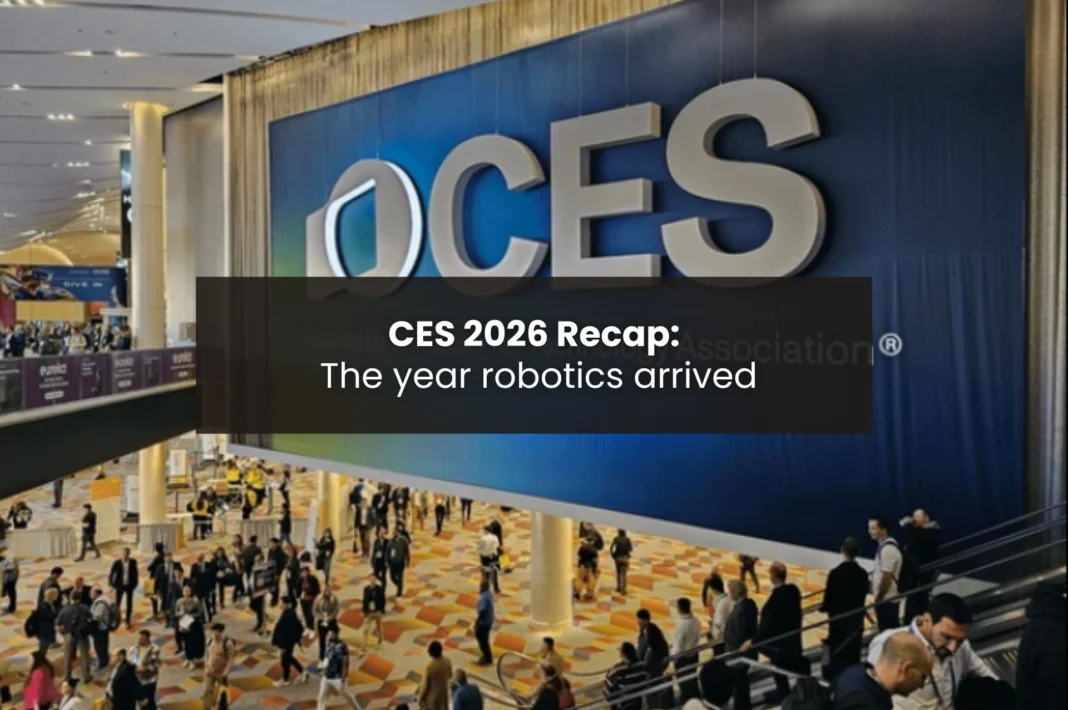
CES 2026 Marks the Rise of Physical AI
The Consumer Electronics Show (CES) 2026 occurred between January 6 and 9 in Las Vegas, Nevada, and was one of the most innovative shows that the Consumer Technology Association has put on to date. This year’s CES was the largest ever, with over 4,100 exhibitors at 13 different venues over 2.6 million net square feet of exhibit space. This year’s CES showed how technology is rapidly evolving and advancing.
The focus of CES 2026 has shifted away from the previous “hype” that AI was only a digital tool (chatbots, for example) and is now focused on what is now called Physical AI. Physical AI is defined as AI technologies used in the physical world (i.e. robots, machines, cars, homes, etc.). Physical AI embeds intelligence into everyday mobility, healthcare, and smart home technologies.
CES 2026 Trends Shaping the Future of Tech

Physical AI and Robotics Explosion
CES 2026 was a huge success for robotics. According to Jensen Huang (CEO of Nvidia), it was the turning point of physical AI—the “ChatGPT moment.”
Boston Dynamics introduced its newest version of the Atlas Humanoid Robot, which is being developed in conjunction with Hyundai. This new robot will have more advanced movement capabilities and will be available for use in the manufacturing industry.
Others had practical robots at CES as well. Companies had robots that fold clothing, help with chores around the house, and maneuver through multiple obstacles. Most notable were LG’s CLOiD, which folds clothing, as well as Roborock’s Saros Rover, which climbs stairs and vacuums simultaneously. These robots signify a shift away from the initial “wow factor” and towards solving everyday problems.
AI Everywhere: From Chips to Companions
NVIDIA has stated that all technology in 2026 will include some form of AI integration. NVIDIA stated the importance of investing in AI infrastructures, data centers, robotics platforms (autonomous systems), etc. Now, NVIDIA sees AI hardware as a central part of modern innovation.
AMD recently released its Ryzen AI and Instinct GPUs, which can run AI capabilities completely on-device instead of just in the cloud. This means more speed and less lag when processing AI tasks.
In conjunction with AI hardware development, there was also a focus on the development of AI companionship and assistance, which have been increasingly developed to include greater levels of emotional and contextual awareness and personalization in the way people interact with AI devices, thus producing a greater sense of being included in our “everyday” life.
Automotive and Mobility Innovations
CES 2026 featured numerous companies that continued to push the envelope of autonomous driving and mobility. The introduction of new forms of transportation, such as Autonomous Robotaxis, is one of the areas of progress for many companies, including Lucid, Uber, Nuro, and Zoox. Currently, these companies have operational prototypes of their self-driving vehicles operating in Las Vegas under actual conditions.
“Our collaboration with Boston Dynamics as part of our AI Robot Strategy will allow Hyundai to create an integrated solution for seamless mobility and automation as transportation and robotics increasingly intersect,” stated Brian Fetter, Boston Dynamics Senior Vice President. “This innovative combination will provide a bridge for people to connect with their vehicle and other forms of transportation.”
At CES 2026, Sony Honda Mobility showed new enhancements made to their 2026 Afeela Prototype SUV. The company plans to incorporate artificial intelligence into its interfaces, sensory experiences, and immersive entertainment capabilities. With the introduction of AI into the car, we are beginning to see automobiles evolve into digital environments instead of simply being used as methods of getting from one point to another. Eventually, vehicles will become a collaborative experience among passengers, the cars, and their surroundings.
Health Tech and Wearables Take Over Daily Life
Health technology made the biggest splash at CES 2026. The health devices were mostly designed for monitoring long-term health rather than short-term fitness data. Vendors presented monitors as long-term tools tracking nutrition, sleep, urine, and biological markers throughout life.
Although wearables are no longer just smartwatches. Smart rings and smart glasses also provide predictive health insights with the goal of identifying health issues before they arise, thus encouraging preventive healthcare. CES 2026 indicated that technology is becoming increasingly integrated into everyday life, rather than simply being viewed as medical devices.
Other Standout Trends
- Smart glasses go mainstream
Brands like TCL RayNeo showcased smart glasses that deliver real-time translation, navigation, and contactless payments, signaling wider consumer adoption. - Solid-state batteries gain momentum
Verge Motorcycles announced production-ready solid-state batteries that promise ranges of up to 370 miles, highlighting major progress in energy storage. - Retro tech and modular design return
LEGO Smart Bricks blended physical play with digital interaction, while modular laptops emphasized repairability, sustainability, and longer product life. - Display technology reaches new extremes
Companies unveiled massive MicroLED TVs, paper-thin screens, bendable displays, and glare-free panels to create more immersive viewing experiences. - Smarter homes arrive at lower prices
CES 2026 introduced affordable smart home upgrades that make connected lighting, security, and automation more accessible to everyday users.
CES 2026 Must-See Gadgets and Award Winners
- Samsung Galaxy Z TriFold
Won Best Overall at CES 2026 by redefining foldable smartphone design with its innovative tri-fold display. - LEGO Smart Bricks
Earned the Best Future Tech award by combining physical building with interactive digital experiences. - Samsung 130-inch Micro RGB TV
It stood out with its massive size, ultra-bright visuals, and next-generation display technology. - Hisense 116-inch MiniLED TV
Impressed audiences with its cinematic scale and enhanced contrast powered by MiniLED innovation. - Lenovo ThinkPad X1 Carbon Modular Laptop
Gained recognition for its modular design that prioritizes sustainability, repairability, and professional performance.
Industry Leaders Making Waves at CES 2026
Technology companies took center stage at CES 2026, with Nvidia’s keynote delivered by CEO Jensen Huang being one of the highlights of the event. His keynote addressed the transition from digital AI to Physical AI. Huang says AI is shifting from digital tools to real-world physical systems like drones and autonomous vehicles.
AMD’s Lisa Su discussed the importance of making AI hardware so that future innovation will happen in the consumer market to ensure that AI is in the hands of consumers. Hyundai and Boston Dynamics (the world’s leading robotics companies) demonstrated robot technology that will shape Mobility and Manufacturing. At CES 2026, LG, Samsung, and Sony embedded AI in devices, while LEGO debuted smart tech to modernize its brand.
CES 2026 Proves the Robot Era Is Here
CES 2026 signified the arrival of robots and Physical AI as real-world technologies. Moreover, the event showcased a move from the hype surrounding AI toward the real-world implementation of related solutions. In addition, CES 2026 highlighted innovations in the areas of health, mobility, home, and consumer technologies.
CES 2026 established trends that will shape robot development and AI integration over the next two years. The coming year will deliver smarter robots with deeper AI integration in daily operations.
For more context on how AI is evolving beyond chat assistants and into physical systems, see Elon Musk’s AI Projects From Grok to Optimus Explained.
