
Why Agentic Learning Systems Are the Future of Training
Imagine a learning experience that goes beyond simple quizzes and instead focuses on planning, reflecting, and adjusting according to people’s personal goals.
The concept of agentic learning systems is aimed at developing people within organizations in a different manner. Instead of just giving a learner a pre-recorded piece of content, agentic learning systems support active participation in creating individualized training plans for each learner and continually adjusting those plans based on the learner’s progress. Additionally, agentic learning systems also assess and guide each learner toward achieving meaningful success, thus representing a shift from traditional, passive learning experiences to dynamic, learner-centered outcomes.
Today, technology has reached a point of maturity where we can begin to realize these opportunities for agentic learning. Advances in autonomous reasoning, autonomous planning, and tool-based services enable learners to have true autonomy over their own development and growth. This article will provide information for designing effective agentic learning systems for both learners and employees in the workplace.
What Is Agentic AI / Agentic Learning?
Agentic AI represents an evolving breed of AI system that boasts four major features: reflection, planning, tool use, and multi-agent collaboration. As a result of the capability of these characteristics, agents that use agentics can perform higher-level tasks than conventional agents who have no capacity for strategic planning, self-evaluation of their performance (as in whether they achieved their desired outcome based on their strategy), or iterative self-improvement.
This difference is fundamentally important because traditional agents perform tasks on behalf of their user, whereas agentically capable systems will navigate, learn, and adapt accordingly to the needs of the learner.
Because of this fundamental characteristic, the design of agentically learning platforms allows for a system where the learner is put at the forefront through goal setting, guided reflection, and a non-linear approach to learning; these systems have the capability of evolving along with the learner as opposed to enforcing rigidly defined learning modules onto the learner at predetermined intervals. To understand how investment is accelerating the growth of these intelligent learning technologies, you can explore our analysis on AI Tutor Startups Funding.
Why Agentic Systems Are Powerful for Learning and Training
1. Learner Autonomy and Motivation
By giving students (learners) control over their own progress through agentic systems, learners have an enhanced experience that feels both individualized and directed; as a result, engagement and retention are increased.
2. Real-World Workflow Integration
Because agentic AI can interact with tools, documents, and systems, training becomes contextual. Learners practice skills inside real workflows, not hypothetical scenarios.
3. Continuous Improvement
Through built-in reflection loops, agentic systems identify gaps, adapt learning paths, and even refine entire training programs over time.
4. Scalability and Efficiency
Organizations can deploy agentic systems across teams and departments with consistent quality. This makes learning scalable without compromising personalization.
Core Instructional/Training Program Components
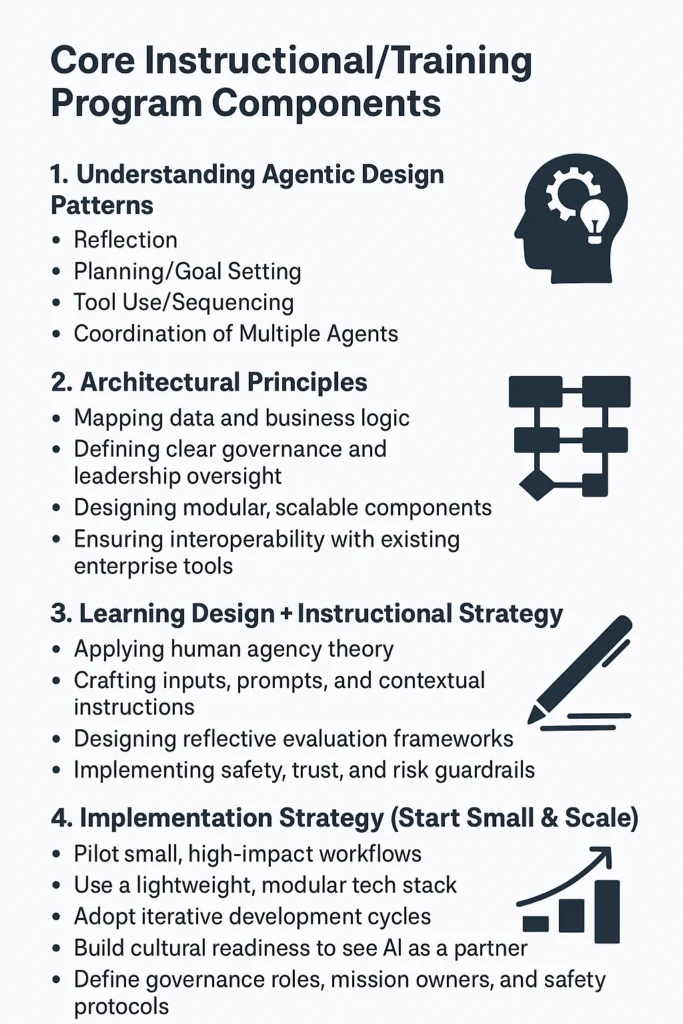
1. Understanding Agentic Design Patterns
To effectively train teams in how agents learn, you will want to include the following in your training program:
- Reflection
- Planning/Goal Setting
- Tool Use/Sequencing
- Coordination of Multiple Agents
By focusing on these patterns, we are providing a foundation for developing autonomous learning experiences for your organization.
2. Architectural Principles
A strong technical architecture underpins every agentic learning system. Training should cover:
- Mapping data and business logic
- Defining clear governance and leadership oversight
- Designing modular, scalable components
- Ensuring interoperability with existing enterprise tools
3. Learning Design + Instructional Strategy
Agentic systems require a redesign of learning methodologies:
- Applying human agency theory
- Crafting inputs, prompts, and contextual instructions
- Designing reflective evaluation frameworks
- Implementing safety, trust, and risk guardrails
This ensures the system not only works but also works responsibly.
4. Implementation Strategy (Start Small & Scale)
Building agentic learning systems doesn’t require a large-scale transformation upfront.
Training should help organizations:
- Pilot small, high-impact workflows
- Use a lightweight, modular tech stack
- Adopt iterative development cycles
- Build cultural readiness to see AI as a partner
- Define governance roles, mission owners, and safety protocols
The goal is to move from experimentation to maturity, step by step.
Challenges and Risks
Agentic (dynamic) learning systems provide revolutionary possibilities but also new challenges for creating and using these systems, as below:
- Data quality/integration issues
- Infrastructure and tool use costs
- Trust/governance issues
- Skills gaps within L&D Engineering & Design teams
- Measuring/Assessing long-term results of learning
These challenges must be dealt with as soon as possible to achieve sustained success with agentic learning systems.
Future Outlook & Potential
Agentic AI is advancing at an unprecedented rate in many capabilities, including memory, reasoning, planning, and adaptability; soon, agentic learning systems will support intelligent co-pilot functions for entire organizations.
The use of these systems will allow for:
- Removal of training silos
- In addition, the provision of highly personalized learning paths
- Use of data analytics in L&D decision-making
- Creation of autonomous and self-managed learners
- Ultimately, with AI support, the shift from top-down training to collaborative and co-creative development will gradually change organizational culture over time
For a deeper look at the emerging digital ecosystem powering these systems, read our guide on the Agentic Internet.
From Learning to Mastery: Harnessing the Power of Agentic Systems
Agentic learning systems allow for maximum autonomy and provide opportunities for all users to think, fulfill their plans, reflect, and grow as agents of their own development. Additionally, agentic learning exists in order to promote collaboration between humans and artificial intelligence; therefore, it is not an individual instructor with a student but rather an intelligent, interactive relationship that continuously evolves with each user.
As organizations progress to next-level (agentic) learning, L&D managers need to carefully implement these learning systems using an incremental approach. Initially launching the first agentic learning system, we’ll be able to support additional systems as they are introduced over time. When fully implemented, this type of system represents a major shift in how we think about training and ultimately will alter the way we develop our own careers.
Ultimately, agentic learning will provide a more intelligent, adaptive, and fully autonomous learning experience. As a result, individuals will have the ability not only to learn from their peers but also to create and curate their own path to mastery. Agentic learning seeks to bridge today’s training system with a highly personalized and empowering future of growth through artificial intelligence. To explore how agentic AI differs from generative AI and its role in learning systems, read our detailed guide.
