

Why Gemini AI’s Data Practices Are Under the Spotlight
One of Google’s most sophisticated AI systems is the Gemini AI platform. Google has already integrated this sophisticated AI into its product ecosystem, which includes Gmail, Search, Maps, and other services. However, Google has done so in a way that uses data from one application to generate intelligent recommendations, offer personalized user experiences, and forecast future actions across these various applications.
Google also has a strategic advantage thanks to these capabilities. Gemini’s performance is difficult for rivals without access to such integrated datasets to match, which calls into question the fairness of the AI market.
How Gemini’s Ecosystem Gives Google More Context
Using data gathered from Gmail, Google Search, Google Maps, and numerous other Google products, Google has enhanced its current ability to forecast user needs based on past activity. They are now using this integrated dataset via Gemini to automate a variety of user tasks with much greater accuracy and to provide more individualized experiences.
Google has a clear advantage over its rivals in terms of its capacity to produce a genuinely distinctive user experience, thanks to all of these improvements in functionality and the variety of data types utilized. Without comparable integrated datasets at their disposal, rivals are unable to offer the same functionality. As a result, the artificial intelligence sector faces a serious ethical dilemma.
What Privacy Activists Say
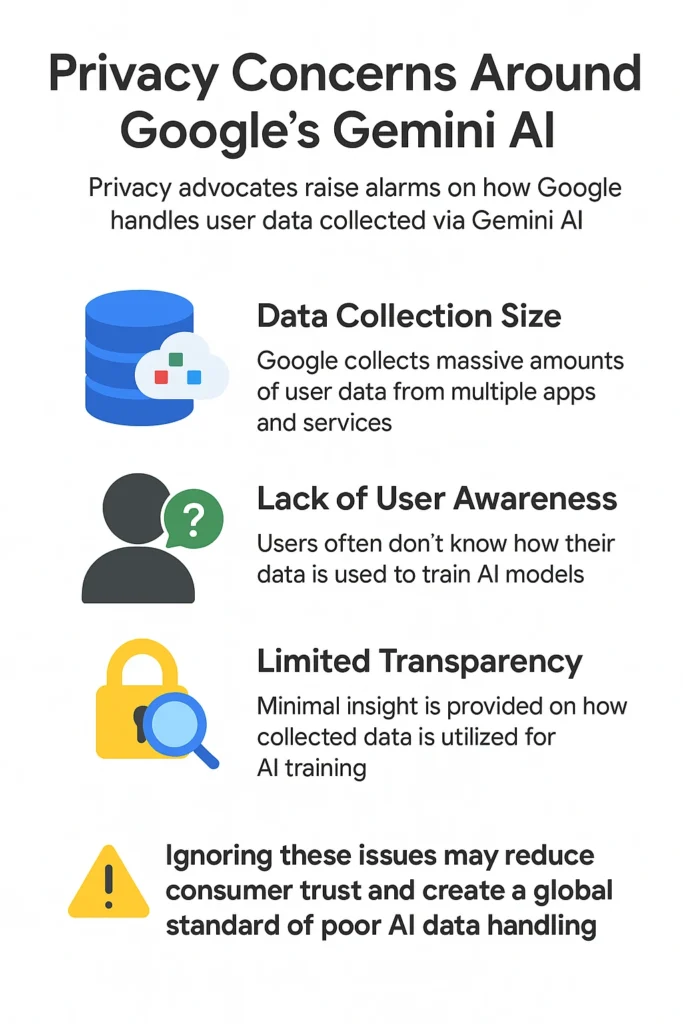
Concerns regarding the collection and grieving of user information by Gemini AI are being raised by privacy advocates due to how Google handles and utilizes the personal data of users collected through Gemini AI. Privacy advocates have posed three primary concerns surrounding how Google’s data practices affect both users and overall transparency with regard to the use of user data collected by Google for the training of AI models.
According to privacy advocates:
- Data Collection Size: Google has an extensive amount of user information collected from users across numerous applications and software.
- Lack of User Awareness: Many users are not knowledgeable about how Google utilizes their data for the training of AI models.
- Limited Transparency: Google provides minimal insight into its utilization of collected user data to train Gemini AI models.
Experts state that failure to address the above issues will result in a decrease in consumer confidence in Google’s operations and set a dangerous standard for how AI handles user information globally.
The Opt-Out vs. History-Loss Issue
Google allows users to opt out of data collection for AI purposes. Users will give up access to personalized features, recommendations, and history-driven insights if they choose to do so.
With this in mind, it is a trade-off that really presents a dilemma to users, as the option would be between privacy and convenience. Furthermore, most users do not understand how opting out affects their experience, again underlining the need for clearer communication and informed consent.
Comparison: Gemini vs ChatGPT Data Policies
| Aspect | Gemini AI | ChatGPT (OpenAI) |
|---|---|---|
| Data Storage | Collects data across Google’s ecosystem | Limits data to platform interactions |
| Model Training | Leverages cross-app context to enhance predictions | Uses platform-specific data |
| Privacy Protections | Limited transparency; raises privacy concerns | Explicitly limits data use |
| Impact | Provides more personalized experiences; gives Google a competitive edge | Safer privacy profile; less context-driven personalization |
For a deeper dive into how Gemini compares with other AI platforms, check out our analysis of “Gemini vs ChatGPT: The real reason why Google might be winning the growth race.”
Should Regulators Limit Cross-App AI Training?
For regulators, cross-app AI training raises many concerns about privacy, fairness, and competition. Regulators and decision makers need to understand how to effectively regulate the use of cross-platform data without hindering innovation. Restrictions on the use of aggregate data may offer consumers better protection from excessive data collection and increase the amount of competition within a relatively unregulated field for smaller companies developing AI products.
On the other hand, imposing restrictions on the collection, storage, and use of data will also slow down the pace of technological development within the artificial intelligence and machine learning industries and will negatively impact the type of personalization and predictive features that consumers expect in today’s market. Currently, lawmakers and policymakers are exploring ways to protect privacy while supporting continued technological advancements effectively.
The Fairness Question: Is Google’s Data Scale Too Big to Compete With?
Google’s massive access to user data gives Gemini AI an advantage that smaller AI developers cannot easily match; hence, this situation raises the following important questions:
- Does cross-app data create an uneven playing field among competitors?
- Does Google’s data scale imply monopolistic dominance in the AI sector?
Ultimately, answering these questions is crucial for ensuring fair competition in the AI market.
Gemini AI Data Privacy and the Future of Fair AI Competition
Google’s new Gemini AI represents a continual challenge in balancing technological advancement, personal privacy, and market competition effectively. While Google uses personal information from multiple sources, it creates more tailored, innovative products for users. However, concerns remain regarding potential violations of consumer privacy and the resulting effects on market competition.
Moving forward, users, regulators, and privacy advocates must work together to ensure that AI platforms like Gemini operate with transparency, respect user privacy, and compete fairly.
In the end, data privacy of Gemini AI is not merely a technical challenge but a definition of how society can govern AI while protecting users and fostering innovation.
Learn more about how Gemini 2.5 enhances daily user experiences and collects contextual data in this detailed post on Google’s Gemini 2.5 Flash‑Image.
