
Why do the pillars of SEO matter more than ever in 2026?
The search engine landscape in 2026 has changed dramatically from previous years. Today’s search results are influenced not only by traditional search engines but also by AI-summarized content, voice-activated searches, and user habits that continue to evolve.
Search engine optimization (SEO) algorithms will continue to prioritize relevance, authority, and the end-user. Therefore, the traditional ways of getting links from other sites to rank well in search results no longer work; this is where the four pillars of SEO come into play. They are a framework that provides stability for businesses to stay relevant in the current marketplace while creating a solid, long-lasting presence on the internet.
How should SEO adapt to AI, Google updates, and AI-generated content in 2026?
SEO is no longer primarily based on keywords because of changes in the way Google uses AI to drive search results, and as a result, optimizing content will be drastically different from what it was.
To Optimize For AI:
- Structure your content using headings, bulleted lists, and brief (concise) responses.
- Utilize FAQs, step-by-step guides, and lists to allow easier extraction of the answers from your content by AI.
- Rather than focusing solely on keyword usage, consider user intent and relevancy to their search in creating your content.
Impact of Google Core Updates:
- Google’s core updates change how a query is interpreted, which often results in improved search performance for helpful, authoritative content.
- During the implementation of core updates, it is common to see niche sites (those with specific topics/niches) gain momentum at the expense of larger publishers losing visibility.
- Helpful, original, clearly written, and valuable content is the most likely candidate for success following the core update process.
Adapting AI-Generated Content:
- Avoid using generic, low-value, auto-generated content from AI.
- Add to the AI-created content with your own knowledge, current data, and an organized layout, respective to SEO principles.
- Add images, video, author information, and references to your existing content to help improve your credibility.
By optimizing your website for AI, aligning your content to be consistent with the Google Core Update process, and producing higher-quality AI-assisted content, your website will be able to maintain its visibility as you adapt to changes in the algorithm, enabling your success in a search landscape powered by AI through 2026.
If you want to improve your website’s visibility in search and AI results, see our Sorank review covering its SEO and GEO features.
How do you optimize for AI search engines and answer engines in 2026?
Searching behavior has transformed in the age of AI. Users now have the option of choosing AI-powered tools like ChatGPT, Google’s AI mode, Claude and Perplexity to get answers to their queries. Such search platforms have been developed to summarize the valuable information instead of giving the existing links to the page.
To enhance your visibility in AI search:
- Always provide a straightforward answer right after each heading.
- Use appropriate H2 and H3 for subtitles.
- Use the FAQ format in the article.
- Provide references of trustworthy sources and the latest statistics important for your evidence.
- Use original examples, screenshots, and expert opinions in your article.
- Create topic clusters instead of unrelated articles.
AI optimization of search improves the readability of the text; hence, it becomes easier for the reader and search engines to understand the content.
What exactly are the pillars of SEO, and why should beginners care?
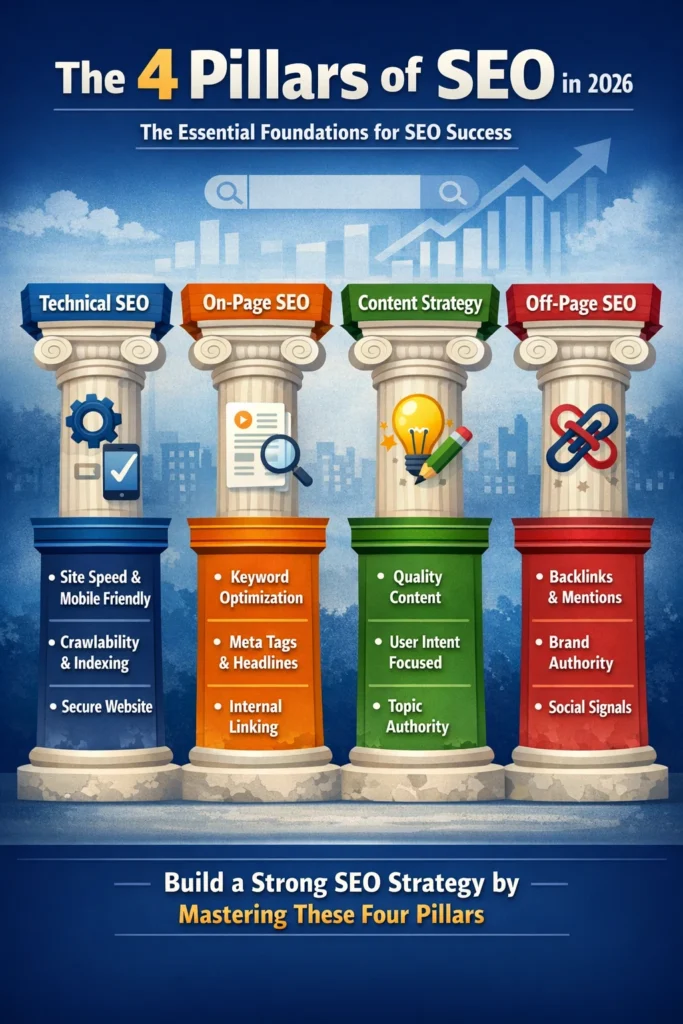
Search engine optimization (SEO) includes four primary components used to analyze how search engines find, evaluate, and rank websites on their platforms. To evaluate the impact of these components on websites’ visibility, we can consider the four pillars:
The four pillars of SEO determine how well-known (visible) your site is to users. If a pillar is weak, then your overall visibility suffers. If the four pillars work together, then they strengthen each other and improve traffic to your site and improve your site’s reach over time.
How does technical SEO build the foundation for rankings?
Technical SEO is the base of all other aspects of SEO; if it fails, no other aspects of SEO have an equal chance of succeeding. The technical SEO allows a search engine to crawl and index your website correctly.
Technical SEO consists of:
- Access to your website in an efficient way (ability to crawl/index)
- Speed of loading pages
- Compatibility of mobile devices
- Secure connection
- Clean site designs and URLs
- Great content may not rank high without a good structure.
To simplify optimization and improve efficiency, many businesses now rely on AI-powered solutions. For example, exploring AI SEO tools that automate workflows and improve rankings can significantly strengthen your technical and on-page performance.
How does on-page SEO help search engines understand your content?
On-page SEO is concerned with optimizing the experience for your visitors at the UX layer and on the SERP layer by utilizing the same data that users see to enhance the speed at which search engines evaluate the pages.
Some examples:
- Keywords in Title and Headings
- Clear, concise Meta Descriptions
- Correct Internal Links
- HTML Format with Optimized Images
All of these will aid search engines in understanding your content and connecting it to what your customers were looking for when they searched for your products or services.
Why is content strategy the heart of the pillars of SEO?
People like to read things that are new or interesting, but they will return again and again if the material is original. If we create an article that meets their needs, it will help us gain trust with the user.
A strong content strategy involves:
- The best quality and usefulness of the content created
- The desire to match the user’s/search engine’s intent
- The development of an authority for the writer on the relevant subject area
- The re-creation of older articles that no longer fit within today’s context.
Users will grow steadily through the availability of useful and credible sources by 2026.
Why does topical authority matter more than individual keywords?
Rather than writing separate posts focused on individual keywords, reputable websites develop detailed content around a single topic. This approach, referred to as topical authority, allows search engines to determine how reliable a source of information you are.
For instance, an SEO website needs to include posts about the following:
- Technical SEO
- On-page SEO
- Off-page SEO
- Local SEO
- AI SEO
- Keyword research
- Link building
- SEO audits
Links between these posts give search engines the ability to crawl all articles and let readers navigate through useful articles easily.
How does off-page SEO strengthen authority and trust?
Signals that originate from other websites are what off-site SEO is centered on.
These include:
- Backlinking from authority sites in your industry
- Mentions of your brand
- Online reputation
These types of signals help search engines determine if people regard your brand as an authority. As AI continues to reshape content creation and digital promotion, understanding how tools like ChatGPT impact advertising and creator strategies can help you refine your SEO and outreach efforts.
How do EEAT signals improve SEO in 2026?
EEAT, or Experience, Expertise, Authoritativeness, and Trustworthiness, is of great importance to Google when determining the quality of content.
EEAT can be reinforced in the following ways:
- Provide an author bio
- Include reputable sources
- Conduct original studies or publish original research
- Update the content regularly
- Add contact info
- Share personal experiences when possible
A high EEAT rating means higher credibility and better chances to get a good search position in results of AI-generated content.
How do the four pillars of SEO work together for long-term growth?
The SEO pillars work collectively as a system. Technical SEO forms the foundation of your website so that it is accessible and has fast page load times. On-page SEO provides clarity to assist search engines in understanding the content. A good content strategy offers value and meets user intent. Off-page SEO establishes trust with backlinks and brand mentions.
As all four pillars align, they provide strength for each other. This leads to stable rankings and continuing growth over time.
Which SEO metrics should you track to measure success?
SEO improvements should always be measured using performance data.
Monitor:
- Organic traffic
- Keyword rankings
- Click-through rate (CTR)
- Indexed pages
- Core Web Vitals
- Referring domains
- Average engagement time
- Conversions from organic search
Review these metrics monthly to identify opportunities for improving existing content.
What common mistakes weaken the pillars of SEO?
- Ignoring technical issues such as slow site speed or crawl errors
- Not optimizing for mobile devices
- Publishing posts without a clear plan or understanding of what users are searching for
- Targeting keywords without understanding our audience
- Only focusing on backlinks, ignoring the quality of the content that we create
- Failing to take advantage of opportunities for internal linking
- Ignoring user experience and how easy it is for users to navigate your website
- Failing to regularly update old articles
- Creating duplicate or “thin” content
- Following trends rather than developing strong fundamentals
How often should you update your SEO content?
SEO isn’t just a one-time activity; search engines like content that is relevant, useful, and correct.
This means reviewing important posts every three to six months by updating the following:
- Stats
- Screenshots
- Internal links
- FAQs
- Sections with recent information
- Outdated advice
- Latest information from Google
Regularly updating content will enable you to maintain both ranking and visibility.
Are you building your SEO strategy on strong pillars or weak foundations?
Even though search engine optimization (SEO) algorithms are constantly changing, the core foundations of SEO will always be the same. Trends will die off, but consistency with strong fundamentals will lead to ongoing success and the potential for continued profitable business growth.
Rather than implementing shortcuts to get what they want, the beginner’s focus should be on ensuring that the foundation is in place first. Improve technical health, refine on-page optimization, create high-quality content, and build strong authority signals to achieve long-term credibility and consistent visibility in 2026 and beyond while adapting to evolving data and search trends.
FAQs
The four pillars of SEO are technical SEO, on-page SEO, content strategy, and off-page SEO. Together, they help improve website visibility, user experience, and search rankings.
Technical SEO provides the foundation, but no single pillar works alone. Long-term SEO success depends on combining technical optimization, quality content, on-page improvements, and authority-building strategies.
AI search engines prioritize well-structured, trustworthy, and user-focused content. Pages with clear headings, concise answers, FAQs, and strong EEAT signals are more likely to appear in AI-generated responses.
High-value pages should be reviewed every three to six months. Updating statistics, examples, internal links, and outdated information helps maintain rankings and keeps content relevant.
Yes. Beginners can achieve significant SEO improvements by creating helpful content, optimizing on-page elements, improving website speed, and building strong internal links. Backlinks become more effective when supported by a solid SEO foundation.
