
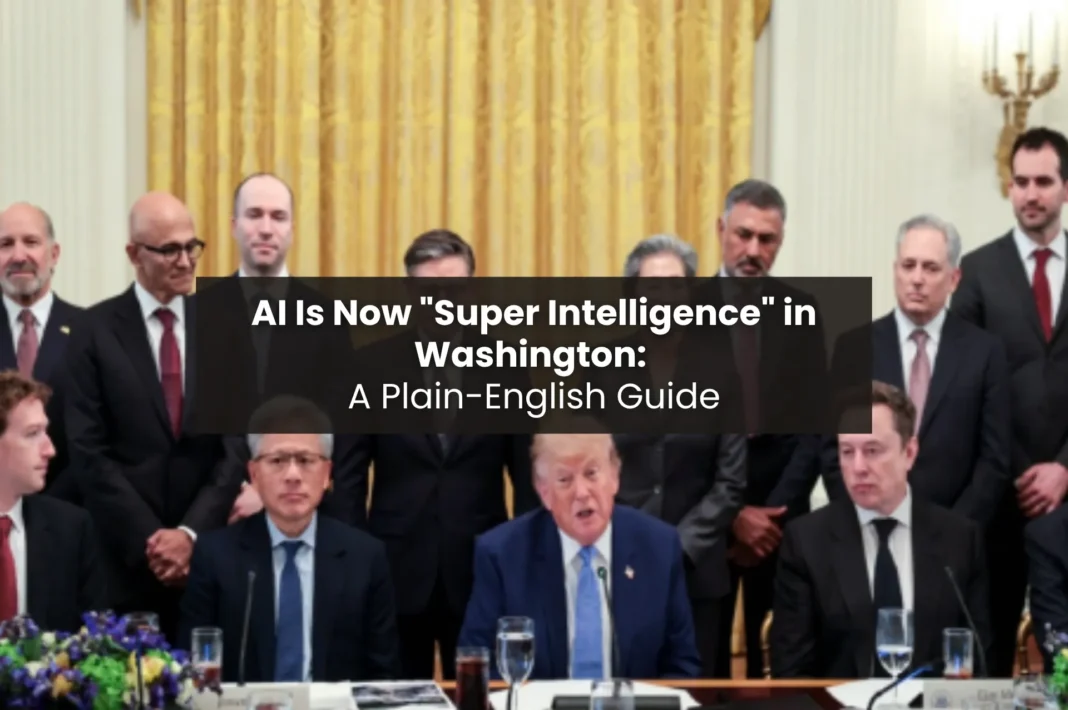
On Tuesday, 29th September, 2026, President Donald Trump authorized an executive order to change the term artificial intelligence to super intelligence in the federal government. Federal agencies must use the word “Super Intelligence” and its acronym “SI” in all communications instead of “AI.” On the same day, the leaders of various tech companies also signed a non-binding agreement for the safety of AI technology. Here is a brief overview of the super intelligence executive order, its implications, and the agreements tech moguls have signed.
What does the super intelligence executive order say?
Trump issued the order after talking with tech leaders in the White House. Elon Musk, Mark Zuckerberg, Sundar Pichai, and Jensen Huang were part of the meeting. The title of the directive reads “Inaugurating the Era of Super Intelligence.”
The statement urges government bodies to adopt the new expressions in their official correspondence, statements to the public, public websites, reports, and policy documents. The ruling also pertains to non-statutory materials and is valid to the maximum extent possible according to the law. Furthermore, it is stated in the order that governmental structures would no longer use such terms as “AI” and “Artificial Intelligence.”
Why is Trump replacing AI with super intelligence?
Trump claimed that the term “artificial” no longer applies. He said that the technology is not artificial and everyone in the room concurred with that. It states that the new designation more accurately describes the potentials of the technologies concerned.
Trump has also described the technology as being far more important than the internet. He first brought up the renaming at the UN General Assembly. In the Assembly, he claimed that the winner of the super-intelligence race would be the one who would be able to take the lead. Before the signing, the specifics of the change were not explained.
How will federal agencies use the new term?
The order sets a short to-do list:
- Agencies switch to “Super Intelligence” and “SI” in official documents.
- The Assistant to the President for Science and Technology drafts a federal definition of SI.
- That official also recommends any extra executive actions the change needs.
- Proposed legislative language is due within 60 days, according to Business Standard
There is no official definition so far. However, there is already the term “superintelligence” used by scientists to denote a hypothetical system that exceeds human intelligence. The novel federal definition will clarify what sense the government supports.
The order is aimed at the federal agencies only. It does not indicate the way private companies should name their products, and it does not change anything about how any model functions.
What is the White House Accord on Super Intelligence?
The agreement was signed on the very same day by the representatives from major companies working in the field of artificial intelligence. The complete name of the agreement is White House Accord on Super Intelligence: Joint Commitment on Frontier Responsibilities. Trump described it as “morally binding”, but in reality it is a voluntary agreement and does not carry any legal force.
Trump pointed out that now companies will have to take care of their own affairs. According to Fox Business, he has claimed that he is against implementing any formal restrictions with regards to production of advanced technologies.
What does the accord ask AI companies to do?
According to the document, organizations that work on technology should have four layers of safeguards to win customers’ trust. They should:
- Supervise their models while they’re trained and during their functioning from the perspective of cyber, bio, and chemical security.
- Assign an internal team of specialists to check the systems’ efficiency.
- Use an independent external audit firm for checking the control.
- Set up independent committees at the board level to solve any issues.
Also, companies will regularly gather to create joint standards. The document hints at possible future regulations, but there is no legally binding document today.
The speaker of the House of Representatives Mike Johnson sees the agreement as voluntary standards combining public interests, innovations, and competition with China. According to Zuckerberg, it is a considerable step in the right direction, which should enhance trust among customers.
Super intelligence order vs White House Accord: which one carries legal weight?
| Comparison point | Executive order | White House Accord |
|---|---|---|
| Who it covers | Federal agencies | Companies that signed |
| Main goal | Change official wording and define SI | Add safeguards and audits |
| Legal force | Directs the executive branch, within the law | Voluntary, not enforceable |
| Next step | Definition and legislative language within 60 days | Regular meetings on shared standards |
The order changes words inside government. The accord asks companies to change practices. Based on current reports, neither one sets a legal rule for private AI companies.
Why do safety and policy watchers care about the rename?
The new label comes at a time when safety issues remain major headlines in the newspaper. Business Standard writes the news that OpenAI has postponed the release of its new model GPT-6.1 Astra due to safety issues. The study of past safety issues at OpenAI offers an overview of these worries.
Also, previously, the governmental policy regarding artificial intelligence changed for the executive order. Trump cancelled the executive order of Biden earlier during his presidency.
Key takeaways on the super intelligence order
The redefinition of AI as hyper intelligence in the federal government is done via Trump’s order, which promises a clarity of definition soon. At the same time, the relevant agreement obliges companies dealing with AI to make four steps in terms of safety measures, although implementation is not obligatory. The new label alters the terminology but not the technology. Hence, observers need to pay attention to the definition of hyper intelligence, relevant audits, and legislative initiatives aimed at creating rules of functioning of the super intelligence in Washington.
