

Looking for some AI business ideas? Well there’s some good news, there was $300 billion of Venture Funding globally in Q1 2026 according to Crunchbase with $242 Billion of that (80%) going into AI companies. Below are 11 AI trends that have taken companies to billion dollar valuations and what they can mean for you as a founder.
The boom is slowing with $159billion raised in Q3 (a 25% decrease from Q2). 64% of this went to AI. Billion dollar refers to a deal or valuation, not profit. The data below is accurate as of the 16th November 2026. fourweekmbavalueaddvc
The 11 trends at a glance
| # | Trend | Lead example | Latest verified milestone |
|---|---|---|---|
| 1 | Enterprise AI agents | Sierra | $950M raised at a $15.8B post-money valuation (May 2026) |
| 2 | AI coding | Cursor | $60B all-stock acquisition by SpaceX, closed August 14 |
| 3 | Healthcare AI | OpenEvidence | $250M at a $12B valuation (Jan 2026) |
| 4 | Legal AI | Harvey | $550M at $15.5B, announced September 9 |
| 5 | Voice AI | ElevenLabs | $500M at an $11B valuation (Feb 4) |
| 6 | Physical AI and robotics | Skild AI | $1.4B Series C at over $14B (Jan 14) |
| 7 | AI drug discovery | Isomorphic Labs | $2.1B Series B (May 12); valuation not disclosed |
| 8 | World models and AI video | Runway | $315M Series E, reportedly at $5.3B (Feb 10) |
| 9 | AI data and agent security | Cyera | $600M at $12B (June 10) |
| 10 | AI chips | Cerebras | IPO at $185, raising $5.55B at about $56.4B fully diluted (May 13) |
| 11 | Sovereign and regional AI | Sarvam (India) | $234M first close of a planned $300M Series B at $1.5B (June 15) |
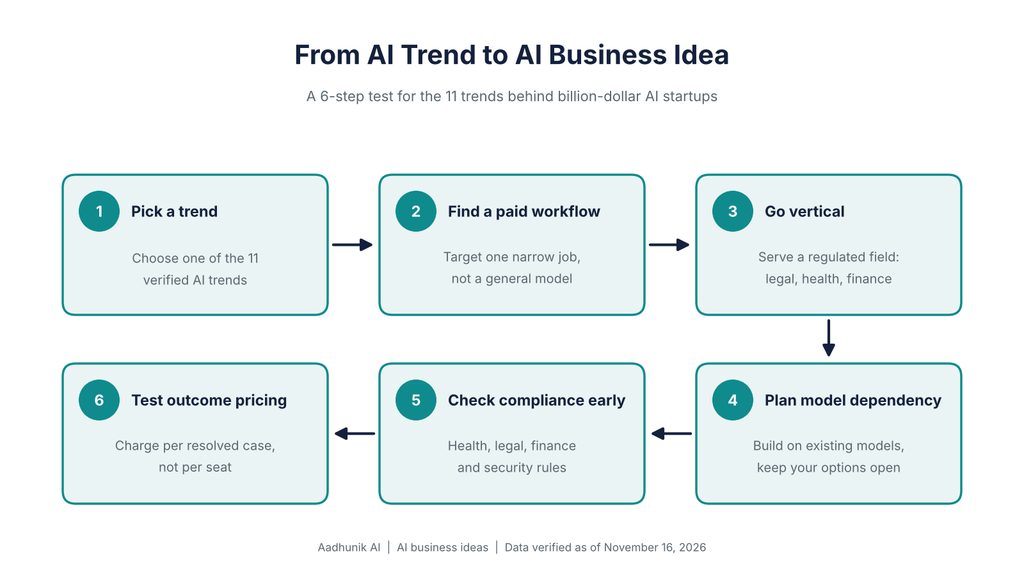
Each trend below ends with one AI business idea. Use this flow to test any of them.
Which AI trends are becoming real software businesses?
1. Enterprise AI agents. Tiger Global & GV spearheaded the funding round for Sierra. On the other hand, Decagon secured $250 million & achieved a valuation of $4.5 billion in 2026. A suggestion given was to concentrate on one specific area of work, whether that be refund processing, claims or onboarding.
2. AI coding and app builders. In April SpaceX announced a partnership with Cursor. They acquired Cursor for $60B in stock. The team are working on Grok products like Grok Bot. We explain what Grok agents (like Grok Bot) do here. The point of this software is to build tools for operations, marketing and small business users who can’t employ developers. The main thing to take away here is that it was an acquisition.driveteslacanadadriveteslacanada
3. Healthcare AI. OpenEvidence raised a round led by Thrive and DST which doubled their valuation to $6B from October. They aim to improve clinician workflows such as documentation, coding and prior authorisation. The biggest barrier is regulation.
4. Legal and professional-services AI. Following their $11B valuation in March, Harvey raised a round led by Diffusion and Lightspeed. The raise comes after they announced their first post-trained open weight model. (See here why they built Tenet on the Kimi K3). This is the same play they are using for tax, compliance and insurance claims.
5. Voice AI. ElevenLabs raised a round lead by Sequoia, tripling their valuation to $3.3B+ since January 2025. They’re focused on voice agents for customer support and collections, particularly focusing on Indian languages.
Which AI trends are betting on the physical world and science?
6. Physical AI and robotics. Skild AI raised a round led by SoftBank, which has more than tripled their valuation in just 7 months. They have a software focussed approach (not hardware) so it’s all about simulating, training and deploying robots.
7. AI drug discovery. Isomorphic raised this round led by Thrive with participation from Alphabet, GV, Temasek and the UK Sovereign AI Fund. As of September 2026 they have not publicly announced any clinical candidates (Sacra). The idea is to use AI to address specific pain points within pharmaceutical R&D such as literature mining and lab automation. Timeframes here are long.
8. World models and AI video. Runway plans to move from video generation to world models that simulate physical reality. Google is chasing the same idea, as our Google Genie 4 article explains. Idea: simulation for robotics and games, and video tools for small-business ads.
Which AI trends are building the infrastructure and trust layer?
9. AI data and agent security. Raised $400M at $9B in Jan. Five months later raised $600M at $12B. Tripled ARR 3 years in a row (no numbers given). The idea is to give different access levels to agents, track who does what, and help with compliance. marketscreeneritbrief
10. AI chips and power. Cerebras ended on its first day of trading at $311.07, up ~68% from its IPO. Idea focussed on the power, cooling and workload scheduling software market. Tends to be a heavy capital investment.
11. Sovereign and regional AI. HCLTech led Sarvam with a $150M cash investment. Idea focussed on Indian language voice and text products and regulated sectors requiring data residency.
What could stop these companies from reaching billion-dollar status?
- Concentration. These 4 companies (OpenAI, $122B; Anthropic, $30B; xAI, $20B; Waymo, $16B) account for ~65% of global venture capital in Q1. This is misleading as the overall figure doesn’t reflect just how concentrated this boom really is. Substack
- Funding down. Despite raising a record number of companies with billion dollar+ raises at 27 companies, Q3 saw a 25% decrease in funding. valueaddvc
- Transparency. Several of these raises don’t show any revenue, only a valuation. Examples include Cyera and Isomorphic. (7,9)
- Dependency. Harvey’s transition to their own post trained model shows why app layer companies desire flexibility. (4)
- Independence. The biggest outcome here was Cursor ending up as a subsidiary.
How can you turn these trends into AI business ideas?
- Start with a paid product. There are very specific roles for Sierra, Harvey and OpenEvidence.
- Go vertical. Items 3 and 4 have very specific funded solutions for regulated professions.
- Based on outcomes. This will appeal to products that need to be charged per case resolved.
- Build on existing models, but plan for dependency. Our Claude models comparison shows how to weigh your options.
- Keep the team small. Capital is available to young founders; see our report on a 19-year-old’s startup raising $11M for an AI computer. It remains the exception, not the rule.
- Check compliance early in health, legal, finance and security.
FAQs
Workflow-specific agents, vertical AI for regulated professions, voice agents and AI data security. These categories drew some of the largest verified rounds listed above.
Ten of the 11 trends above have at least one company with a reported valuation above $1B. Isomorphic Labs did not disclose its valuation.
It means a reported valuation, funding-round price or acquisition price. It does not mean profit or revenue.
Nobody can say for certain. The verifiable facts are that funding is concentrated in a few deals, Q3 volume fell 25% from Q2, and many rounds disclose valuation without revenue.
