
Anthropic developed Claude AI models to perform a variety of tasks, including text generation, coding, reasoning, and content creation. Developers, businesses, and researchers use these models to save time, improve output quality, and handle complex workflows efficiently. This article explains the differences between Claude models and guides readers in selecting the right one. We also provide a Claude AI model comparison to make the decision easier.
Claude models are a family of AI models with different strengths
Claude includes multiple models, each optimized for specific tasks. Some models offer enhanced reasoning/intelligence, while others have been constructed for greater speed and cost-effectiveness. By considering the strengths of each model, users can select and match the appropriate model to their project requirements and workflows.
Several other important trade-offs to consider would be:
- Intelligence vs. Efficiency: Opus offers particularly strong output but will take longer than some other models to provide that output.
- Speed vs. Accuracy: Haiku has a fast response time but does not respond as well to more complicated and/or sophisticated events or conditions.
- Cost vs. Performance: More advanced models will typically have a higher cost associated with them than will simpler models that may require lower operating costs.
Read this detailed guide on Claude AI pricing, including free vs. paid plans and usage limits.
Claude AI model comparison shows how each variant excels in different areas
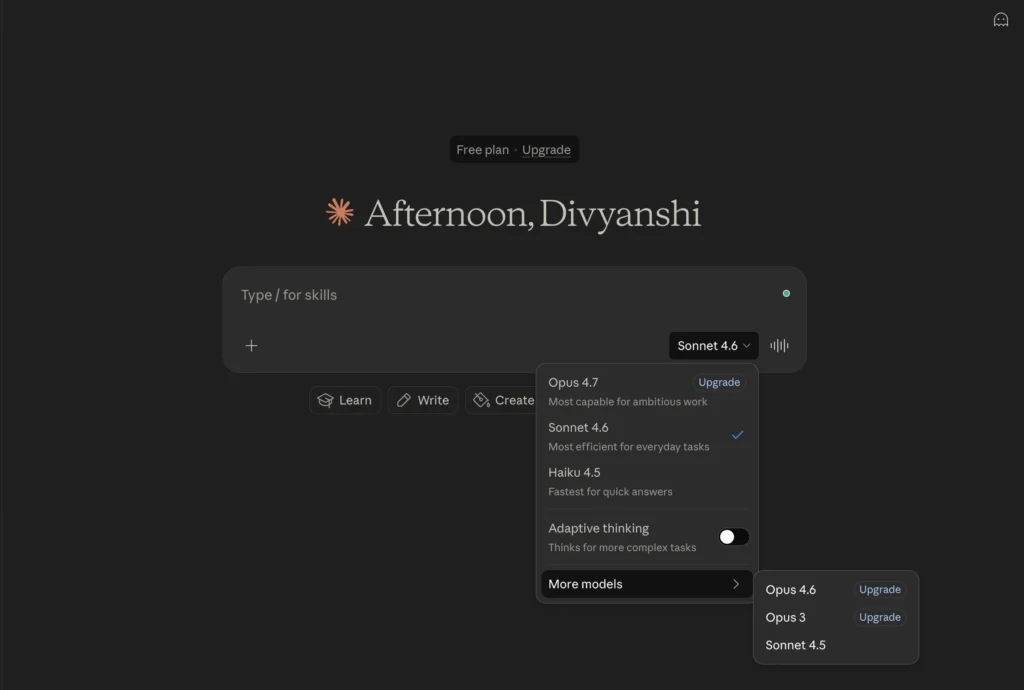
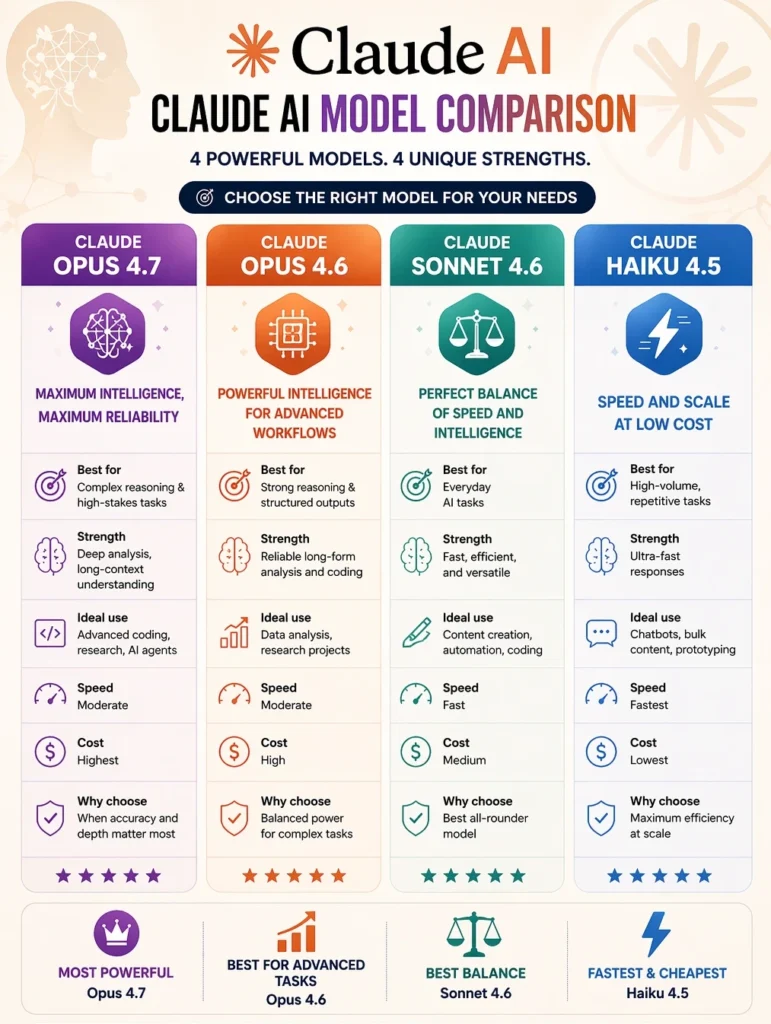
The following table provides a Claude AI model comparison of the main models:
| Feature | Claude Opus 4.7 | Claude Opus 4.6 | Claude Sonnet 4.6 | Claude Haiku 4.5 |
|---|---|---|---|---|
| Description | The latest and most advanced model with improved reasoning and coding | The most intelligent model for building agents and coding | The best combination of speed and intelligence | The fastest model with near-frontier intelligence |
| Pricing (input/output MTok) | $6 / $30* | $5 / $25 | $3 / $15 | $1 / $5 |
| Extended thinking | Yes | Yes | Yes | Yes |
| Adaptive thinking | Yes | Yes | Yes | No |
| Priority tier | Yes | Yes | Yes | Yes |
| Comparative latency | Moderate | Moderate | Fast | Fastest |
| Context window | 1M tokens | 1M tokens | 1M tokens | 200k tokens |
| Max output | 128k tokens | 128k tokens | 64k tokens | 64k tokens |
| Reliable knowledge cutoff | Aug 2025* | May 2025 | Aug 2025 | Feb 2025 |
| Training data cutoff | Jan 2026* | Aug 2025 | Jan 2026 | The latest and most advanced model with improved reasoning and coding |
Note: All models support text and image input, text output, multilingual capabilities, and vision. Developers can access them via the Claude API, AWS Bedrock, and Google Vertex AI. Bedrock and Vertex AI offer global and regional endpoints for maximum availability or data routing through specific regions.
Claude Opus 4.7 sets a new benchmark for advanced AI performance
For those who face complicated processes, Claude Opus 4.7 provides more reasoning power, consistency, and better management of extensive input data. The model is designed for situations when usual AI models can encounter difficulties related to complexity, accuracy, and scale issues.
It can be used for:
- Multi-stage code writing and designing complex systems
- Deep research and analysis processes
- Long texts analysis
- AI operations demanding reliability
Using Claude AI for content creation is only one part of a successful digital strategy. A solid understanding of the pillars of SEO helps ensure AI-generated content reaches the right audience and performs well in search.
It outperforms its predecessors in managing unusual situations and retaining context throughout conversations. Opus 4.7 will be most effective in the hands of professionals involved in influential work requiring reliable and accurate outcomes.
High-performance models like Claude Opus are ideal for complex tasks
An expert research project or advanced reasoning task will be taken care of by Claude Opus 4.6, giving users accurate, in-depth, and reliable results. Opus supports long-term workflows and can be used by those needing:
- Complicated software agents and/or complex coding
- Research or data analysis projects
- AI systems with high reliability and reasoning
The typical user for whom Opus is suitable will be someone who needs precise, in-depth, intelligent decision-making.
Claude Sonnet models balance capability and efficiency for everyday tasks
The Claude Sonnet 4.6 has rock-solid logic and an extremely fast run time; great for regular publications, easily coded tasks, and the vast range of artificial intelligence-related operations in between! Features include:
- Efficient, cost-effective balancing of jobs/requirements
- High-speed processing for consistently recurring work
- Reliable results that combine different workflows into one coherent outcome.
Claude Haiku models are optimized for speed and high-volume tasks
At Haiku, we concentrate on cost savings and fast production. The Haiku delivers:
- Production of many content types
- Customer service bots.
- Creating prototypes quickly and testing.
While the Haiku may not have as much detail as the Opus when working on complicated projects, it is quicker for working on repetitive or high-volume tasks.
Understanding retired or legacy Claude versions
Previous Claude models (Claude 1 and Claude 2) form the basis of today’s modern models. Users transitioning from these legacy Claude models may notice significant differences in:
- Reasoning and coding abilities, multilingual support, and output quality
- Long context handling and memory
- Image processing and multimodal input handling
When migrating to Claude 4.6 (Opus or Sonnet), your teams will leverage enhanced intelligence, additional thinking capabilities, and faster, higher-reliability performance.
How to choose the right Claude model for your use case
- Identify the type of task you want to use Claude AI for: Is it for text, code, or research? Will you be creating a lot of content very quickly?
- Start testing with the lighter weights first: An example would be using Haiku, which is great to use when you are in the early stages of testing ideas.
- Scale to more capable models: Use Sonnet for general-purpose tasks, and Opus for high-stakes projects.
- Refer to the Claude AI model comparison: Review features, token limits, and costs to finalize your choice.
- Consider endpoints and availability: Use global or regional endpoints on AWS Bedrock and Google Vertex AI, depending on latency and data requirements.
By following these steps, you can systematically choose the most suitable Claude model for your project. Additionally, you can check out these best Claude tips and tricks to further enhance your model performance and outputs.
Benchmarking and real-world testing to refine your choice
Test your chosen model on real prompts and datasets to ensure it meets your accuracy, speed, and cost requirements. Developers can also query token limits and capabilities programmatically via the Models API. Key evaluation points include the following:
- Accuracy and reasoning quality for your specific tasks
- Latency and speed of output
- Cost per token and overall project cost
- Stability across platforms and endpoints
Moreover, benchmarking allows iterative refinement. As a result, you maximize both the efficiency and output quality of your Claude AI model.
Selecting the right Claude model for effective AI solutions
The Claude AI models can do many different kinds of tasks, including generating large amounts of content, reasoning at advanced levels, and coding. You can use Claude AI model comparisons, conduct real-world tests, and evaluate each model’s unique strengths to choose the right one. As a result, selecting the appropriate model will improve AI solutions on your projects by making them quicker, better, and more effective compared to previously available AI solutions. To see how AI adoption is shaping industries and communities, explore how women in tech in India are driving AI innovation and adoption.
FAQs
Claude 3.5 Sonnet is best for coding because it balances fast responses with high-quality reasoning, making it ideal for debugging, generating code, and software development tasks.
Claude 3 Haiku is best for long documents when you need fast summarization at low cost, while Sonnet works better for deeper understanding and analysis.
Claude 3 Opus is the most powerful model, designed for complex reasoning, advanced analysis, and high-accuracy tasks where quality matters more than speed.
Claude 3 Haiku is the most cost-efficient option, ideal for high-volume tasks like summarization, extraction, and lightweight automation.
Claude 3.5 Sonnet is the best all-rounder for writing, coding, reasoning, and everyday AI tasks due to its balanced speed and intelligence.
