
Why learning AI in Chandigarh could be your next career move
Due to the integration of AI technologies, the business environment is influencing the requirements for professionals with specific knowledge and skills in machine learning, generative AI, and automation. As a result, this means that people who are educated in the mentioned fields are able to find jobs in a variety of sectors.
AI training offered in Chandigarh has courses for easygoing learners as well as for students and busy professionals. However, it should be mentioned that practical skills in the sphere of artificial intelligence are usually preferred by employers who would like to hire candidates with some work experience.
In whichever way you want to apply for a job in the world of AI or enhance your knowledge in this field of technology, you should select the appropriate one that would suit your goals and aims.
1. C-DAC Mohali provides advanced learning for technical AI careers
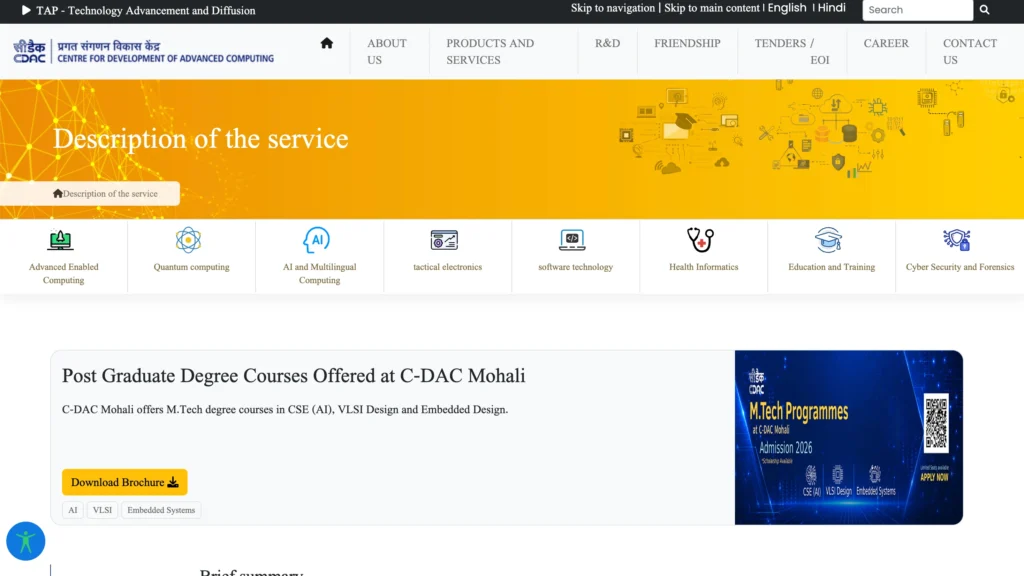
The C-DAC or Centre for Development of Advanced Computing, is an institution that issues postgraduate qualifications to pupils wishing to refine their technical abilities. The Mohali unit of C-DAC issues an M. Tech in computer science and engineering with a specialization in artificial intelligence.
This program is specifically suitable for those willing to acquire advanced information in regard to computers and how to use them to study and perform tasks in the area of artificial intelligence.
What learners can explore:
- Various theories related to artificial intelligence and computer science
- Different advanced techniques and methods
- Numerous research and development initiatives
- Various academic and project activities
You can also experiment with AI tools without spending money upfront. Explore our guide to free AI offers in India to discover free access options and offers that can support your learning.
Who should consider it?
Graduates of engineering disciplines and students willing to study artificial intelligence must consider enrolling into this program. Nevertheless, be ready that this program requires effort and is more demanding than short-term AI classes.
Our take: this program is a perfect option for those who want to gain solid technical knowledge for work. If you are just considering using generative AI techniques for simple tasks, it’s better for you to take a short course instead.
2. Netmax Technologies focuses on practical AI and generative AI skills
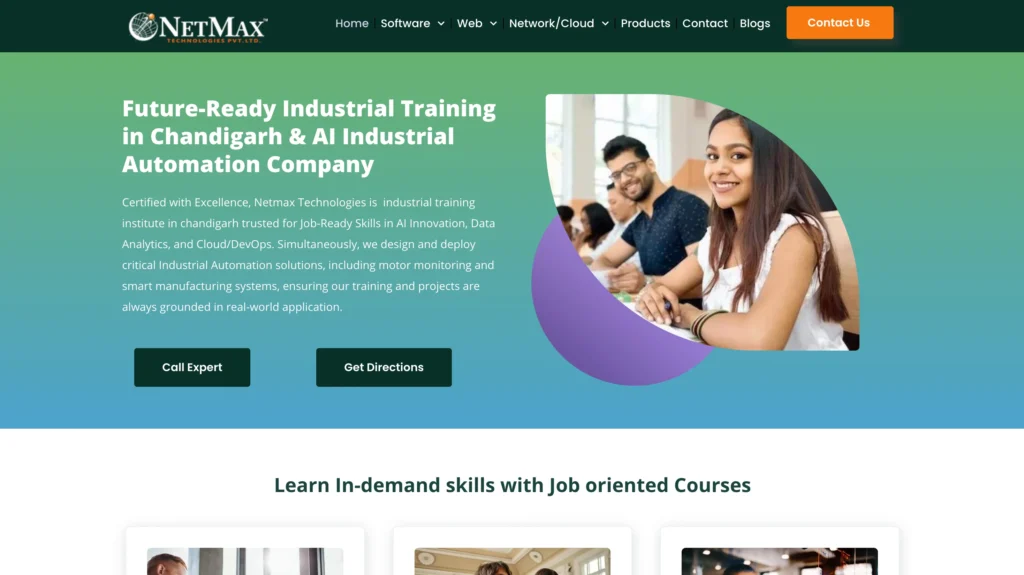
Netmax Technologies provides a variety of training in technology in the fields of data science and machine learning to students interested in programming and reasoning with AI.
Students attending data science and machine learning courses will be acquainted with different subjects related to practical projects. The institution is also known due to its innovative program utilizing the concept of generative AI.
What learners can explore:
- Python programming language
- Machine learning algorithms
- Neural nets and deep learning
- Basic ideas about reverse engineering
- Principles of prompt engineering
Who should consider it?
Those interested in the operations of AI machine learning systems can join and take part in the programs offered by the institution.
Our take: Look attentively not at the number of tools included in the syllabus but at the responses of the school members, whether you are going to work with the models and datasets and realize the projects on your own because it gives a better understanding of the material.
3. Flex Academy connects AI learning with application development
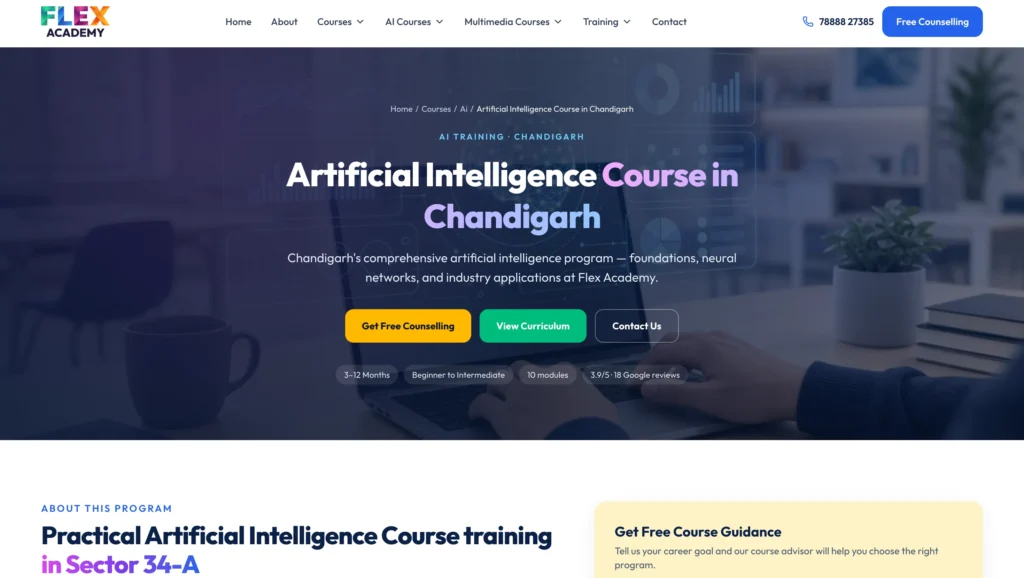
Flex Academy is situated in Chandigarh’s Sector 34-A and offers training in artificial intelligence. The course covers artificial intelligence, machine learning, neural networks, and practical applications.
Flex Academy additionally offers specializations in generative AI, machine learning, and AI agents.
What learners can explore:
- Python programming language for artificial intelligence applications.
- Machine learning and deep learning concepts.
- Natural language processing.
- Large language models.
- LangChain and retrieval-augmented generation.
- Development of AI applications and hands-on projects.
- Apart from other courses, it has a fundamental program of three months, an advanced program of six months, and a career-oriented extended course.
Who should consider it?
Students and professionals intending to design their AI applications, delve deeper into large language models, and take on career responsibilities in the area of AI development can enroll in this academy.
Our take: The program is relatively advanced, as it deals with APIs, LLMs, and methods of organizing machine learning work. Nonetheless, beginners must validate their programming skills before applying for regular training programs.
4. TechCADD Chandigarh offers separate paths for AI and generative AI
TechCADD Chandigarh is an organization offering different training programs in AI technology, including agentic AI and generative AI. Providing a variety of programs helps trainees to concentrate on specific areas.
The course of generative AI gives an in-depth analysis of the concept of large language models and their programming support, while students will also learn the basics of Python programming language and statistics in the course.
What learners can explore:
- Python, NumPy, and Pandas.
- Machine learning and deep learning.
- Generative AI and large language models.
- LangChain and Hugging Face.
- Agentic AI and autonomous processes.
The duration of the AI program varies from 3 to 6 months, while the generative AI and the agentic AI courses include 2-3 months of training.
Who should consider it?
The programs could be interesting for those who already possess programming skills or would like to focus on AI development, generative AI, or agentic systems.
Our take: Separate courses can help learners avoid studying unrelated topics. However, agentic AI and generative AI require a different skill set from basic AI literacy. Choose a program that matches your existing knowledge instead of selecting a course only because its subject sounds advanced.
5. CITC offers AI courses for beginners and advanced learners
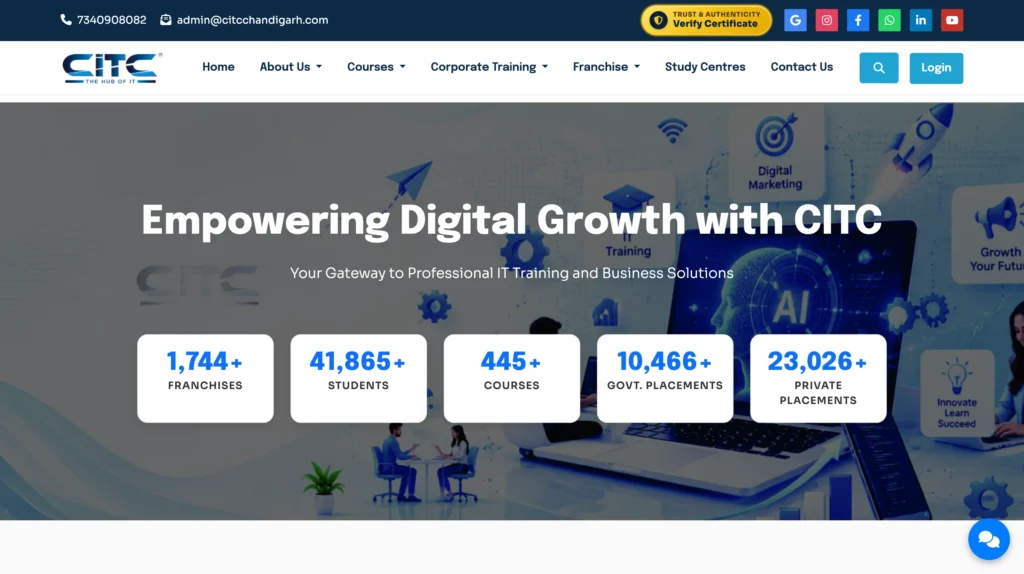
CITC offers three AI learning levels for students and professionals with different experience levels. More importantly, its programs range from introductory, no-code training to more advanced technical courses.
This structure helps learners choose a course based on how much programming they want to learn.
What learners can explore:
- Applied AI: A 30-hour program that introduces learners to AI tools and applications without requiring coding.
- AI Course for Beginners: A three-month, 90-hour program that introduces guided coding and AI fundamentals.
- AI Professional Course: A six-month, 180-hour program that covers generative AI, RAG, and AI agents.
CITC lists fees from ₹6,000 to ₹35,000, depending on the program. Additionally, it offers online and offline learning options through its centers in Kharar and Mohali.
Who should consider it?
Beginners who want to explore AI without coding can start with Applied AI. On the other hand, learners who want to understand programming and build AI applications can consider the longer programs.
Our take: The three-level structure makes it easier to compare learning commitments. Nevertheless, learners should check the actual projects, instructor support, and assessment methods before paying for a professional course. A longer course does not automatically guarantee stronger practical skills.
6. Excellence Technology is another institute to check for technical training options
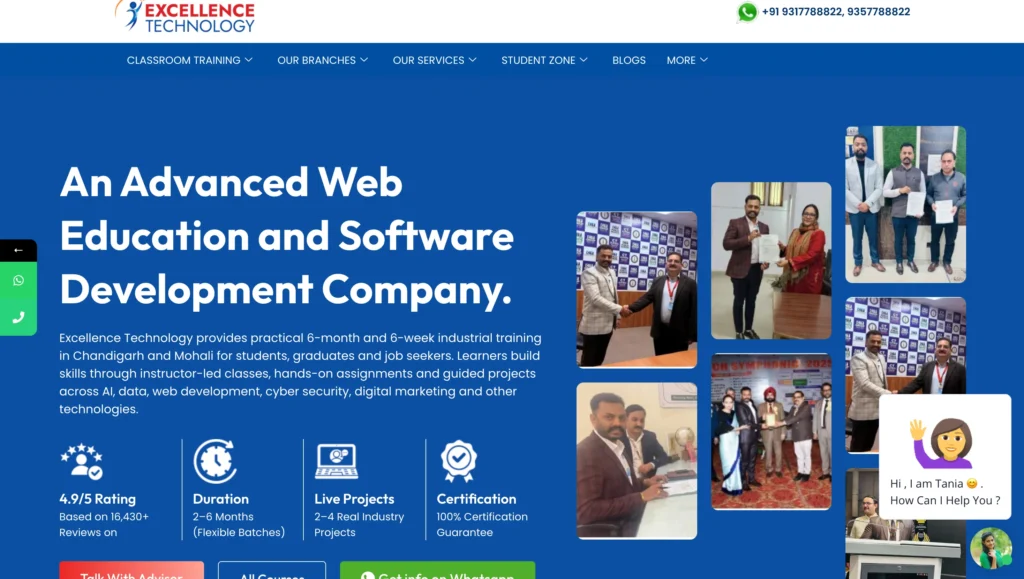
Excellence Technology is one more place to look into while doing a comparison of other available courses in Chandigarh. But before considering it as a training place for AI, it will be better to check its availability of the actual course on artificial intelligence.
What learners can explore:
- If the institute has any AI or machine learning courses at the moment.
- If they offer anything related to Python and practical artificial intelligence use.
- If students will be provided with individual work to get their hands dirty.
- If they just teach the classical version of AI or they also engage in generative artificial intelligence.
- If the institute offers a demo class, see the details regarding costs.
Who should consider it?
Individuals who want to compare local technical training providers can contact the institute to find out more about its courses in AI.
Our take: don’t think that experience in IT training means that the institute can provide good AI training; check every piece of information about the syllabus and the experience of trainers before putting the institute on the list.
7. upGrad offers structured AI learning programmes for learners across India

Discover flexible online AI courses with upGrad
upGrad offers its learners online educational programs regarding AI, data science, and other modern technologies. Unlike local institutions, it allows students to engage in well-prepared classes without attending literal campuses.
For example, its training on generative AI and agentic AI educates learners about the practical implications of applying these technologies in the course of designing AI systems and automating processes.
What learners can explore:
- Basics of generative AI
- Large language models and prompt engineering
- Retrieval-augmented generation
- Agentic AI and intelligent processes
- Python and AI development
- Practical assignments
Some educational programmes may also include students’ practical training and additional certificates.
Who should consider it?
All professionals, students, and graduates willing to study in a flexible way can apply for upGrad’s courses.
Our take: Online education can help one get access to different courses that local schools or universities may lack. However, this kind of education is based on self-motivation. Therefore, you should check if the course offers any chances of live instructor-led sessions, scoring, and a chance to get answers to your questions apart from using recorded lessons only.
8. NIELIT Chandigarh offers government-backed AI and machine learning training
The Ministry of Electronics and Information Technology, Government of India, oversees the work of the National Institute of Electronics and Information Technology (NIELIT). NIELIT Chandigarh center trains learners in highly technical domains like machine learning, artificial intelligence, programming, etc.
In its joint program with IIT Ropar, NIELIT offers a six-month program leading to certificate in AI and ML.
What learners can explore:
- Python programming
- Data science libraries such as NumPy and Pandas
- Data cleaning and visualisation
- Machine learning models
- Deep learning and neural networks
- Practical projects in AI and ML
The institute has also prepared documentation about the activities in AI lab dealing with predictive analysis, computer vision, etc.
Who should consider it?
Students and technical learners who prefer structured training and want to explore government-backed educational programmes can check NIELIT’s current offerings.
Our take: NIELIT’s collaboration with IIT Ropar makes its joint AI and machine learning programme worth investigating. Nevertheless, older course brochures do not confirm current admissions. Contact the institute to check the latest batch, eligibility, fees, and availability before making a decision.
How to choose the right AI training programme in Chandigarh
Selecting an AI course involves evaluating more than its length, certificate, or promoted placement guarantee. Make sure you compare the course curriculum against your career goals before signing up for the program.
The following are six pointers to keep in mind while choosing the right AI course for you:
- Make sure the syllabus meets your career objectives
- Decide on the skills you want to gain before you compare different institutes
- If you are new to AI, then you will need to learn the basics of AI.
- If you want to handle data analysis and prediction models, then follow the machine learning path.
- If you want to create applications with LLMs, take the generative AI route.
- If you want to be able to make agentic systems, learn about agentic AI.
Evaluate the course quality, cost, and learning support
Find opportunities to develop skills with practical assignments
A good course not only tells you theories but also provides you with opportunities to apply those theories. Inquire whether you will be able to create AI bots, recommender systems, predictive models, or document-based AI assistants.
AI fundamentals training can also help professionals apply their knowledge in business settings. For example, a case study on training 2,000+ engineers in AI fundamentals highlights how structured training can support AI adoption and project development.
Analyze trainer experience
Furthermore, learn about the instructors’ technical qualifications and experience in the industry. Trainers with experience in AI projects are better placed to tell developers how these technologies are used in real-world applications.
Check course fees and duration
Make sure to compare the total course fee, learning hours, software requirements, and any additional fees before deciding which course to take. A longer course might have a more in-depth syllabus but should also bring you enough practical skills to make up for the money spent.
Before choosing a specialisation, understand how these two fields differ. Read our guide on agentic AI vs generative AI to see how their capabilities and applications compare.
Learn about certification and placement support
In addition, find out if the institute is granting a certificate of completion, internship opportunities, interview preparation, and placement support. Be sure to differentiate placement support from job placement.
Attend a demo class
Last but not least, a demo class allows you to see the teaching style, syllabus, and difficulty level of the course. Take this chance to ask questions regarding assignments, projects, and instructor assistance.
Can AI classes in India offer the same learning opportunities as offline courses?
You do not always need to attend a physical institute to learn artificial intelligence. In fact, several platforms offer online programmes that cover AI fundamentals, machine learning, generative AI, and application development.
When comparing AI classes in India, consider how online learning differs from classroom training.
| Factor | Offline AI classes | Online AI classes |
|---|---|---|
| Learning format | Classroom sessions | Live or recorded sessions |
| Flexibility | Fixed schedules | Often more flexible |
| Instructor support | Direct interaction | Depends on the programme |
| Practical learning | Classroom labs and projects | Online labs and assignments |
| Networking | In-person interaction | Online communities |
| Best suited for | Learners who prefer classroom guidance | Working professionals and independent learners |
As AI becomes more integrated into education, schools are also reconsidering how students access digital learning tools. Google’s upcoming changes highlight this shift, as explained in our article on why Google is changing search access in schools.
When should you select offline training?
Offline courses are advantageous for those who prefer in-person teaching, one-on-one resolution of questions, in-class activities, and structured learning activities. This way, you find it much easier to follow the learning process.
When should you opt for online training?
In contrast, online learning may be ideal for you if you are busy, live too far from the major places where training is conducted, or wish to learn specific AI disciplines from many different places.
How do you assess an online AI course?
No matter which format is chosen, check the curriculum, the qualifications of the instructor, the project’s requirements, and the assistance offered in the process along with certification. Make sure that the program covers practical skills that can be applied to real life or theoretical concepts only.
Our take: There is no format that is better than the other one in terms of results. What really matters is the learning style needed, the time available, and the level of practical help that is needed.
Find an AI course that matches your career goals
Artificial intelligence allows for different ways to learn, from basic tool use to advanced machine learning and application development. This means that the right program depends on what exactly you want to be able to do and what relevant technical knowledge you have.
If you are starting, you may want to go for some basic AI fundamentals courses to get acquainted with how different tools work. If, on the other hand, you would like to acquire some technical skills, you may want to find courses that cover programming in Python, machine learning, and practical tasks.
The best option for those who want to create a modern AI application is to learn about generative AI, LLMs, and agentic AI.
Before signing up, do not forget to check different educational institutions, ask for the latest brochures, or ask them whether there are any practical assignments students have to complete.
In the end, the best AI course for you is the one that allows you to understand not only terminology but also gives you confidence in applying artificial intelligence for a real task.
FAQs
Aadhunik AI Academy is a business-focused AI training programme that helps organisations integrate AI into their everyday workflows. Rather than relying on generic video lessons, it focuses on auditing existing processes and building practical AI standards for teams.
Teams work on practical AI applications, including creating customised prompt libraries, establishing guidelines for responsible AI use, and setting up review processes for AI-generated outputs. The goal is to make AI use more consistent across an organisation.
Aadhunik AI Academy describes its approach as live, hands-on training rather than pre-recorded online courses. Its listed cohort is based in Gurugram, so organisations should contact the team to confirm the available training arrangements.
Yes, several institutes offer beginner-friendly AI courses that introduce programming concepts gradually. However, advanced programmes covering machine learning, deep learning, and AI application development may require Python knowledge or regular coding practice.
The duration depends on the course level and curriculum. Short introductory programmes may take a few weeks, while comprehensive AI and machine learning courses can last three to six months. Therefore, compare the training hours, practical projects, and topics covered before enrolling.
