
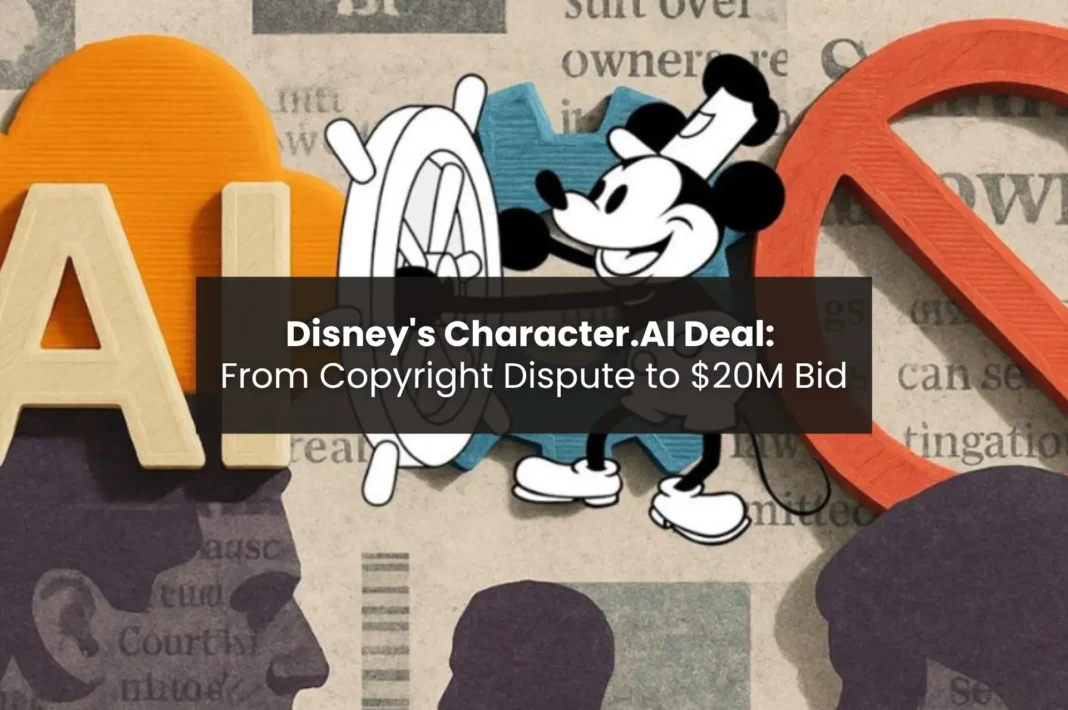
For a long time, Disney has sought to shield its fictional characters from being used without authorization.
When Character.AI first allowed users to interact with AI characters from popular franchises like Frozen and Star Wars, Disney objected, claiming that its copyrighted characters were being used illegally by the startup.
Character.AI has since expanded beyond text-based conversations with features like AvatarFX, its AI video generation feature, which brings characters to life through animated videos. Disney and Character.AI have turned a corner in their relationship, however.
Character.AI has declared bankruptcy, and Disney is now ready to launch a $20 million opening move to get some of the startup’s technology and intellectual property. They have also taken on most of Character.AI’s employees.
Still, the question remains how a business that once took legal action against a firm for using its copyrighted characters can now purchase the technology that the business uses to allowed AI-generated characters.
The answer seems to be in the difference between allowing anyone to create works that use every character from popular culture and creating AI-based products that a corporation can control.
Key takeaways
- Disney is offering $20 million for a non-exclusive, perpetual license for select Character.AI intellectual property.
- Disney had sent Character.AI a letter requesting that it stop using copyrighted characters.
- The proposed deal does not include Character.AI’s app, nor does it include user data.
- Character.AI’s financial problems demonstrate the high expense of running consumer AIs and the legal risks involved.
- This deal is still subject to bankruptcy sales procedures and court approval.
Why did Disney challenge Character.AI in the first place?
Character.AI provides users with a platform where they can create chatbots which have conversations similar to those that any cartoon character would have through their personalities created with help of AI.
Due to this freedom in putting together chatbots, the company has been able to attract many customers but it has also created difficulties for the copyright owners.
In the month of September 2025, Disney sent Character.AI a cease-and-desist letter requiring the removal of the chatbots created with the help of Disney characters. Disney insisted that it is using copyrighted materials without having any permission from them. Character.AI has removed Disney characters thanks to the complaint.
However, the issue didn’t only concern the possibility of chatting with the characters of the cartoons but also the way why these chatbot interacted with kids and the potential harming Disney’s reputation.
Disney realizes that fictional characters are very substantial assets for the business. Consequently, the company has been spending lots of money on the creation, licensing and protection of Disney characters in films, games, and merchandising.
An AI chatbot can make a character interactive in ways that a film or television show cannot. Apps like Animates, which offers AI character interactions, show how these experiences can extend beyond traditional storytelling. But if a third-party platform controls that experience, Disney has less control over how its characters behave.
That is the tension at the heart of this story.
What is Disney actually buying from Character.AI?
Disney’s suggested deal is not as simple as purchasing the whole company.
Under the agreement that was announced in October 2026, Disney had the chance to be the initial bidder for a perpetual and nonexclusive license to selected intellectual property of Character.AI. The license is supposed to cost $20 million. Even though there might other parties that might prove to be more successful in the process of bankruptcy.
WIRED connects the deals with the licensed assets that are supposed to be in such forms as code. Supporting documents, frameworks of development as well as equipment used for ensuring safety and trust or predicting age.
The systems refer to those technologies that develop the products of AI companies.
However, the agreement has its restrictions as well. For example, the announced license does not involve the website of Character.AI, its application for consumers and data as well.
Additionally, the license is nonexclusive and the agreement although might not be considered as a total victory of Disney because it does not guarantee granting exclusive ownership of the technology to the company.
The bankruptcy sale is still subject to court approval and competing bids. Disney’s proposal is therefore a significant development, but it is not yet a completed acquisition of Character.AI.
Why would Disney want technology from a company it challenged?
Understanding the seeming inconsistency starts to make sense once we differentiate the characters from the technology used here.
The controversy concerning Disney’s copyright involved the alleged infringement of its copyrights due to unauthorized use of its characters in multimedia. The deal in question targets the technology enabling a company to create and run AI systems for its purposes.
Those two things differ.
Thus, a company can protest against the unauthorized use of characters by some companies and at the same time appreciate the technology that those companies developed.
To illustrate, AI technologies can be used for the purposes of interactive storytelling and for creating computer-generated characters that can interact with a person. A company with a huge portfolio of entertainment materials can experiment with such technologies and create its own rules of how its characters should act.
Nonetheless, there is already no confirmation that Disney is going to create AI Mickey Mouse or AI Elsa based on this deal. Since they may only become a possibility, but not a part of the plan.
The usefulness of the technology goes beyond just being entertaining. The moderation, age estimation, and AI conversation management systems can help developers solve some of the problems associated with the use of AI by people.
Disney may be interested in using these technologies by itself. Even if it does not have plans to run the current version of Character.AI consumer platform.
Character.AI’s financial problems add another layer
The agreement serves as a reminder that a successful AI application does not imply a successful business. Character.AI’s million-user base used its technology in order to get help in conversations and to have fun with chatbots. However, the support of these services entails a heavy burden of costs related to computing, technology, and continuous development.
As reported by Reuters, before declaring bankruptcy, Character.AI was losing $8 to $9 million monthly. In addition to financial troubles, the company was also undergoing a number of lawsuits and investigations. Which are actually concerning alleged misconduct against minors.
According to a TechCrunch report, Disney intends to hire “60 or more” employees from Character.AI. As part of a separate arrangement from the $20 million acquisition of the startup’s intellectual property.
Disney is evidently seeking the technology along with qualified talent, as opposed to merely acquiring a consumer-facing chatbot.
It underlines a challenge that startups face. Building a technology that attracts the users is not enough. As there are many other issues involved, which include managing operations and revenue generation as well.
What does this mean for AI copyright?
The deal between Disney and Character.AI shows how companies change their approach towards AI. The emergence of AI tools that create conversations, images, videos, and interactive experience puts intellectual property owners in the position of having to choose how to react. They may fight against unauthorized use of their property, negotiate licenses, build their own systems, or combine these approaches.
One alternative is licensing.
Licensing lets a rights holder set the terms for how others can use its intellectual property, rather than allowing unauthorized use.
However, licensing technology does not mean licensing all characters or franchises. For instance, Disney’s licensing proposal will not guarantee the use of its characters.
Thus, it becomes more and more clear that entertainment companies developing AI products and AI developers interested in using their intellectual property should be aware of the issue of intellectual property rights.
The bigger question is who controls AI characters
Although Disney’s deal does not necessarily signify a change in its stand regarding copyrights. It seems to demonstrate that a firm can contest the unauthorized utilization of its characters. That too without dropping interest in AI technologies that could be beneficial for its products.
The arrangement leaves many things unclear. Will there be another bidder with a more attractive proposal for Character.AI? What about the consumer platform? Will the technology acquired under license be used to develop innovative interactive products?
These inquiries will be resolved in the course of the bankruptcy process. As well as in line with Disney’s plans for product manufacturing.
However, for now, the most significant conclusion is that the AI industry has moved beyond the straightforward consideration of questions about whether companies should use AI. Now the important issues are regarding the ownership of the technologies. That are being used, the character control, and profit generation from the process.
