
AI coding tools are moving into software management
AI coding tools are capable of producing full software modules, yet, the task of those changes’ assessment and acceptance may take considerable time. Therefore, the business referred to as Anthropic decided to solve this challenge and developed AI agents named Claude Ship that can finalize software changes and find and fix errors.
On 23 November 2023, Anthropic announced Claude Ship, which is the continuous development of Claude not in the field of code production. The announcement brought up a problematic issue for software developers: to what extent should AI systems be enabled to make changes to code?
Anthropic is taking Claude AI agents beyond code generation
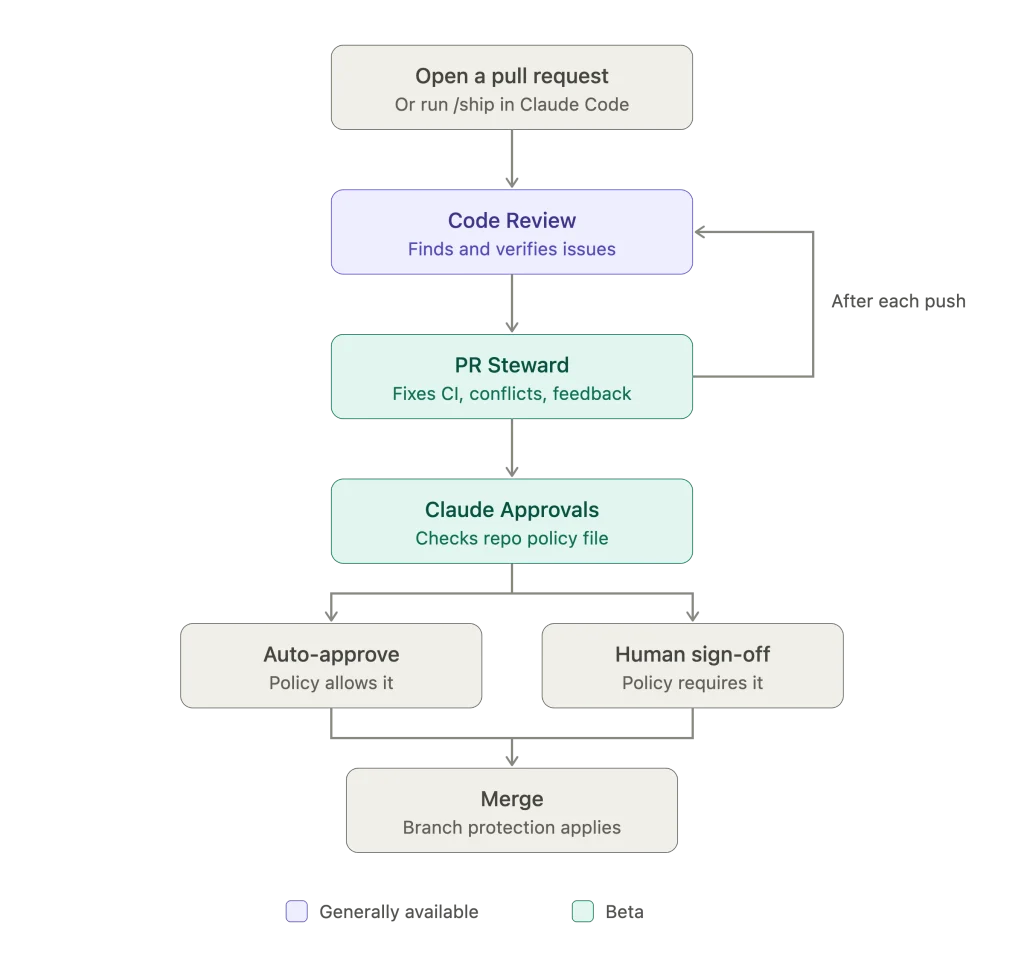
Anthropic has launched Claude Ship to assist developers in getting more stages of the software development process under their control. This system consists of three elements: Code Review, PR Steward, and Claude approvals.
The role of code review is to locate issues with the suggested code modifications. The other two components have the capability of tackling the feedback and approving some of the decisions themselves. The company’s purpose is to speed up moving pull requests through the development cycle.
Developers can also explore different Claude AI coding assistant use cases to understand how Claude supports everyday programming tasks beyond reviewing and approving code.
Claude Ship uses three components to review, fix, and approve code
Each component handles a different part of the pull request workflow.
Claude Code Review identifies issues in proposed changes
Code review evaluates the code performed by engineers or intelligent machines and alerts about possible issues in pull requests. Teams have their own choices between quick, standard, and deep check levels depending on the level of detail they want Claude to review the changes.
This capability is already generally available.
PR Steward fixes failed checks and resolves merge conflicts
PR Steward handles issues that arise during code reviews, including failed automated checks, merge conflicts, and feedback from reviewers.
It can make the required changes and explain what it modified, including how developers can undo them. However, PR Steward cannot approve or merge pull requests. It is currently in beta.
Claude Approvals can approve routine changes based on team policies
Claude Approvals reviews changes against policies laid out in natural language and held in storage. The software can accept routine changes when they meet the criteria established by teams or escalate changes that require human intervention.
It can also be configured to take into account Code Review results and other signals in the decision-making process. Currently, Claude Approvals is in the beta phase.
Anthropic’s announcement about Claude Ship describes how all three elements interact in review, repair, and approval phases.
Developers can control how Claude AI agents handle code changes
Anthropic’s solution allows teams to control which GitHub repos can use Claude Ship, how deep the code review will be, as well as how human escalation rules and budgets will be structured.
Coders can also use the /ship command available in Claude Code to make changes, create pull requests, conduct reviews, and deal with any feedback and check failures.
Anthropic is broadening Claude’s capabilities beyond software development by introducing tools for spreadsheets, joint brainstorming, and data processing, along with Claude Sheets, Whiteboards, and data tools.
Nevertheless, Claude’s ability to merge code depends on the privileges given to developers and the branch protection rules of the repositories. Anthropic advises starting with a setup where Claude Approvals can just observe before being allowed to make decisions about approvals.
This approach lets teams evaluate the agent’s decisions before giving it more responsibility. TechCrunch’s report on Claude Ship also highlights the importance of human oversight as AI takes on more development tasks.
Claude Ship is rolling out to Team and Enterprise users
Claude Ship can be used by subscribers of the Claude Team and the Claude Enterprise using GitHub repositories. The Code Review feature is available to the public, while both PR Steward and Claude Approvals are still in beta.
Usage costs follow a token-based system and vary depending on factors such as the number of pull requests, review depth, and the work required to resolve issues. Teams can impose spending limits on Code Review and PR Steward.
See Anthropic’s official announcement about availability, usage, and implementation.
Claude is moving closer to managing software development
Claude Ship shows that there are changes happening in the world of AI-assisted development. As AI systems are producing an increasing amount of code, reviewing changes becomes the next bottleneck faced by software teams.
Developers looking to get more out of Claude can also explore these best Claude AI prompts for practical ways to use the AI assistant across different tasks.
Automating these tasks will reduce repetitive work, but it will also make human oversight more important. Developers will have to make sure that the automated instructions work according to the tasks at hand and that the rules of approval do not let through any errors.
With the help of Claude Ship, Anthropic expands the role of Claude from coding and reviewing to managing whole processes of software development. How successfully IT specialists can delegate decision-making to AI while maintaining control will determine the success of this approach.
FAQs
No. At launch, Claude Ship supports repositories hosted on GitHub. Anthropic has not announced support for GitLab or Bitbucket.
Claude Ship, like other AI development tools, can miss bugs, security vulnerabilities, and other code issues. Developers should still use human reviews and traditional security checks to verify the code.
Yes. Developers can reply to PR Steward with @claude stop a pull request to stop its work. They can also be used @claude to provide additional instructions and guide its changes.
Claude Ship charges customers based on tokens used, so some of the organization’s expenses can exceed the subscription cost. Teams can manage token costs for Code Review and PR Steward by setting spending limits. Claude Approvals does not have a fixed fee, but some policy features may consume additional tokens.
Claude Ship is not an option for organizations that operate under Zero Data Retention (ZDR) policies, under HIPAA regulations, and those making use of keys that they manage themselves. Such organizations may need to review their existing security configurations and data setups before considering this feature.
