

The AI infrastructure boom creates opportunities beyond Nvidia
Nvidia is one of the major players in the AI chip production industry, but it is not the only one that creates equipment that works with AI data centers. Companies across the semiconductor, memory, networking, and data center industries can also capitalize on growing AI demand.
These companies represent a perfect investment opportunity for those who want to participate in the AI sector. However, the fact that there is demand for certain products does not mean that investors should take any opportunity available on the market. Those planning to invest in AI infrastructure stocks must analyze their 2026 revenue, profitability, competitiveness, and product costs.
Those investors who consider ventures in the AI industry will find our guide on AI IPOs of tech companies to be helpful.
Nvidia’s latest developments raise new questions about the AI infrastructure boom
Nvidia has become a major player in the world of artificial intelligence thanks to its GPU units, software, networking solutions, and partnerships. The company is working on the creation of the infrastructure required for artificial intelligence through different forms of funding and investment operations.
It was reported on November 12, 2026, that Jensen Huang stepped down as chief executive officer. CFO Colette Kress took over the management of the company while the board members carry out a search for a new chief executive officer. Although this announcement creates concerns regarding the potential future of the company, it has no impact on the demand for AI computation activities.
Nvidia’s Vera Rubin platform could reshape the next phase of AI infrastructure
Nvidia’s Vera Rubin technology delivers processing via seven different vectors, with Vera CPU, Rubin GPU, BlueField-4 DPU, and Groq 3 LPU being some among them. It also enables AI model training, post-training optimization, and agentic inference. The details regarding the platform will be available in March 2026.
Various suppliers of solutions get an opportunity to earn benefits from the anticipated rise in demand for modern AI technologies. However, these systems require advanced memory, specialized technology, and clean energy to operate.
11 AI infrastructure stocks worth researching beyond Nvidia
1. Broadcom (AVGO) is benefiting from custom AI chips and networking demand
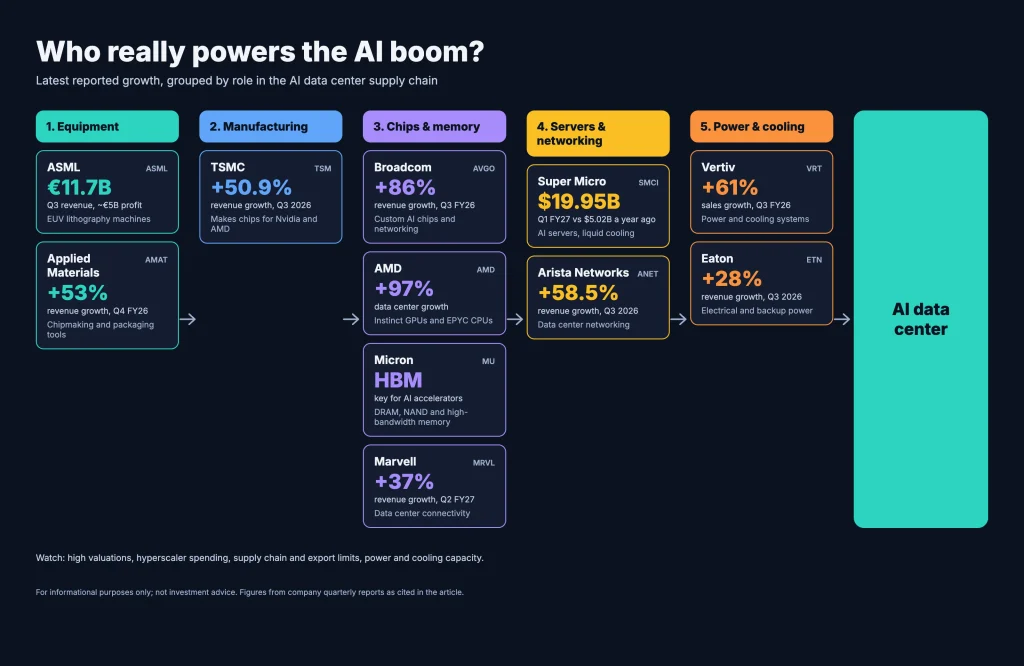
Broadcom is the developer of customized AI acceleration technology, communication technologies, and network chips available to many businesses in the technology sector. Its earnings in Q3 of fiscal year 2026 equaled $29.6 billion, showing an 86% increase compared to the past year, while the earnings from AI semiconductors exceeded $16.7 billion, increasing by 221%. The company’s specialization in custom chips and successful cooperation with hyperscalers are the main factors of its growth, while customer dependence, competition, and valuations are significant threats.
2. Advanced Micro Devices (AMD) is expanding its position in AI computing
AMD has developed Instinct GPUs (graphics processing units) and EPYC server chips. The company goes on to report revenue of $13.4 billion in Q3 2026, with impressive growth in its data center revenue by 97%, which now stands at $8.5 billion. The company’s offerings in CPU and accelerators therefore give a great alternative to Nvidia’s products. However, investors should evaluate the company’s prospects for growth based on its software adoption and efficiency as well as competitive threats.
3. Taiwan Semiconductor (TSM) manufactures the chips powering AI systems
TSMC, or Taiwan Semiconductor Manufacturing Company, has advanced chips manufactured for firms like Nvidia and AMD. The company’s revenue for the third quarter of 2026 reached NT$1.49 trillion, amounting to a year-over-year growth of 50.9%. It has a crucial position in the industry due to its large manufacturing volume and advanced technology but faces risks due to tensions between countries, production costs, and disruptions in the supply chain.
4. Arista Networks (ANET)
Arista Networks manufactures network devices responsible for quick connectivity of computers within data centers. Increased utilization of AI implies more exchanges of data between the processors, leading to a surge in demand for high-speed connections. As a result, the company generated $3.66 billion in revenue in the third quarter of 2026, which represents 58.5% annual growth and a GAAP operating margin of 44.9%.
Though Arista has all necessary technological capabilities and solid relationships with major players in the cloud business, a number of issues, including the company’s reliance on a limited base of clients and fierce competition, may interfere with its plans for future growth.
5. Micron Technology (MU)
Micron produces memory types such as DRAM, NAND, and high-bandwidth memory in order to facilitate the use of computing technologies and AI servers by users. High-bandwidth memory is especially critical when it comes to AI accelerators, which require access to huge datasets.
Recent reports show Micron earned total revenue of $54.23 million during the fourth fiscal quarter of FY2026, while it earned $11.32 million in the same quarter of the last year. As the demand for memory related to AI grows, Micron benefits from this trend, as this industry is subject to volatility, the company should also be aware of pricing changes.
6. ASML
ASML is a leader in manufacturing top-of-the-line lithography machines utilized in the semiconductor industry for the production of developmentally advanced chips. The firm helps supply chips suitable for processing AI applications thanks to its cutting-edge extreme ultraviolet lithography. In the third quarter of 2026, the company generated revenue of approximately €11.7 billion with profit of about €5 billion. Due to high demand for the production of advanced chips, ASML is looking forward to its future; however, challenges associated with exports and the constraints associated with clientele expenditures and high prices on machines pose issues that need to be solved.
7. Applied Materials (AMAT)
Applied Materials is recognized as a supplier of technologies and services used in manufacturing semiconductors and advanced packaging components. The industry’s need for high-tech equipment is driven by developments in chip manufacturing companies in order to produce chips according to the needs of artificial intelligence.
The company’s revenue in Q4 FY2026 amounted to $10.41 billion (53% of sales growth year-on-year), along with 50.4% GAAP gross margin. The company continues to operate in different parts of the semiconductor chain due to diversified machinery; however, it faces risks related to cycles in the industry and limitations on exporting products.
8. Vertiv (VRT)
The company Vertiv specializes in power management, cooling management, and data center infrastructure solutions. The fact that AI servers use significant amounts of energy means that cooling and power management systems are crucial for expanding data centers. Vertiv’s sales reached around $4.31 billion in the third quarter of FY 2026, marking a 61% growth compared to the values for the previous year and high growth of orders, which signifies the sustainability of growth for the company since it is involved in data center construction projects.
9. Eaton (ETN)
Eaton offers electrical equipment and power management services to data centers and other sectors. The rise of artificial intelligence operations drives users to require reliable power supplies and backup systems that can meet rising energy needs. The third-quarter report of the company revealed a profit of $8.9 billion, which shows a 28% increase compared to last year’s performance.
Along with high-order growth and an increase in electrical backlog, the company demonstrates strong performance in terms of revenue growth of its electrical division, expanded capacity for investment in data centers, and successful management of threats associated with industrial demand, execution of projects, and pricing issues.
10. Super Micro Computer (SMCI)
Super Micro Computer designs server systems and storage systems used in AI data centers. The liquid-cooling solutions and ability to implement new technologies are very useful for customers who want to implement powerful AI applications. The company reported that its revenue in Q1 FY2027 reached $19.95 billion in comparison to $5.02 billion in the same quarter the previous year. However, although the rapid growth opens many opportunities, there are some problems, namely low profits, difficulties with cash flow, and problems in implementation, as well as competition.
11. Marvell Technology (MRVL)
Marvell designs and formulates semiconductor technologies for connectivity in data centers, networking, and specific computing applications. The organization’s services aid the transport of data in artificial intelligence operations through optical communication and special semiconductors. The revenue of the company for the second quarter of the financial year 2027 amounted to around $2.74 billion, which is an increase of 37% in comparison with the previous year, while the revenues for the data center segment have grown by 46%.
Thus, the fact that Marvell is working in the field of artificial intelligence and provides solutions with regard to unique chips means that there are possibilities for growth and development, though different problems such as customer concentration, rivalry, and execution risks may hinder the operations of the company.
How these AI infrastructure companies compare on growth and financial performance
There may not be much equivalence in their financial performance because the companies operate in different parts of AI infrastructure market. The margins, requirements for capital, and the growth cycle differ for semiconductor designers, chip manufacturers, networking companies, and equipment suppliers.
| Company | AI infrastructure exposure | Latest reported revenue growth |
|---|---|---|
| Broadcom | Custom AI chips and networking | 86% |
| AMD | AI accelerators and CPUs | 45% |
| TSMC | Advanced chip manufacturing | 50.9% |
| Arista Networks | Data centre networking | 58.5% |
| Micron | High-bandwidth memory and storage | 379.3% |
| ASML | Semiconductor manufacturing equipment | 55.2% |
| Applied Materials | Chipmaking and packaging equipment | 53% |
| Vertiv | Data centre power and cooling | 61% |
| Eaton | Electrical infrastructure | 28% |
| Super Micro Computer | AI servers and systems | 297.5% |
| Marvell Technology | Data centre connectivity and custom silicon | 37% |
Investors should also compare operating margins, free cash flow, debt, capital expenditure, and valuation. Revenue growth alone does not establish whether a stock is attractively priced.
AI’s growing role in business operations also extends to data analysis and productivity, as demonstrated by Claude’s new tools for spreadsheets, whiteboards, and data analysis.
What risks could affect AI infrastructure stocks in 2026?
Companies that provide AI infrastructure are greatly profiting from the increasing investments, but such companies are impacted by different issues:
- Slower hyperscaler spending: Cloud services providers may choose to minimize or postpone capital expenditures in data centers if AI investments do not yield the anticipated returns.
- High valuations: Overall growth expectations are possibly reflected in a company’s valuation, which creates less room for disappointment.
- Supply chain problems: The semiconductor production process depends on sophisticated manufacturing equipment, materials, and global suppliers.
- Geopolitical tensions: Geopolitical pressure and trade claims could impact chip manufacturing and international sales.
- Power and cooling constraints: Growth in data centers is determined by the availability of power sources and sufficient cooling technologies.
- Competitors: Custom chips and novel technologies can compete with existing players.
- Financial and execution risks: Big infrastructure projects need enormous capital and can have cost overruns and delays.
AI adoption is also changing how institutions use technology, including schools, where Google’s approach to AI-powered search is raising new questions about access and digital learning. Read more in our article on why Google is changing search access in schools.
Are AI infrastructure stocks worth buying instead of Nvidia?
Direct exposure to the field of AI computing is provided by Nvidia through its hardware, networking products, and software systems. All the other companies mentioned in this article provide exposure to different components of the infrastructure stack, such as memory, production, power, and cooling.
The above-mentioned difference allows investors to cut down their risk by tapping into various sectors of the AI supply chain instead of investing in just one company. That being said, diversification does not mean that the stocks of the companies will be cheaper or less risky.
Considering this, an investor needs to assess the revenue growth and profitability of the companies, ability to generate cash, competitive position, and overall valuation of each investment. Moreover, whether the current infrastructure spending in AI can sustain growth expectations incorporated in the share price of the companies should also be taken into account by investors.
Investors who want to use AI-powered tools to research market trends, evaluate stocks, and support their investment decisions can also explore our guide to the best AI stock trading apps in 2026.
AI infrastructure investing is about more than finding the next Nvidia
The world of AI infrastructure is primarily dominated by Nvidia, but there are a lot of other companies that make it possible. Chip manufacturers, designers, suppliers of memory chips, providers of networking services, and specialists in the infrastructure of data processing facilitate the working of AI systems.
Here are the top 11 companies that operate in the market of AI infrastructure in different ways aside from Nvidia. These companies will prosper if they can sustain a level of demand of AI, switch to successful implementation of their ideas, and make infrastructure expenditure profitable.
This article is for informational purposes only and does not constitute investment advice. Stock prices, financial results, and company outlooks can change. Research each company and consider your risk tolerance before making investment decisions.
FAQs
AI data centres depend on companies that manufacture processors, memory, networking equipment, servers, power systems and cooling solutions. Broadcom, AMD, Micron, Arista Networks, Vertiv and Eaton operate in different parts of this supply chain.
AI accelerators, high-bandwidth memory, advanced semiconductor packaging, data centre networking and power management are important areas to watch. Their growth will depend on AI adoption, infrastructure spending, component supply, and customer demand.
AI infrastructure stocks represent companies that supply the physical technology needed to develop and operate AI systems, such as chips, servers, networking, and cooling equipment. AI software stocks focus on applications, platforms, and services that use artificial intelligence.
Yes. AI expansion also creates demand for electricity distribution, cooling systems, data centre construction, and other industrial equipment. Companies such as Eaton and Vertiv benefit from these infrastructure requirements even though they do not primarily design AI processors.
Investors can compare a company’s price-to-earnings ratio, price-to-sales ratio, revenue growth, operating margins, free cash flow, and debt levels. They should also examine how much AI contributes to actual revenue rather than relying only on future growth announcements.
Yes. Several technology and semiconductor ETFs hold companies involved in AI infrastructure, although their exposure varies. Investors should review each fund’s holdings, sector allocation, expense ratio, and concentration before investing.
