
We ran the same two texts through three free AI checkers: AIDetector.cx, QuillBot and GPTZero. However, on rewritten AI text, they disagreed completely.
Verdict: As a free AI checker, AIDetector.cx is applicable for five scans in total, not a continually free service. Moreover, it was the most unbiased of the three detectors we reviewed, and the only one that presented two engines and a confidence level. Use it to collect a second opinion, not for substantiation. This article combines the features provided by the site with our own tests done on October 22, 2026.
What is AIDetector.cx?
AIDetector.cx is an online detector used for predicting if the text was generated by AI technologies such as ChatGPT, Claude and Gemini. Among other products, it is a set of products rather than a tool. The website offers tools for counting words, summarizing text, making human-like texts, detecting plagiarism and images/videos, AIDetector essay tool, SEO helper, API, WordPress plugin and Chrome extension.
Is AIDetector.cx really a free AI checker?
For a trial period only. The pricing page defines the free trial as consisting of five checks. One can be done as a guest and four must be done with an account. Therefore, there are no monthly resets, and the allowance is a one-off experience. During our test, the website showed “0 free checks left” right after completing the guest check. Free checks are limited to a length of 2,000 words.
However, our competition has a different setup. By comparison, the pricing page of GPTZero defines the free plan as consisting of 10,000 words per month, a basic check, a free advanced check, and five free AI highlights within the Chrome extension. The plans from QuillBot show “Access AI Detector (limited)” on the free plan, but the limitation was not displayed.
If content is scanned weekly, a repeating allowance is more beneficial. If you want tools that need no account at all, see our guide to free AI tools like ChatGPT that work without login.
Key features
- Two detection engines per scan. The Balanced Detector is marked “Recommended” and aims for fewer false positives. The High-Sensitivity Analysis is marked “Strict” and flags weaker signals, with a stated higher false-positive risk.
- Sentence-level and paragraph-level breakdown.
- Mixed-content detection. Results split into AI, Human and Mixed.
- Explainable signals and exportable reports. Exports are listed under paid plans.
Language support
The site has a grading system for its own transparency. There are four languages validated by the site, English, French, German, and Portuguese. Twelve languages are in Beta, including Hindi, Spanish, and Arabic. Lastly, there are three languages categorized under Experimentation. Furthermore, this honesty acts in its favor.
Meanwhile, Hindi is considered to be in Beta for Indian readers, according to the site. As a result, we cannot comment on how well Hindi works because we have only tested the English language.
How accurate is this free AI checker? Our AIDetector.cx test results
However, the site does not publish an accuracy percentage and openly acknowledges this limitation. We ran two texts, both written about Aadhunik AI, on October 22, 2026:
- Text 1 (256 words): raw AI output, pasted unedited.
- Text 2 (141 words): an AI draft that we rewrote by hand, adding our own commentary. Consequently, it tests substantially rewritten AI text rather than light touch-ups because it is shorter and heavily reworded.
| Metric | Text 1: raw AI | Text 2: rewritten AI |
|---|---|---|
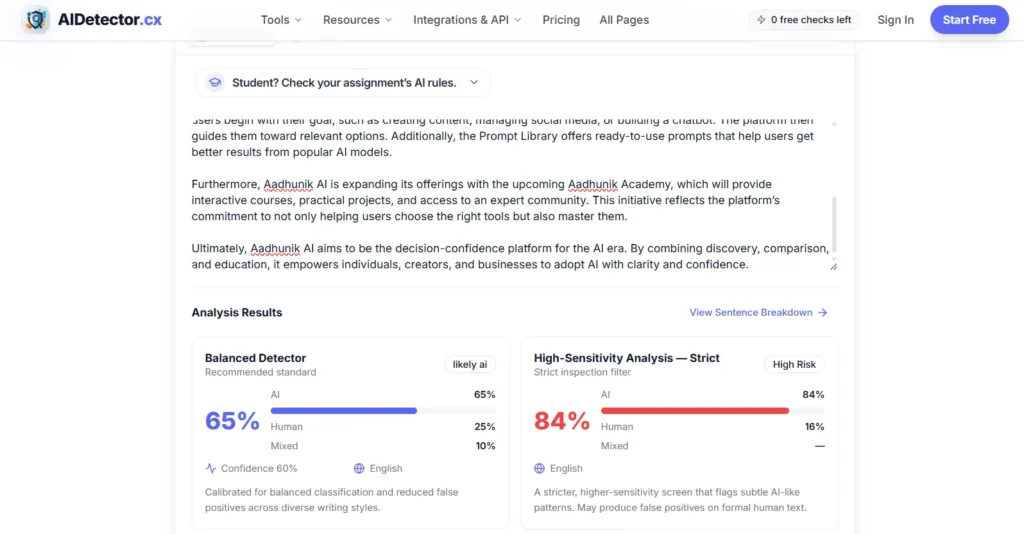
| Balanced: AI / Human / Mixed | 65% / 25% / 10% | 14% / 81% / 5% |
| Balanced verdict | “Likely AI” (confidence 60%) | “Likely Human,” Low Risk (confidence 69%, High) |
| High-Sensitivity: AI / Human | 84% / 16% | 74% / 26% |
| High-Sensitivity verdict | High Risk | High Risk |
| Language detected | English | English |
What we found in the AIDetector.cx test.
- Raw AI was flagged, but not decisively. The Balanced engine said 65% AI at 60% confidence. The strict engine was more certain at 84%.
- Rewriting flipped the Balanced result. It fell from 65% to 14% AI and moved to “Likely Human.”
- The strict engine barely moved. It went from 84% to 74% and stayed at High Risk. On Text 2, the two engines sat 60 points apart.
- The advice is about style. On Text 2, the strict engine suggested adding personal anecdotes and a first-person perspective to reduce AI risk. That advice is about how the text reads, not evidence of who wrote it.
- Speed: the Text 2 scan took about 1.7 seconds (engine 2.5.1).
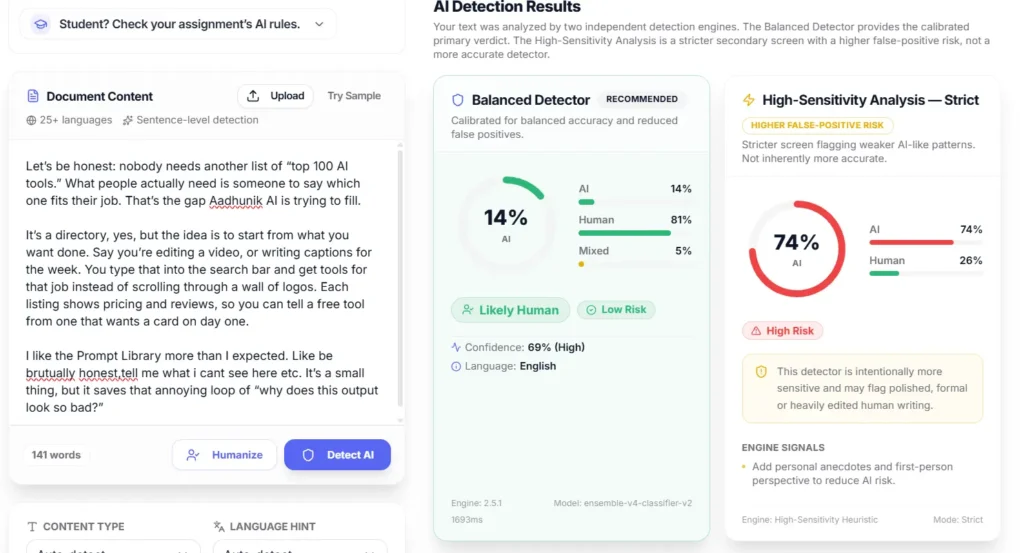
Our reading (analysis, not a tested fact): the Balanced engine responded to the rewrite and the strict engine did not. The scan screen labels the strict engine a “heuristic” and the Balanced engine an ensemble classifier model. Whether that explains the gap, we cannot verify.
Why caution matters beyond this tool
Detector error is not an AIDetector.cx problem. It is an industry problem.
- OpenAI withdrew its own AI text classifier on July 20, 2023, citing low accuracy. At launch, it had said the tool correctly identified 26% of AI-written text and wrongly flagged human-written text as AI 9% of the time. OpenAI also warned that it was unreliable on text under 1,000 characters. That note applied to OpenAI’s own tool, but it is a reminder that short samples are harder for any detector.
- A Stanford-led study in the journal Patterns tested seven widely used detectors on 91 TOEFL essays by Chinese students and on 88 essays by US eighth-graders. The detectors misclassified more than half of the TOEFL essays as AI-generated, an average false-positive rate of 61.3%. The authors also found that simple prompting could both reduce the bias and bypass the detectors. The study is from 2023 and tested the detectors of that time, not today’s versions of the tools in this review. It also did not test Indian writers. The pattern it describes, where writers with a narrower vocabulary are flagged more often, is a reason for Indian students and professionals to be careful with a high AI score.
Free AI checker comparison: AIDetector.cx vs QuillBot vs GPTZero
We ran the same two texts through the free versions of three detectors. We used QuillBot’s AI Detector from a free account, GPTZero’s basic scan without logging in, and the AIDetector.cx free plan. If you are searching for a QuillBot AI content detector comparison, this is the head-to-head.
| Tool | Text 1 (raw AI) | Text 2 (rewritten AI) |
|---|---|---|
| AIDetector.cx, Balanced | 65% AI, “likely AI” (confidence 60%) | 14% AI / 81% human, “Likely Human” |
| AIDetector.cx, High-Sensitivity | 84% AI, High Risk | 74% AI, High Risk |
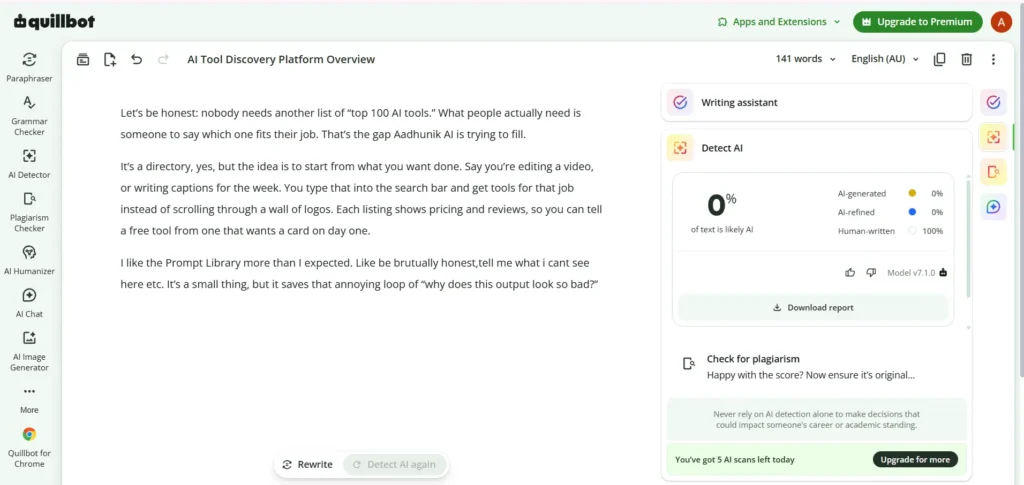
| QuillBot (model v7.1.0) | 100% AI-generated, 0% AI-refined, 0% human-written | 0% AI, 100% human-written |
| GPTZero (model 4.1o) | “Highly confident” AI: AI 100%, Mixed 0%, Human 0% | AI 100%, Mixed 0%, Human 0% |
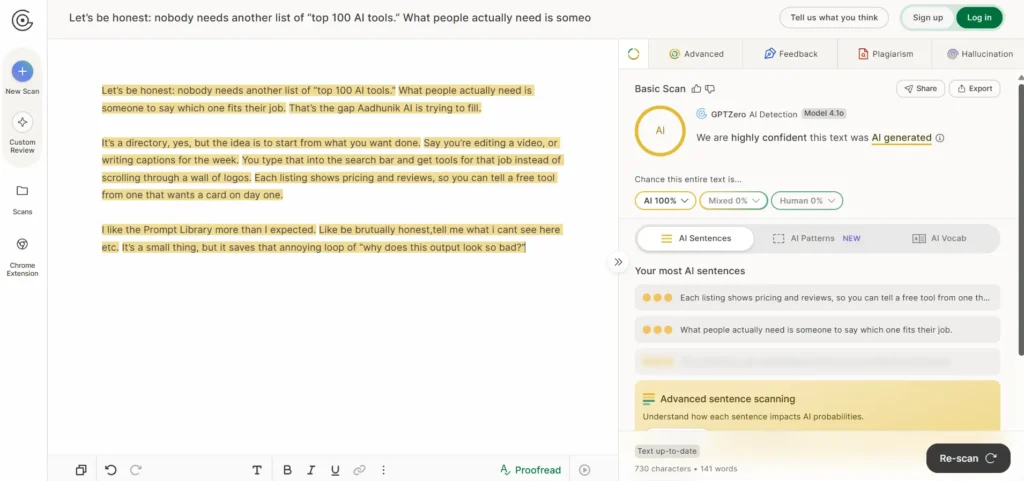
What the three-tool test showed.
- All three flagged the raw AI text. QuillBot and GPTZero both returned 100%. AIDetector.cx was less decisive, at 65% (Balanced) and 84% (strict).
- Rewriting split the tools completely. On Text 2, QuillBot said 100% human, GPTZero said 100% AI, and AIDetector.cx landed in between depending on the engine.
- There is no single correct label for Text 2. It started as AI output and was rewritten by hand. Judged by origin, GPTZero and AIDetector.cx’s strict engine flagged it, while QuillBot and the Balanced engine rated it human or likely human. We are reporting the disagreement, not declaring a winner.
- Score style differed. In our two tests, QuillBot and GPTZero returned all-or-nothing scores (100% or 0%). AIDetector.cx returned graded percentages plus a confidence level. That reads as more cautious about uncertainty, but it does not prove it is more accurate.
Features and access
| Feature | AIDetector.cx | QuillBot | GPTZero |
|---|---|---|---|
| Free access | 1 guest check + 4 account checks, one-time | Free account with a daily scan counter (it showed 6 left after our first scan, 5 after our second) | Basic scan worked without logging in; free plan lists 10,000 words/month |
| Result categories | AI / Human / Mixed per engine, plus confidence and language | AI-generated / AI-refined / Human-written | AI / Mixed / Human |
| Engines shown | Two (Balanced and High-Sensitivity) | One (v7.1.0) | One (4.1o) |
| Sentence-level view | Sentence breakdown page | Highlights flagged text | Highlights text and lists “most AI sentences”; some detail was blurred behind an advanced-scan prompt |
| Extras seen | Humanizer, plagiarism, SEO tools | Plagiarism checker, downloadable report | Plagiarism and hallucination tabs, share and export |
We saw only QuillBot’s remaining-scan counter, not its total daily allowance, so we do not state a number.
What the free AI checker plans and paid tiers cost
Prices below are as displayed to us on October 22, 2026. GPTZero and QuillBot showed rupee prices. AIDetector.cx showed dollar prices. We have not converted between them.
| Tool | Free plan | Entry paid plan | Higher tiers |
|---|---|---|---|
| AIDetector.cx | 5 checks total, one-time | Pro: $10/month ($120 billed annually); 300 credits/month, dual-mode detection, PDF/DOCX/CSV exports | Pro Plus $24.17/mo ($290 annually); Business $65.83/mo ($790 annually); Agency Unlimited $2,500 for one year |
| GPTZero | ₹0: 10,000 words/month, basic scan, 1 free advanced scan | Premium: ₹599/month, billed annually; 300,000 words/month, advanced scan, multilingual detection, downloadable reports | Professional: ₹1,199/month, billed annually; 500,000 words/month, scan up to 250 files at once |
| QuillBot | ₹0: AI Detector (limited), plus paraphrasing and grammar limited to 100 words | Premium: ₹334/month, billed annually; full AI Detector access | Team Plan: usage metrics, user management, centralized billing |
The specific plan information provided by AIDetector.cx has additional two details. According to its pricing page, the Pro plan has two detection modes available, but both models were already discussed in our free tests. In addition, the Agency plan mentions that the detection supports publishing decisions but does not certify the authorship.
Limits of this test
- There are two texts; one has short length (141 words) while the other one is longer (256 words).
- The second text contains rogue personal commentary we had kept in; all three tools did the scanning.
- Detector models keep changing, so the results are considered as a snapshot of what happened on 22 October, 2026.
- There is no “best” detector because the results do not support it. For more options beyond these three, see our roundup of free AI content detection tools.
What to do when detectors disagree
Run the text through more than one tool
      ↓
All low   →  weak signal that it is human-written; still not proof
All high  →  a prompt to review the text, not a verdict
Disagree  →  treat the spread as information, not noise
      ↓
Check draft history and sources, read the flagged sentences,
and ask the writer about their process
That follows AIDetector.cx’s own advice to read both engine results together with human judgment. Aadhunik analysis: if three tools can return 100% human, 100% AI and a split verdict on one text, then the useful question is not “which tool is right?” but “what other evidence do I have?”
Detection versus provenance
The footer of AIDetector.cx indicates “Verified Authorship” and “C2PA & Provenance Standards.” This indicates that AIDetector.cx uses a different strategy, which involves tracking the origin of the content instead of guessing its characteristics. C2PA is an open technical standard employed for identifying the source of media. However, the application of C2PA is partial, as it does not guarantee the accuracy of the information provided, and only limited usage has been recorded. Provenance is also separate from text watermarking, which we explain in our piece on Claude’s text watermark. Detection says “this looks like AI.” Provenance says “this was made by X.”
Pros and cons
Pros
- Transparent about its limits, including its own language grading
- Two engines show where signals disagree
- Graded percentages with a confidence level
- Sentence-level evidence
- Multilingual, including Hindi in Beta
Cons
- Also, regardless of having 5 total free checks, it is part of the monthly quota of GPTZero service.
- Experimental and Beta languages
- The results are probabilistic and the engine flagged and detected both our samples.
- Some marketing phrases are somewhat contradictory (“the worldwide standard”) compared to the tool’s own warnings.
Who should use this free AI checker?
- Bloggers and SEO teams: a quick check for generic, AI-sounding drafts. If a draft gets flagged, our guide on how to avoid AI slop covers what makes writing read as machine-made.
- Teachers and students: only as one signal among several. AIDetector.cx says results should not be sole evidence in academic or disciplinary decisions, and our test supports that.
- Businesses: check how pasted text is handled before you scan anything sensitive. Our piece on data security for business AI tools shows what to ask.
Our verdict: is this free AI checker worth using?
Use AIDetector.cx and take advantage of the five free checks offered. The double engines are ideal for spotting disagreements while transparency of the website is another definite plus point. For those seeking an on-going free allowance, one can sign up for the free offer at GPTZero and QuillBot offers partial access. Regardless of the option selected, it is important not to interpret any percentage as a guarantee of authorship. During our test, three tools gave conflicting results for the same text.
