
Anthropic has made a recent announcement with big implications for users of Claude. From now on, the future Claude models will incorporate an AI text watermark in the texts that they create. This change will directly impact people who write, edit, or publish using Claude.
Anthropic has explained everything about it in a post from August 14th, 2026. Shortly after TechCrunch announced the implementation of the change intending to fit the requirements of the EU AI Act. The article contains information on the function of the AI text watermark, how the Claude watermark functions, and how it will affect day-to-day work with the tool.
What is an AI text watermark?
An AI text watermark is a concealed statistical pattern that is left in AI written text. And it does not introduce any sort of characters, letters, or visual marks. Rather, it will alter the process of choice of words by the model so that after the crank, it can be discovered using a particular key.
Anthropic is not doing it alone. As of August 2, 2026, the European Union has ordered all providers of AI that are working in Europe to be labeled. Anthropic agreed on the European Union’s Code of Practice for the Transparency of AI Generated Content, together with around 190 signing parties, including other well-known developers of AI models.
This means that Claude is now one of many chatbots planned to be used in the near future that will come with watermarked texts. So Claude’s move sits alongside a broader push towards AI content disclosure that the whole industry is slowly adapting.
How does Claude’s text watermark work?
LLMs produce language slowly, one word at a time. Sometimes, several words may be equally suitable for the context. For example, in the sentence, “Today’s weather is cold and…” the next word could be either “overcast” or “grey,” both of which would make sense.
Usually, Claude would randomly choose a word based on a random number. However, introducing a watermark technique affects this randomness. The watermark can replace the random number generator with a unique key combined with preceding words. As a result, the word chosen by Claude remains natural from the reader’s perspective. But someone with knowledge of the key may evaluate a certain text and determine the probability that this text was written by Claude.
Anthropic applies SynthID Text, watermarks, developed by Google DeepMind, in its work. This method is based on an idea proposed by Scott Aaronson in 2022.
Watermarking never forces Claude toward an odd or unnatural word. It only allows Claude to choose between several words that it would have chosen anyway. Anthropic’s own example: watermarking would never push Claude to write “nubilous” instead of “overcast,” because Claude would not use that word regardless.
Does watermarking change how Claude’s answers read or perform?
No, Anthropic does not see a measurable difference in the quality, creativity, and readability of watermarked and non-watermarked content. Human reviewers looking at the two sides by side see no systematic difference.
Google DeepMind tested it on live Gemini traffic using the same SynthID Text process, and similar to Anthropic, their study found no significant changes in user ratings. Watermarking also does not slow Claude down or generate more tokens, thus making it more cost-effective.
Here is a brief overview of what does change and what remains constant.
| What people ask | What actually happens |
|---|---|
| Does the output look different? | No. There are no visible changes or hidden characters. |
| Does it cost more or run slower? | No. It runs at the same speed and costs the same. |
| Can it identify me or my chat? | No. The watermark contains no personal or organizational data. |
| Does it apply to every response? | It applies more often when word choice is flexible. |
| Does it apply to translations? | Yes. Claude generates every word, so the watermark can apply. |
Claude text watermark vs ai detection tools like Pangram: what’s the difference?
The fact that these two technologies differ so greatly causes confusion, as people often make the same mistake in thinking they are similar technologies. One of the AI detection tools, Pangram, works by analyzing different stylistic characteristics of text, which could include stylistic patterns like the phrasing of “this is not X; it’s Y,” or by taking note of the use of different words in excess. AI detection tools work on the basis of certain habits in writing.
Watermarking has a different working principle. Watermarks do not analyze text; instead, they involve checking generated text against a cryptographic key that is available only to Anthropic, which gives a probability value instead of a stylistic guess.
Anthropic is going to launch watermark detection API soon; however, the access related details of it are not yet clarified.
Does watermarking work the same way on code and edited text?
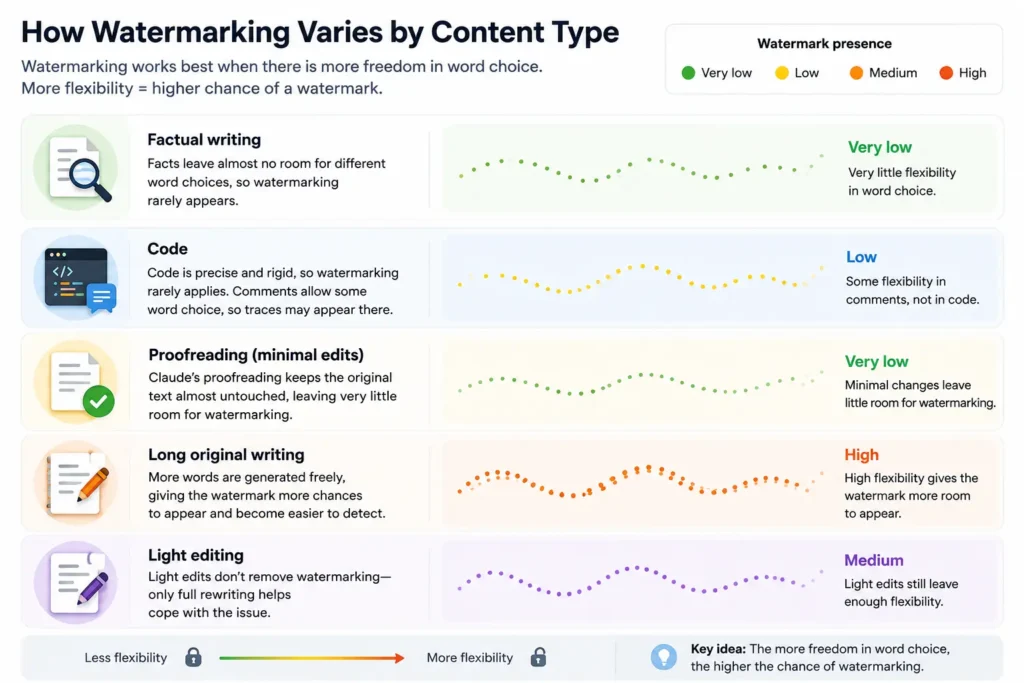
Watermarking relies upon having great flexibility in terms of the choice of words. Therefore, we see inconsistent watermark presence in different types of writing.
- Factual writing: Watermarking generates almost no effect on pure facts, such as in a sentence, “The most famous work of Isaac Newton was called Principia.”
- Code: Most of the content is written in precise code, making it incapable of carrying any watermark. However, any comments in the code provide flexibility in terms of word choice, allowing some traces of watermarking to get in.
- Proofreading: With proofreading done by Claude, the person’s text remains almost untouched. The watermark has very little to attach to in that case.
- Long original writing: The more words Claude generates freely, the more chances the watermark has to appear, and the easier it becomes to detect with confidence.
- Light editing: As Anthropic states, light editing does not remove watermarking and only full rewriting helps cope with the issue.
What does this mean for everyday Claude users?
For most of the people, nothing will change from a practical point of view. You will not observe any differences in terms of tone, precision, or pace. The purpose of the watermark is for verification, nothing else.
Anthropic has claimed that the watermark does not reveal any information related to a user or organization. Instead, it simply indicates that Claude was likely involved in the creation of a certain piece of content.
In addition, a watermark does not reveal whether Claude produced a text from scratch or overhauled a ready piece of work. Plus, it can prove nothing in terms of human authorship, and it cannot even identify whether another AI system has produced the content in question.
Earlier models of Claude that were released before August 2, 2026 such as Claude Opus 5 will also make use of the watermarking feature over time as a part of the gradual process, initiated according to the EU’s requirement.
Key takeways
The Claude watermark is a subtle back-end update meant to facilitate transparency rather than to modify or limit the content that Claude produced. It leaves no visible trace, costs nothing extra, and cannot be traced back to a specific person or chat. The presence of Claude watermark is evident in free-flowing text but non-existent in code, factual or minimal edits.
For anyone using Claude often, the watermark is not significant at all. What is important is that it mirrors the impending trend of the entry of the AI writing into a new phase, where verification methods become the industry standard driven by legislation like EU act.
FAQs
No. Tests performed by Anthropic have shown that a watermarked response does not produce any difference regarding the quality or creativity of the content produced.
No. The watermark and its key carry no identifying information about you, your organization, or your conversation.
No. Watermarking does not add additional tokens and does not have any effect on the speed of responses and prices.
Light edits likely will not remove it. A full rewrite where every word changes probably will, though at that point the text arguably is not AI generated anymore. This is different from techniques which aim at making AI content sound more human, which change tone and phrasing rather than the underlying watermark
Not really. Code needs exact syntax, and therefore it does not allow the flexibility that watermarking requires. Only slightly changed elements may show traces of watermarking.
