
TL;DR
- On July 24, 2026, Anthropic introduced the Opus 5, the latest flagship model in Claude series line.
- Opus 5 performs almost on par with Fable 5 in many tasks, while costing half as much.
- The pricing remains unchanged from the previous version Opus 4.8, and is set at $5 for every million of the input tokens and $25 for each million of the output tokens.
- Now Opus 5 is the default model used by Claude Max, and the most advanced model of Claude Pro.
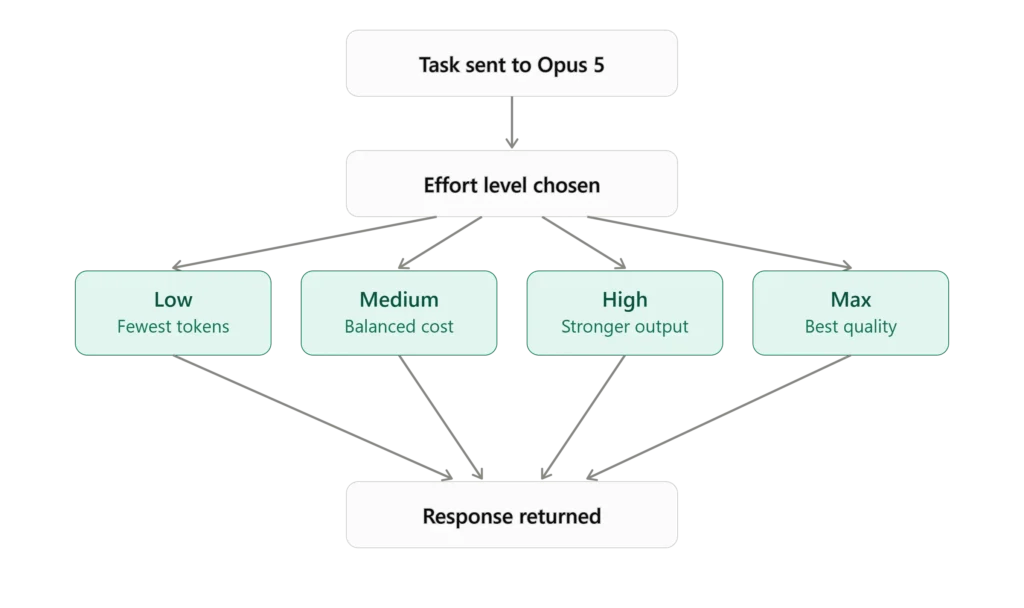
- With the effort dial users can select low, medium, high, or maximum power for every task.
- There have also been changes introduced in the API with respect to mid-conversation tools and automatic fallback.
What happened?
On July 24, 2026, Anthropic released the Claude Opus 5, designed to serve as a day-to-day solution for coding, knowledge work, and enterprise-related AI tasks instead of being just a benchmark authority.
Opus 5 is already up for sale via the Claude platform and is also included in the Claude API. Opus 4.8 has now been replaced with Opus 5 as the default model on the Claude Max platform, gaining the title of the best model on Claude Pro so far. According to Anthropic, the model works best for business companies and developers as it allows them to conduct long and complex tasks on the Claude platform. If you don’t want to miss any such important AI news, subscribe to our newsletter, where we share an AI brief every Friday. All you have to do is go to https://aadhunik.ai/blog/ and drop in your email on the homepage.
What’s new in Claude Opus 5?
Better performance for less
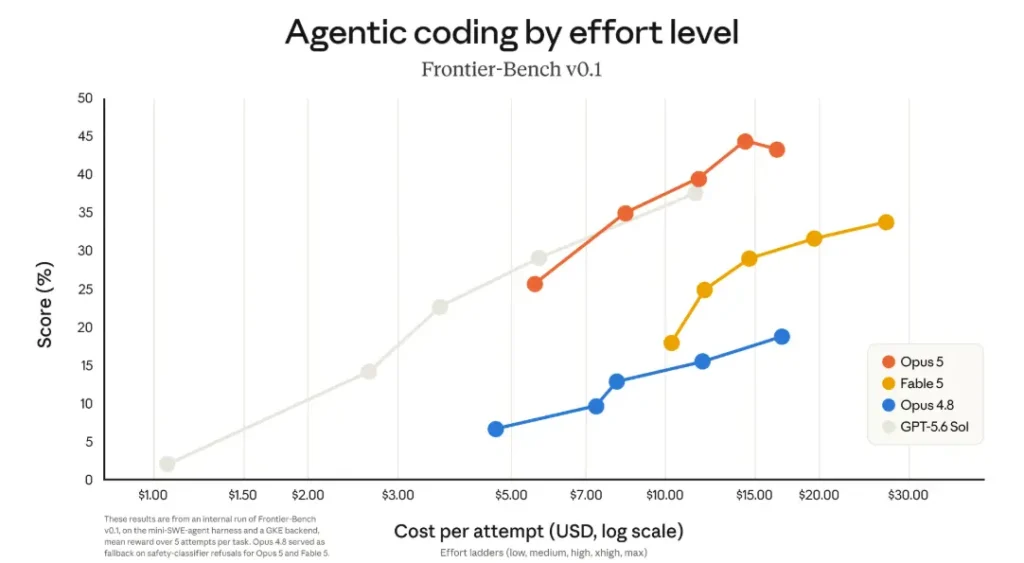
Upon testing Frontier-Bench v0.1, Opus 5 scored a much better result than Opus 4.8, scoring much more in total, but spending lower on every task. When performing on CursorBench 3.2 under maximum effort conditions, Opus 5 reached a score very close to that of Fable 5, but while costing twice lesser for each task.
Built for agentic coding
Anthropic intended that Opus 5 works seamlessly with coding agents and software applications used. It is capable of ensuring quality of its own output, as well as rectifying mistakes by itself, thus minimizing the need to work interactively over long sessions of programming.
An effort dial instead of one fixed mode
For each task in which Opus 5 is involved, users may adjust its performance level, which means they can switch from very low to low, medium, high, or to maximum effort. The lower the effort mode is, the smaller number of tokens is used in doing the work, which means lower costs per task performed.
Enterprise-first improvements
Anthropic has introduced new features on the Claude Platform together with Opus 5. Coder’s can update the tools that Claude makes use of during the conversation without losing the prompt cache. Moreover, Antropic has created automatic fallback on the API such that requests which are detected by safety classifiers can be routed to another model instead of just solely being blocked.
Alignment and safety
Anthropic claims the Opus 5 provides one of the best model aligning outcomes ever being achieved with the Opus model since it has demonstrated lower percentages of deceptive conduct in internal testing. Nevertheless, this model is still lagging behind the Mythos 5. As far as cybersecurity and biology evaluations are concerned and it cannot make advanced dual-use applications in these areas either.
Pricing and availability
Opus 5 has the same prices as Opus 4.8, meaning it costs $5 per million tokens for input and $25 per million tokens for output. Opus 5 is launched and available for use in Claude.ai, Claude Max, Claude Pro, the API of Claude, and in enterprise applications. Anthropic still advices users to use Fable 5 for demanding long projects.
Why this matters
Anthropic is not on this mission of benchmarking alone. The company is also competing in terms of pricing, speed, and effectiveness of the models in everyday business processes.
In regards to coding helpers and AI agents, speed of response and token costs are just as important as overall smartness of a model. The model that completes its tasks faster and at a cheaper price is usually preferred over the one that performs slightly better but has higher operating costs. Businesses typically care less about the model’s position in rankings. And care more about the reliability of its performance over hundreds of calls of the same type every day.
This tendency is reflected in Opus 5’s dial of efforts. It gives the user a freedom of choosing a model based on the cost. Rather than on the trade-off between the different options available. Which is important for a team that is keeping a close eye on the budget allocated for AI service.
Claude Opus 5 vs Opus 4.8: quick comparison
| Feature | Claude Opus 4.8 | Claude Opus 5 |
|---|---|---|
| Performance | Strong reasoning and coding baseline | More than 2× better on Frontier-Bench v0.1, with improved reasoning and coding capabilities |
| Coding | Solid support for agentic coding | Better self-verification, error recovery, and long-running coding tasks |
| Reasoning Effort | Fixed reasoning approach | Adjustable effort levels: Low, Medium, High, and Max depending on the task |
| Enterprise Features | Standard tool use | Supports mid-conversation tool switching, automatic fallbacks, and more reliable enterprise workflows |
| Speed | Standard inference | Optional Fast Mode delivers responses up to 2.5× faster |
| Pricing | $5 input / $25 output per million tokens | Unchanged: $5 input / $25 output per million tokens |
Final thoughts
In order to compete strictly on a usability basis and not just on benchmark performance, Anthropic released Claude Opus 5. With prices being kept stable, an effort dial for controlling costs, and a better agent-supporting code, it is tailored for teams operating AI on a daily basis. Opus 5 indicates what the future holds for enterprise AI competition: performance, reliability, and availability of the product.
