
AI labs do not usually share a launch day. However, that changed on September 22, 2026. Anthropic publicly launched Claude Opus 5.5 in the morning, and merely a couple of hours later, OpenAI revealed the new GPT-6 Sol and GPT-6 Luna.
This alignment was intentional on the part of both companies, as they sought to ride the headline wave. This article summarizes released products, compares pricing and features, and discusses what the alignment means for developers of AI-assisted applications.
What is GPT-6, and why did two labs launch on the same day?
Currently, OpenAI’s family of models is represented by GPT-6. The package started with GPT-6 Astra, the key model released on September 3, 2026. The remaining models of the family, Sol and Luna, are considered small by OpenAI and therefore cost less.
Right in the beginning of that Tuesday morning, Claude Opus 5.5 was released by Anthropic as their new model. The reports indicate that the time gap between the releases varies. Some sources say it was only a few minutes while others claim that the span of time is closer to 90 minutes. However, OpenAI’s own announcement was made within 2 hours following that of Anthropic’s release.
Both parties claim that it is an accident that the two labs made their announcements almost simultaneously. However, it is not the first case this year when the two companies released products very close in time to each other and journalists are starting to get used to the same-day releases.
How does Claude Opus 5.5 work, and what changed from Opus 5?
Claude Opus 5.5 is Anthropic’s debut model in its new 5.5 series. According to Anthropic, its performance is close to that of Claude Fable 5.1, but operating costs are 40% lower than those of the older model, Opus 5.
Other changes include the following:
- Output generation is approximately 30% faster than that of Opus 5
- Costs of input and output tokens, which are now $4 and $20 per million respectively, reduced by 20%
- The model’s availability has expanded beyond Claude’s apps, as the new model can be used through AWS, Google Cloud, and Microsoft Azure
- Limits have increased by five hours on Pro, Max, Team, and Enterprise plans with a one-time reset of limits for subscribers
- Anthropic claims that the new model has outperformed all previous models according to its internal benchmarks.
Sonnet 5.5 and Haiku 5.5 should also be available shortly, says Anthropic.
What do GPT-6 Sol and GPT-6 Luna actually bring?
Sol and Luna occupy the bottom and middle echelons of the GPT-6 series. According to OpenAI, the learning techniques used in their training has some similarity to that of Astra, which has made it possible to gain certain advantages over Astra and smaller models.
Sol was developed for complicated complex tasks and assigning multiple programs, whereas Luna is a more affordable and mobile version for jobs that do not require too much time and resources. Sol and Luna charges 50% less than the cheap GPT-5.6 offer.
- GPT-6 Sol: $2 per million input tokens, $10 per million output tokens
- GPT-6 Luna: $0.10 per million input tokens, $0.50 per million output tokens
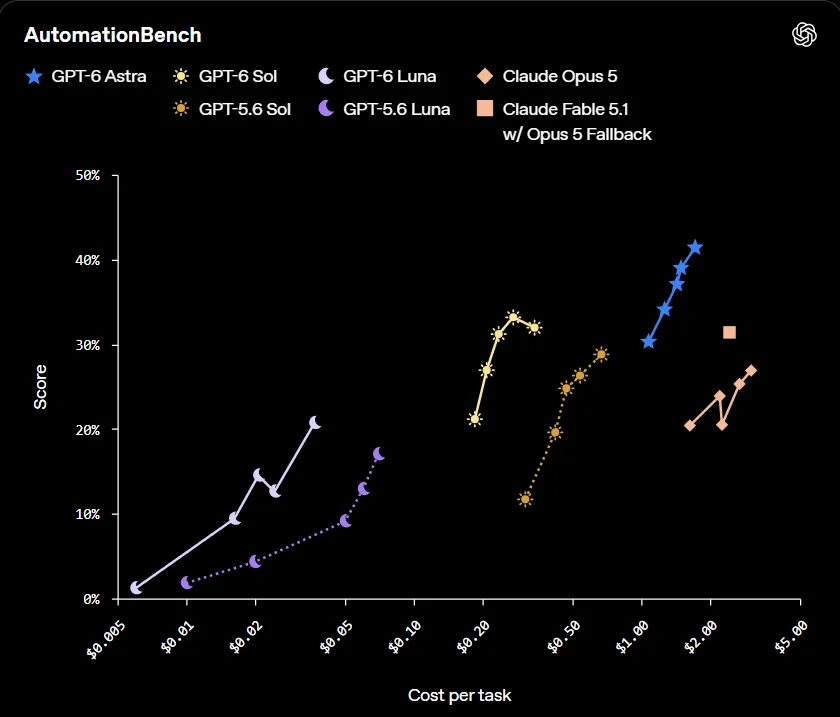
OpenAI compared Sol and Luna against Claude Opus 5 and Claude Fable 5.1 in this chart – not the newer Opus 5.5, which launched the same morning
Both versions are incorporated into the current version of ChatGPT Work and Codex and can be used by Plus, Pro, Business, and Edu users. The free version of ChatGPT can work with Luna through the desktop application. However, both models are not yet available in the regular interface of ChatGPT.
In order to use the system, developers may call the API with the access key gpt-6-sol and gpt-6-luna.
The publication takes place one week prior to OpenAI’s annual event, DevDay, which is planned for September 29, 2026.
GPT-6 Sol vs GPT-6 Luna vs Claude Opus 5.5: how do the numbers stack up?
| Model | Best for | Input price (per million tokens) | Output price (per million tokens) |
|---|---|---|---|
| Claude Opus 5.5 | Flagship reasoning, agentic coding, knowledge work | $4 | $20 |
| GPT-6 Sol | Complex coding and professional tasks | $2 | $10 |
| GPT-6 Luna | Fast, lightweight, high-volume tasks | $0.10 | $0.50 |
It is crucial to point out that neither of the two companies made a direct comparison of their new offerings on the same day. OpenAI compared the models Sol and Luna with Claude Opus 5 and Fable 5, while Anthropic compared Opus 5.5 with GPT-6 Astra and GPT-5.6 Sol. Thus, there was no further independent testing comparing Sol and Opus 5.5 as of the first day of launch.
Claude Opus 5.5 vs GPT-6: should you switch right now?
If you are already working in a specific ecosystem, it may not be necessary to act right now. Opus 5.5 is suitable for teams that focus on long reasoning processes and programming in several environments such as AWS, Google Cloud, or Azure. Sol is perfect for teams that want to achieve GPT-6 results at a more affordable price, especially in the case of GitHub Copilot or Codex. Luna is useful for businesses that perform straightforward repetitive tasks at scale, where cost is more important than capability.
Since no comprehensive tests have been conducted yet, it is advised to wait for a week or two before moving the production environment. Most often, early tests provide a false impression of the product quality as public testers do not have real-life access to the product.
What does this mean for AI companion apps and other everyday AI tools?
Price reductions in frontier models are unlikely to remain there for a long time. Whenever leading companies lower prices, their products, including chatbot applications, writing software, and other types of AI-based tools, usually lower their prices or improve quality soon after.
It’s a trend that’s worth considering in this case as well. In our previous analysis of competing virtual assistants, we compared Grok with ChatGPT and Gemini. And looked at where AI companion tools stand in our coverage of Rudi, Mika, and Ani.
Key takeaways
September 22, 2026 was also a record launch day. Anthropic launched Claude Opus 5.5 first, thereby reducing expenses by 40% and accelerating production by 30% when compared to Opus 5. GPT-6 Sol and GPT-6 Luna were launched by OpenAI in just over two hours, resulting in a 50% reduction in the cost of the company’s API.
Neither laboratory has provided a side-by-side comparison at this point. For now, if you’re curious about which service to use, the best idea is to run both of them on your own workloads for comparison.
FAQs
It’s available in ChatGPT Work and Codex for Plus, Pro, Business, Enterprise, and Edu users. It is not yet in the standard Chat interface.
GPT-6 Sol costs 50% less than GPT-5.6’s promotional pricing: $2 per million input tokens and $10 per million output tokens.
No. On list price, GPT-6 Sol costs less per million tokens than Claude Opus 5.5. Neither company has published an independent, same-harness comparison between the two yet.
Sol is built for complex, multi-step work like coding. Luna is a lighter, faster, and cheaper model meant for high-volume, simpler tasks.
References:
Claude Opus 5.5 — cost, speed, pricing
- 40% lower cost on typical workloads vs. Opus 5; ~30% faster output; performs at Fable 5.1 level “on most work”: Anthropic’s official announcement
- $4/$20 per million tokens (input/output), a 20% cut from Opus 5’s $5/$25: MacRumors and Forkast
- Raised five-hour usage limits on Pro/Max/Team/Enterprise + one-time rate limit reset: Thurrott.com and MacRumors
- Available on AWS, Google Cloud, Azure; Sonnet 5.5 and Haiku 5.5 coming in weeks: 9to5Mac
- “Strongest performer to date” on the automated behavioral audit: SiliconANGLE
GPT-6 Sol and Luna — pricing, availability
- $2/$10 per million tokens (Sol) and $0.10/$0.50 (Luna), 50% below GPT-5.6 promotional rates: Unite.AI and Pulse2
- Availability in ChatGPT Work/Codex, Free/Go via desktop app, not yet in standard Chat: 9to5Mac and Pulse2
- Trained with methods similar to GPT-6 Astra; API identifiers gpt-6-sol/gpt-6-luna: OpenAI Developer Community announcement and TechCrunch
- Launch tied to DevDay on September 29, 2026: Pulse2
Timing gap between the two launches
- “Minutes after” Opus 5.5: Decrypt
- “Around an hour later”: Simon Willison and 9to5Google
- “About 90 minutes later”: The Neuron
- No direct head-to-head published by either lab: thenewstack and WindowsForum, citing VentureBeat
