
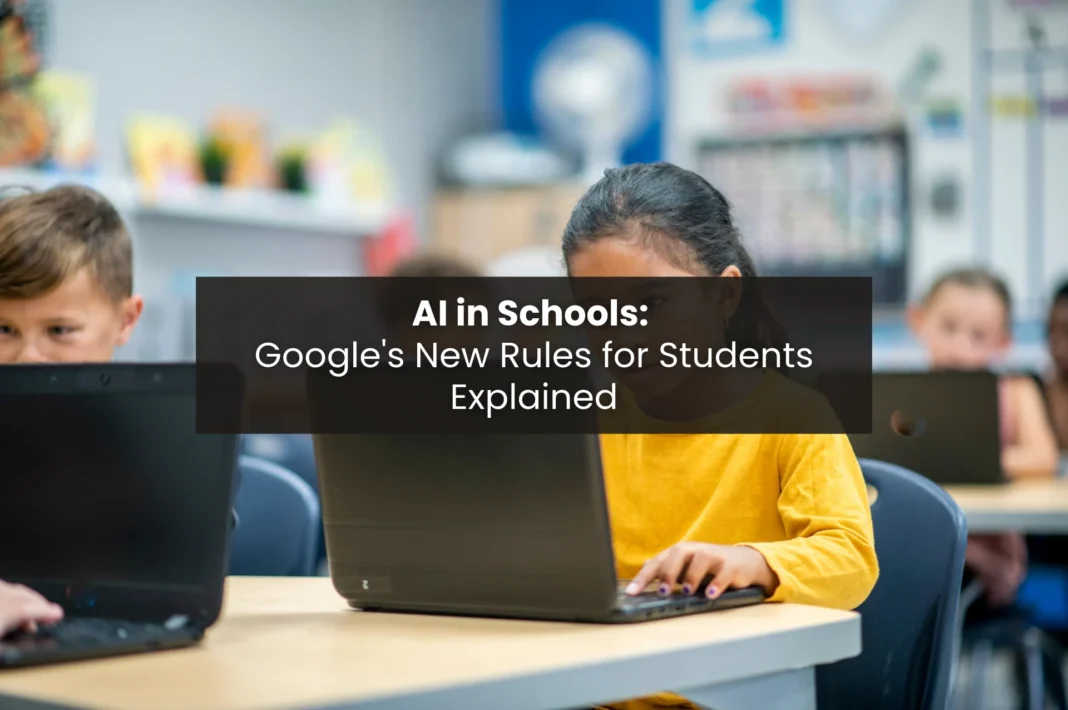
Students have been taught in schools for quite some time about the use of Google Search engine and its functionalities to get information, perform research and complete their academic tasks. Now that AI is getting into the picture of the Internet browsing, schools are presented with the following dilemna: can they allow students to use Search but not let them administer AI?
Google has shifted the debate into one direction when it announced that starting from early 2027 it will restrict the access of K-12 institutions students to a number of programs. Including Gemini and Google Search. Schools will be forced to choose which services to allow students to have access to. However, opting for banning AI from the student accounts will also deny students access to Search.
This decision offers schools an opportunity to limit student access to AI on one hand. And on the other hand it makes one question whether schools will be able to manage technology independently. Without giving up the important tools they had relied on for years.
What is Google changing for schools in 2027?
Google has tweaked the default access configurations for its education services. According to new guidelines, the following products will remain disabled for K-12 student accounts unless explicitly enabled by school administrators:
- Gemini: Google’s AI-based chatbot.
- Gemini Notebook: Google’s AI-based research and notetaking tool, also known as NotebookLM.
- Gemini in Classroom: AI capabilities available through Google Classroom.
- Google Search: Google’s search engine.
Essentially, this change means students will not automatically have access to the aforementioned services. It is now up to school administrators to enable or disable access depending on students’ grade levels.
In other words, this does not mean that there is a total ban on the use of AI technologies at schools. Google’s new approach means that the decision regarding the availability of AI technologies is vested in school authorities and not taken by Google independently.
According to the company, the decision has been made in response to concerns voiced by schools, teachers, academicians, and policymakers. Google wants school administrators to have greater influence in the process of students’ use of AI technologies in schools.
However, there is one important detail behind the announcement: schools that decide to switch off AI entirely will also lose access to Google Search.
Why could rejecting AI mean losing Google Search?
The segment of Google’s announcement that has received harshest criticism is as follows.
Schools can choose to enable or disable Google’s AI offerings.
They will be unable to create a distinct profile that would allow them to offer Google Search to students while prohibiting the use of its AI capabilities.
Google claims the two are deeply intertwined. Therefore, if schools decide not to enable the relevant settings, they will not be able to give students the option of Search in their accounts.
That creates problems for the school wishing to limit the use of AI.
For example, a school may want its students to do a project on the Great Depression and find various reliable sources to compare them. The teachers may want students to learn to perform research without any help from AI systems.
But now they will not have that opportunity because under Google’s policy they will either have to enable the AI-powered experience. Or stop providing access to Search completely.
This does not imply that the students will not have access to the broader internet. Schools may consider different search engines or tools. But moving to another service may require adjustments to teach in a classroom, as well as school systems and online learning methods.
The point here is not whether students need to use AI. The main question is if schools should have a chance to utilize a search engine without benefits of AI.
What is Guided Learning, and how will it change Google Search?
There is a shift on the way Google operates with AI tools when it comes to helping students. Rather than having AI give students all the answers, it now seeks to guide students through their learning process.
This is done through Guided Learning.
In Gemini, Guided Learning refers to the function of an interactive study helper that asks questions, explains complex subjects, and helps students figure out how to solve problems. Instead of merely presenting them with the final solution.
Google is looking to add similar features to its Search and Google Classroom tools.
When it comes to implementing the feature, a student may paste a difficult physics question in Google Search. Instead of providing the answer right away, it may navigate the student through the concepts people need to understand in order to answer the problem.
According to Google, with this feature students would be able to apply critical thinking skills in their studies, rather than resorting to AI. The company plans to trial its Guided Learning in Search at specific U.S. schools in the near future.
Guided Learning is also becoming available in Google Classroom. Teachers may assign tasks based on their curriculum and find out the areas of education that require intervention. Google made the announcement that this feature will go globally on the 3rd of November, 2026.
Thanks to this new functionality, AI can be a better learning assistant for students. Nevertheless, school boards will still have to assess whether the product corresponds with their teaching approach. As well as with the student’s needs.
Why are schools concerned about Google’s AI policy?
The issue of AI in education is nothing new. Teaching faculty and parents have been worried about learners using AI applications to get their homework done. That is without thinking for themselves and rely on AI-generated answers to learn a subject.
Earlier decisions of Google regarding students and the Galaxy program also have come under sharp criticism. The policy made it possible for K-12 users to join who make decision to use the program. However, the restrictions in searches caused another problem.
There are some big points of worry.
1. Students could lose access to a familiar research tool
Google Search has been integral to students’ information retrieval for years. If a school stops letting students use Google’s AI services. They will also lose Google Search access through their school accounts. Schools may have to seek alternatives and modify their teaching methods regarding online research.
2. AI-generated answers could affect critical thinking
Artificial intelligence tools offer greater ease of getting an immediate response. However, while these technologies make things easier, students still must be taught how to analyze the problem, compare the data and draw their own conclusions.
Teachers fear that students will rely too heavily on AI unless it is used properly. The method of Guided Learning hopes to solve the problem. Yet educational institutions will need time to figure out whether it is effective.
3. Smaller schools may have fewer alternatives
Bigger school districts might be capable of assessing more search tools, integrating other systems or developing technological solutions. However, this might not be the case with smaller schools due to lesser staff levels and funding. This situation could make it difficult for some schools to leave the use of Google’s services behind.
4. Schools may have less flexibility over technology choices
The primary concern is whether schools will be allowed to make independent decisions regarding AI and Search. Educators would like the ability to use traditional search tools while cutting AI tools off from students. Unfortunately, Google’s current policies do not allow for such a combination.
What are policymakers and critics saying?
The recent announcement from Google has raised eyebrows and received criticism from many government officials and advocates of education. Who believe that adoption of AI technology is not needed for schools to be able to use Google’s search engine.
One of the critics of this move was a former chair of the Federal Trade Commission, Lina Khan. According to her, Google has been abusing its dominant position in search services by forcing the educational institutions in question to adopt artificial intelligence.
Why critics say Google is limiting school choice
Not only Khan thought that the measure is wrong. New York City Mayor Zohran Mamdani expressed his own concerns regarding the major role played by technology companies in determining how children acquire knowledge.
Bernie Sanders, who is a US senator, didn’t stay indifferent to the news and stated that schools should not be forced to adopt the new technology, describing it as “a form of extortion”.
Such reactions show that there is a bigger debate going on concerning the role of tech companies in education. Schools use tech platforms in their everyday activities, from giving their assignments and materials to students, to searching for any information that can help the process of learning. If the service and its functions change, this is likely to have an impact on the students’ learning process.
However, while Google describes the change in certain terms, the message is different. The company claims that he goal of the change is to give schools greater autonomy in terms of the use of AI and to enable the latter to determine what tools may be used.
Thus, the controversy is about the meaning of “autonomy”. According to Google, the schools have the power to decide whether to switch on the service, but the critics believe that the absence of Search in schools that disallow AI means that no real autonomy is provided.
How could the change affect students and teachers?
The overall consequences will depend on the choices made by the individual schools. Schools could allow Gemini and Search for some students while restricting access for others, based on their age and learning needs.
For students, the changes may alter the way they do the research and work on their assignments. They would probably be engaged in more AI-assisted activities in their Search and Classroom learning platforms. As these tools become central to daily learning, gaining a solid foundation in modern AI concepts through programs like AI training in Chandigarh can help students and even working professionals make the most of AI-driven education.
In terms of teachers’ perspective, they would have the opportunity to analyze their curricula and decide the ways of utilizing AI in their teaching. They have to clarify the questions on AI use by students and direct them when it is appropriate to use AI services, when the students should work on their own and how to verify the output produced by these tools.
School administrators will also need to manage the practical aspects of this change. They will have to review existing technology policies, communicate with parents and teachers, and decide which Google services to enable for each grade.
The decision could be especially difficult for schools that want students to develop digital research skills but do not want AI-generated content to become part of every search.
Is AI becoming unavoidable in education?
Google’s policies raise a question that goes beyond one firm or one product: Is it growing tougher for educational institutions to fully incorporate digital technologies without using AI in the process?
Big tech firms, from search engines to productivity apps and e-learning platforms, keep extending the use of AI in their work. While bringing changes to the process of completing various tasks, AI alters the way students approach information.
It does not mean, however, that the incorporation of AI must be standard for all educational institutions. Young students might require a degree of control which would depend on their grade level; some subjects would benefit from being explained by AI, while others may need student creativity.
Thus, policies concerning the use of technology must reflect this fact. Saying yes or no to the use of AI constitutes only a small part of the necessary solution.
Apart from that, schools must teach their students how to verify AI-generated responses, source-check and identify whether the tool is faulty.
What should schools consider before enabling AI tools?
There will be several decisions for the school’s management in response to the changes made by Google in their work.
There are some things schools should keep in mind, such as:
- The age of the students: How much access the learners of a certain level should have?
- The educational objectives: Will using AI help students to understand ideas better or will it just motivate them to miss some important things?
- The help of the teachers: Can educators use the AI tools enough?
- Concerns about safety and privacy: What information is being taken by the above-mentioned tools? How are students’ usages controlled?
- Other alternatives of search engines: If the school does not want students to use Google AI Search, which other research tools can be applied?
- The interaction with parents: How should the new policy of the school concerning AI be explained to the parents?
These issues will allow schools to make choices depending on their teaching goals instead of just following the defaults.
The goal should not be to adopt AI because it is available or reject it because it is new. Schools need to understand what each tool does and decide whether it supports student learning.
Conclusion: Schools need more than an AI on/off switch
The alteration of the Google policy in 2027 creates a problem for schools as the school administrators will have more control over whether to use Gemini, Gemini Notebook, Gemini in Classroom and Google Search; however, if they decide not to use the Google AI services, they will have no access to Google Search.
In addition, the announcement demonstrates that AI is becoming more and more common in student devices. Guided Learning might help students understand complicated concepts; however, the schools will need to check how effective it is before introducing it into their work.
The main question, nonetheless, is in the need for providing schools with choice. Institutions should be able to choose the way of application of AI in their work. Without giving up other important digital tools.
