
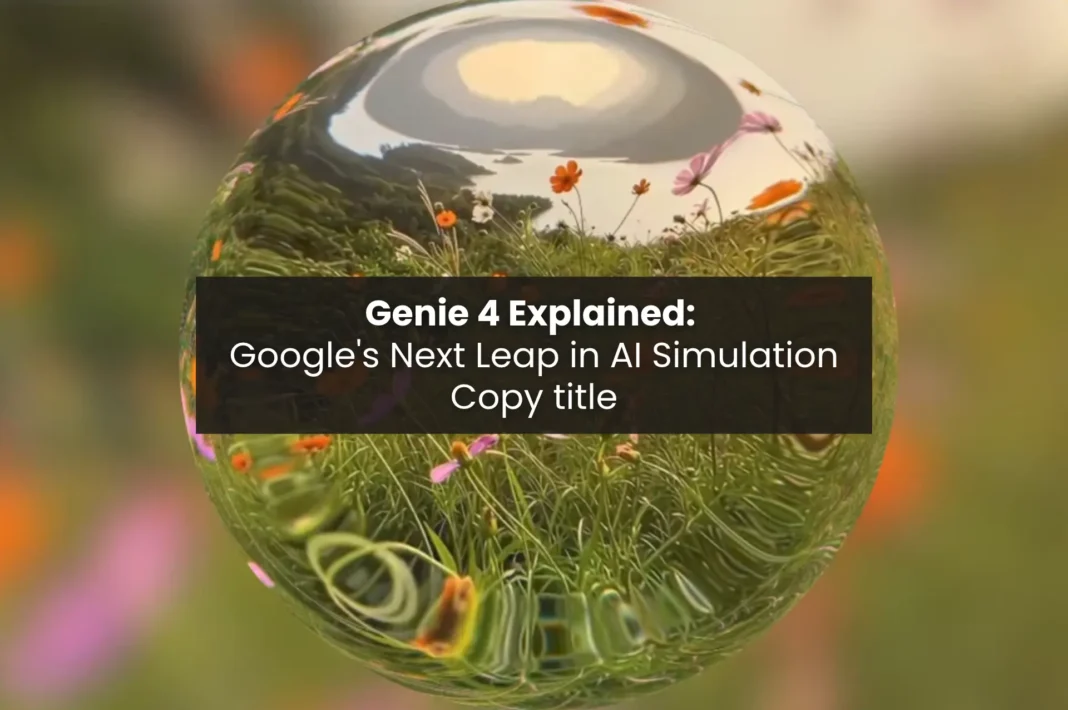
Google DeepMind has announced Genie 4, an AI world model that generates interactive environments with more realistic visuals, native audio, and real-time controls. Announced on October 27, 2026, Genie 4 lets users explore AI-generated scenes. While changing elements such as weather, camera angles, and characters through natural-language prompts.
Genie 4 differs from other AI video generators that create watchable videos and gives one the experience of living in a changed surrounding. It is stated that the model can create sounds, tunes and dialogues according to the model used.
What is Genie 4, and how does it work?
Genie 4 is the latest world model from Google DeepMind which is a type of AI that can create environments and forecast the changes in them based on actions users make. Users can give a description of a scene, enter the created environment, and act within it.
For instance, a user exploring a virtual forest can change the weather, add a new character, or change camera perspective. The model will create a presentation of the changes.
According to Google, Genie 4 develops the models in the Gemini series. Gemini Omni makes simulations look and behave more like the real world, while other Gemini models help the system reason through tasks and plan actions.
The idea is not only to make realistic visuals. But to create something that is going to listen to a user’s commands and change as the user interacts with the Corporation.
What makes Genie 4 different from Genie 3?
In August of 2025, Google created and unveiled Genie 3, a model which proved that text descriptions could be used to create interactive environments. Genie 4 comes as an improvement. As this new version is enriched with enhanced visual realism, physical simulations, real-time interactions, and audio production.
The main new feature is native audio output. This means that environmental sounds, music, and voice conversations are produced as a part of the entire experience itself. Rather than added as an editing separate layer after the video is done. In this version, the audio is produced together with the evolving environment itself.
| AI technology | Primary purpose |
|---|---|
| AI image generators | Create still images from prompts |
| AI video generators | Generate video clips, sometimes with audio |
| Game engines | Build interactive environments using designed assets, rules, and code |
| Genie 4 | Generate explorable environments that respond to inputs and evolve in real time |
Moreover, it is possible to change scenes while they are going over at the moment. It is also possible to change the weather, add the objects and characters, and change the camera angle with the help of natural language instructions. Google mentions that there are improvements in the field of physical reality. It means that aerodynamics and collision phenomena were taken into consideration. As well as character motion simulation.
These updates could make generated worlds feel more responsive. However, they do not yet establish that Genie 4 can reproduce real-world physics reliably or support fully fledged games.
Does native audio make Genie 4 more useful or just more immersive?
Although the practical significance of audio lies in the way sound events link to events. It is much more than just a decorative tool.
In a virtual world, sounds in the background can show events happening behind the screen. Having dialogues can make characters come alive, while the sound of effects can help the user figure out interactions. When shooting a scene, a filmmaker is able to hear the ambience, which can aid the evaluation of an idea before starting production.
Audio can also have importance in simulations focused on AI agents. The researchers can use the sounds and dialogues in virtual reality for studying ways of behaving besides making visual navigation.
There’s one crucial point to notice: generation of the audio doesn’t mean that the audio is precise. Sound must refer to the present event. So that it can happen at the right time in the simulation and stay valid through all changes in the process. According to Google, real-time accuracy of audio is one of the things that still require attention.
At the moment, Genie 4 is better due to the presence of the native audio. But it will be helpful only if the interaction of sound, visuals and events is of proper quality.
Why is Google building AI-generated worlds?
Google has a vision regarding the concept of training AIs, which can recognize the actions performed in different situations and how the performed actions affect the environment around. This may be utilized in the area not limited only to game development. Similar research explores how AI agents can behave like people within a digital world, as demonstrated by Harvard and MIT’s digital world with persona agents.
Robotics and AI agents
Scientists could apply simulated environments in order to see how robots and AI agents would apply their knowledge in different situations and perform required tasks. The simulation could serve a purpose of studying how one robot operates in a variety of unfamiliar environments. Which would significantly reduce the necessity of actually testing robots before they are used in real life.
Gaming and creative production
The opportunity to try out gaming environments has been made available for game producers. Who now can examine gaming ideas and play with various locations in their games. All of it without requiring to create every object in the scene separately. Filmmakers could apply interactive environments when creating early versions of the movie. In order to find the best camera angles, lighting, and composition of the scenes.
Education and training
It is possible that interactive simulation technologies would give students a chance to investigate historic places or scientific methods in future. Instead of viewing fixed videos, students could alter the variables and see the results of such actions.
These are potential applications, not proven capabilities. Genie 4 has not yet demonstrated that it can reliably support professional game development, filmmaking, or robot creation. The developers view the technology as researchers who took a significant step towards the implementation of interactive technology. And as the creation of innovative learning environments.
What are Genie 4’s limitations?
Regardless of the advancements made, Genie 4 is still very much at the experimental technology stage. Some of its shortcomings include:
- Lack of consistency in visuals as objects and visual details can undergo re-shaping during exploration of other locations or while carrying out edits.
- Low degree of physical fidelity as simulations actually may not work in accordance with real-life laws of physics making use of Genie 4 for carrying out tasks that necessitate high precision impossible.
- Lack of audio fidelity as sounds generated may not correspond to events or may remain out of sync with the environment.
- Inconsistency when it comes to text and spatial fidelity with readable text and consistent spatial details being the significant challenge for AI world creation.
- Issues with maintaining consistency long-term as maintaining a coherent environment over a longer period of usage remains challenging.
- Genie 4 is not the complete game engine. Just because AI can generate an interactive world doesn’t mean developers can turn it into a fully playable game.
At present Genie 4 can be utilized mostly for brainstorming ideas, scene prototyping, or running interactive simulations.
Can you use Genie 4 right now?
Genie 4 has been released as a research preview by Google DeepMind for a small group of reliable testers. Additionally, Google intends to grant access to Project Genie to Google AI Ultra subscribers. As well as the first participants in the Gemini API and Google AI Studio.
A broader launch of Genie 4 for users and developers has yet to be disclosed. Interested users can visit the official Genie 4 announcement to find the Project Genie waitlist. Wider availability, including access for developers, will depend on Google’s rollout.
What does Genie 4 mean for the future of AI?
Genie 4 showcases a transition from AI responsible for media generation to AI responsible for simulating environments where users can interact. Native sound takes these environments to a new level. While the use of real-time controls makes them more flexible for innovative purposes. Google is also exploring how AI can move beyond generating content, as seen in its work on agentic video in Gemini.
The main challenge here is whether Google will be able to make these environments sufficiently coherent. And also credible to implement valuable projects instead of just short presentations. Should Google achieve this goal, models of reality will be able to move from the realm of prototypes to a valuable technology.
