
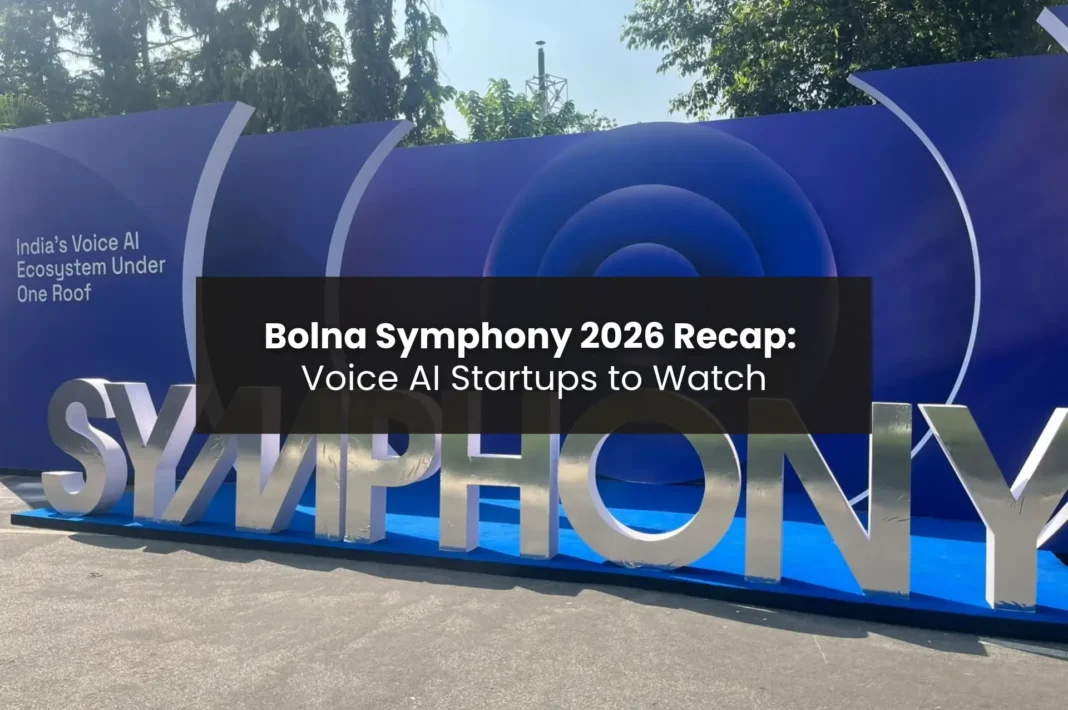
Event: Symphony 2026 by Bolna | Date: 20 November 2026 | Venue: The Lalit Ashok, Bengaluru
Voice AI has an unusual issue. As its technology improves, it becomes harder to detect.
I attended Symphony 2026 in Bengaluru last week, where this issue was present all along the exhibitions. The best showcases were the ones that had no problems whatsoever.
My visit had one main goal: to figure out what the current voice AI landscape in India looks like in a single venue where several key players from the industry were present. As a result I collected numerous contacts and relevant numbers.
This article covers everything that I saw there, what happened at the three different halls, describes the most relevant companies to know about, as well as mentions the exciting experiences I had during my day at the event.
What is Bolna Symphony 2026?
Bolna’s flagship event in the field of voice intelligence is called the Symphony event. This event was held on Friday, the 20th of November 2026 at The Lalit Ashok, Bengaluru. The organizers were expecting more than 1000 participants attending and about 42 speakers sharing work on three different platforms.
All the halls had Hindi names that represented what they did. The main stage was named Sur, the expo and networking zone was called Mehfil, and the build stage was called Abhyas.
What is Bolna, the company behind Symphony?
Based in Bengaluru, Bolna is an AI voice orchestration platform. It was established by IIT Delhi graduates Maitreya Wagh and Prateek Sachan in 2024, obtaining investment from Y Combinator and spearheaded by General Catalyst in its seed funding of $6.3 million in January 2026.
Rather than attempting to create one complete model, Bolna’s AI technology incorporates speech-to-text tools as well as other technologies such as language models, text-to-speech, and telephony in an effort to allow companies to create test, implement, and analyze voice agents. Initially, the company developed unique applications but then changed its orientation by 2025.
When talking numbers, Bolna has approximately managed to put together three figures for its activities: 1.5+ million conversations processed in a single day, around 150,000 voice agents developed in total, and over 8 million minutes used within a month in more than 22 languages.
What happened on the Sur main stage?
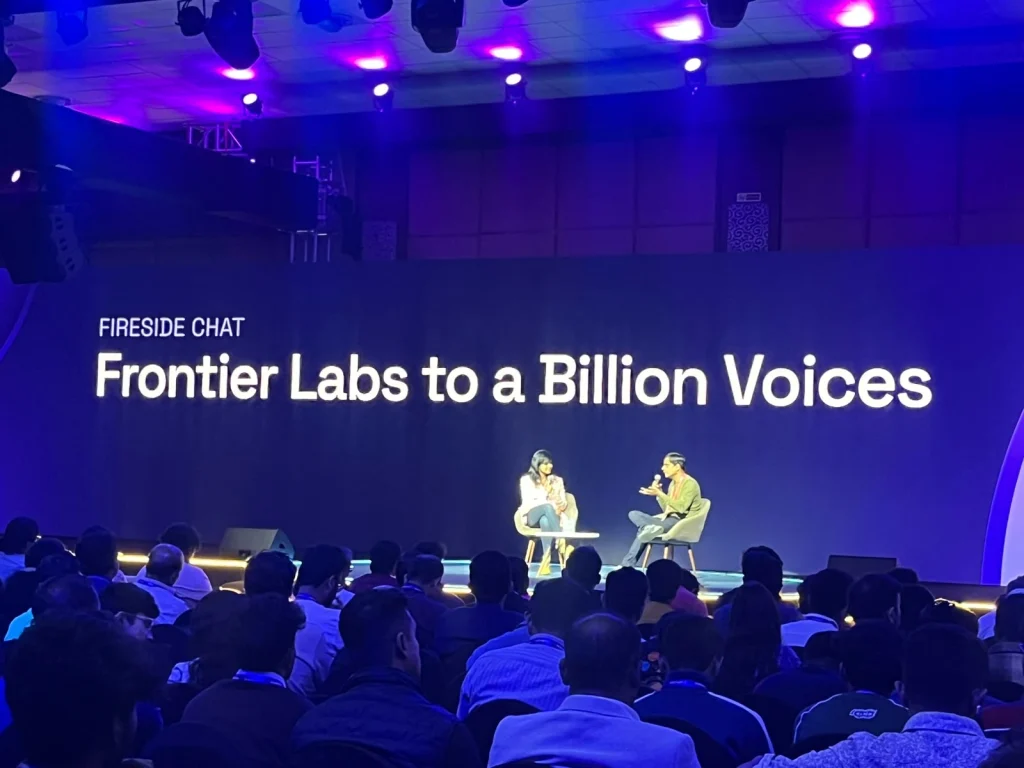
Sur commenced with the founding members of Bolna delivering the welcome address, following which the event proceeded with several panels throughout the day. As per the schedule board, the event consisted of sessions detailing the following:
- Frontier labs to a billion voices: speakers from Google DeepMind, an ex-OpenAI CTO of B2B applications and Schema Ventures
- Individual agents to orchestrated intelligence: session by Sachin Bhatia of Exotel
- Speech models developed for human nuances: Karya, Kalpa Labs, Navana.ai and ElevenLabs
- Creating the stack behind voice agents of India: Vobiz, Smallest.ai and Deepgram
- Reaching every citizen: voice AI for public services in India
- Bringing voice AI to Indian companies: AT&T Global Network Services India, NVIDIA, Exotel and Simplismart.
- Investing in voice AI: who is adding value and what will be funded in India next.
- Bolna customer success stories Facebook and Bolna launches.
- Symphony Awards, Buildathon winners and stand-up comedy session ending the day.
There was one common theme in all the sessions: opportunity, the challenges of the sector and financing.
How big and how hard is the voice AI market in India?
The potential is immense. India has a plethora of languages, innumerable phone conversations happening every day, and many businesses that are still reliant on telephonic conversations. For instance, collections, renewals, KYC follow-ups, and everything related to support start with a call.
As stated in a report by Navana.ai, the estimated value of India’s voice AI market is roughly ₹9,500 crore. Exotel claims that around 40% of the conversations in this category happen in India.
But the challenge, nevertheless, exists. The founders of Bolna state frankly that they are aware of how difficult it is to find business in this market. Businesses expect the results of the same quality, speed, and price as that of a human agent.
Language creates another layer. The founders of Navana say that English is creeping into the local language, and that the same words are pronounced differently in different regions.
Telecommunications is the silent issue. It is essential that Indian numbers should be compliant with the TRAI guidelines, so a number which has been marked as spam can end the effort before the agent has a chance to speak.
Is a voice agent cheaper than a human telecaller in India?
This is what I thought of often. Human customer support personnel cost between ₹ 7 and ₹ 8 per minute, while voice agents still demand an average hourly rate of ₹ 20. This indicates that developing an affordable substitute for a human being is far from simple.
One of the key factors is hidden in the stack itself. Voice agents comprise of 4 paid components: automatic speech recognition, natural language processing, text-to-speech, and telephony. Each of these components has its own individual provider, charges and profit margin, and consequently, finding a way to simultaneously cut all these prices without diminishing the quality of the service is a daunting task.
This is what led to a rise of many infrastructure startups at the expo. For instance, Navana’s Bodhi text-to-speech system costs ₹ 0.72 per minute of generated speech, while Simplismart offers even cheaper services. That is, every rupee saved on one component translates into a decrease in the final costs.
Who is funding voice AI in India?
The panel of investors was inquiring as to who is bringing value to the table, and whose products ought to be made financially viable. The Akarsh of General Catalyst had been invited to be the part of the panel, and the startup Bolna raised its seed money from General Catalyst.
The data speaks volumes regarding the funding scenario: Tracxn data reaffirms that Sarvam bagged the lion’s share of $346 million out of the total investments of $399 that Indic AI startups received in 2026. The rest of the funds were shared by the other startups in a combined funding of $54 million over seven rounds.
Nevertheless, all four rounds in recent times have a few things in common:
- Bolna: $6.3 million seed (January)
- Smallest.ai: $13 million Series A (July)
- Navana.ai: ₹40 crore Series A (September)
- Simplismart: $14 million Series B (October)
Each of these funding companies has a specialized component in the tech stack rather than being a universal chatbot service provider. One placard at the event put it succinctly: “India needs an Indian YC!”
For a look at the companies building voice-based AI solutions, check out our list of the best AI voice agents.
What was on the Mehfil expo floor?
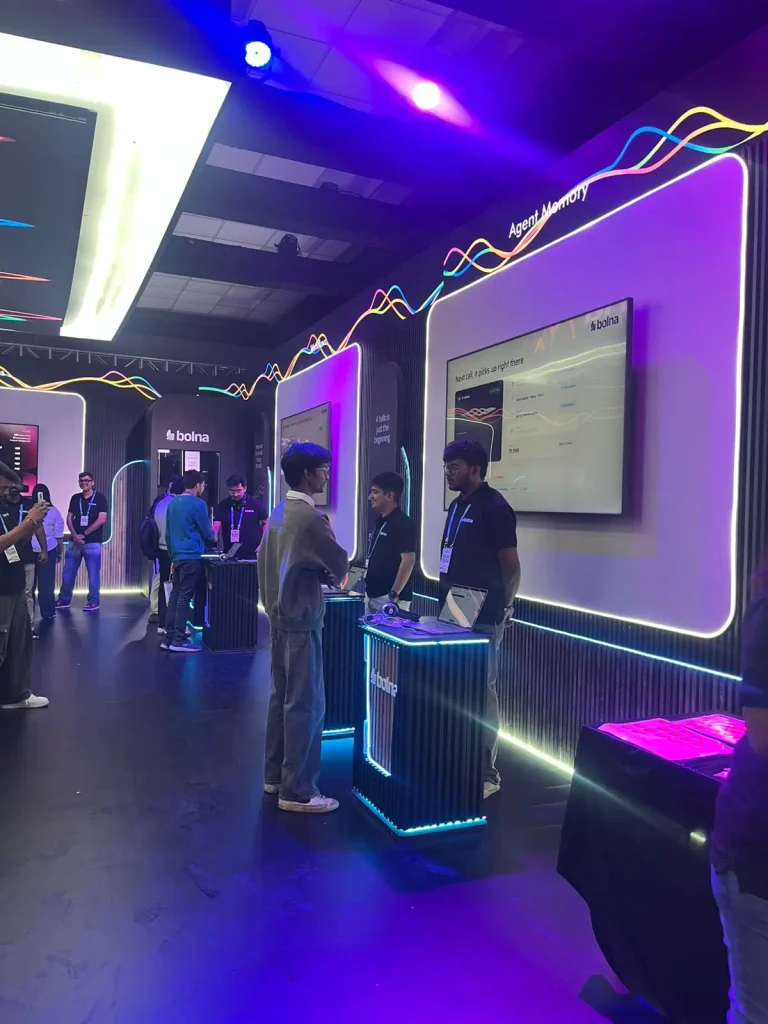
Mehfil was referred to as the expo hall. It held a voice AI experience centre, an AI barista, and a networking lounge with tons of giveaways. There were startups at their booths conducting live demonstrations.
There were themed pavilions in Bolna’s space with zones like Agent Studio, Simulation Suite, and Agent Memory. One screen informed visitors about how an agent can pick up the next call at the same point where the last call ended.
Let’s have a look at some of the noteworthy startups.
VoiceLink
VoiceLink offers TRAI-compliant Indian numbers and telephony for voice bots. It also works to keep those numbers free of spam labels on Airtel.
Simplismart
Simplismart allows organizations to speed up and make AI model inference less costly by using GPU processing. The company was able to secure $14 million in Series B funding in October, as Exotel switched its model inference to the platform.
Cartesia
Cartesia is a San Francisco-based research lab that specializes in state-space models, a simpler alternative to transformer systems. It designs its Sonic systems with the aim of supporting low-latency speech, and plans to secure as much as $100 million in 2025
Navana.ai
Navana.ai is into developing voice AI specifically for banks as well as lenders and has developed models for twelve Indian languages and forty-five dialects. Navana raised ₹40 crore this September, and the Bodhi model developed by the company can read figures such as ₹1,00,000 correctly.
Sarvam AI
Sarvam reached unicorn status in June after successfully completing its Series B funding of $234 million. The company is known to have introduced Prism, an open-weight decision-making model that responds in just 44 milliseconds, reported TechCrunch.
Google Cloud
Google Cloud was a diamond sponsor of the event. The company rebranded its Vertex AI to Gemini Enterprise Agent Platform and is introducing Gemini 3.5 in India equipped with computer facilities on-site.
Other companies on the Mehfil list include:
- ElevenLabs: ElevenLabs signed an agreement with Karnataka’s KITS in October and works with more than 250 Indian companies.
- Deepgram: has received $130 million financing at the valuation of $1.3 billion and its Flux model suitable for interruptions.
- Smallest.ai: secured $13 million in Series A funding in July with its fast Lightning speech model.
- Kalpa Labs: developing a speech model to replace the need to have different models for transcription, speaking and cloning.
- Exotel: fitted Harmony with AI support for consumer experience.
- Vobiz: works for voice agents and its customers include Bolna, Sarvam and Razorpay.
- Truecaller: Truecaller partnered with Bolna to help users identify AI-generated calls.
What is the Abhyas stage?
The venue wherein the builders had knowledge input was Abhyas. There are multiple events, such as Bolna case studies, the build-along, the finals of the Buildathon, and Voice Tank, which occurred here.
Prior to the event, Bolna had disclosed that the five best teams in the Symphony x Y Combinator Buildathon were to receive cash prizes totaling ₹5 lakhs and visit the destination live and pitch their idea. Among other perks for winners is their possibility of receiving an offer to interview with Y Combinator.
How do self-improving voice agents work?
Out of all the sessions, I remember the Bolna presentation the most clearly. Bolna showed how it can identify mistakes made by voice agents.
Mistakes made by voice agents are strikingly ordinary. They sometimes mispronounce names, mix up numbers, or pronounce words incorrectly. Bolna showed how they managed to rectify all these problems in real calls.
This is what I took from the loop:
- The platform monitors live and test calls.
- It identifies subsequent errors regarding pronunciation, numbers or wording.
- The Bolna team takes corrective action with respect to the prompt, voice settings or rules of pronunciation.
- The voice agent undergoes testing before it handles the next call.
The next instance that baffled me is the one where Bolna demonstrated an agent who was dishonest to a customer. The app detected the situation and successfully dealt with it.
Furthermore, second instance was equally intriguing. When the customer becomes annoyed, the agent involves a human operator. Self-improvement does not mean no supervision at all.
Can you tell if you are talking to an AI?
Bolna made the space a fun zone by conducting various activities in between the different sessions. The first activity was a game where participants had to identify whether the speaker in eight different clips was a human or an AI.
Next, the organizers conducted a second activity in which AI used voice recognition technology to analyze participants’ voices and identify their home states in India. The speaker then had the choice of agreeing or disagreeing and marking their reaction accordingly.
The third was a wall of hot takes with reaction stickers. A few cards stood out:
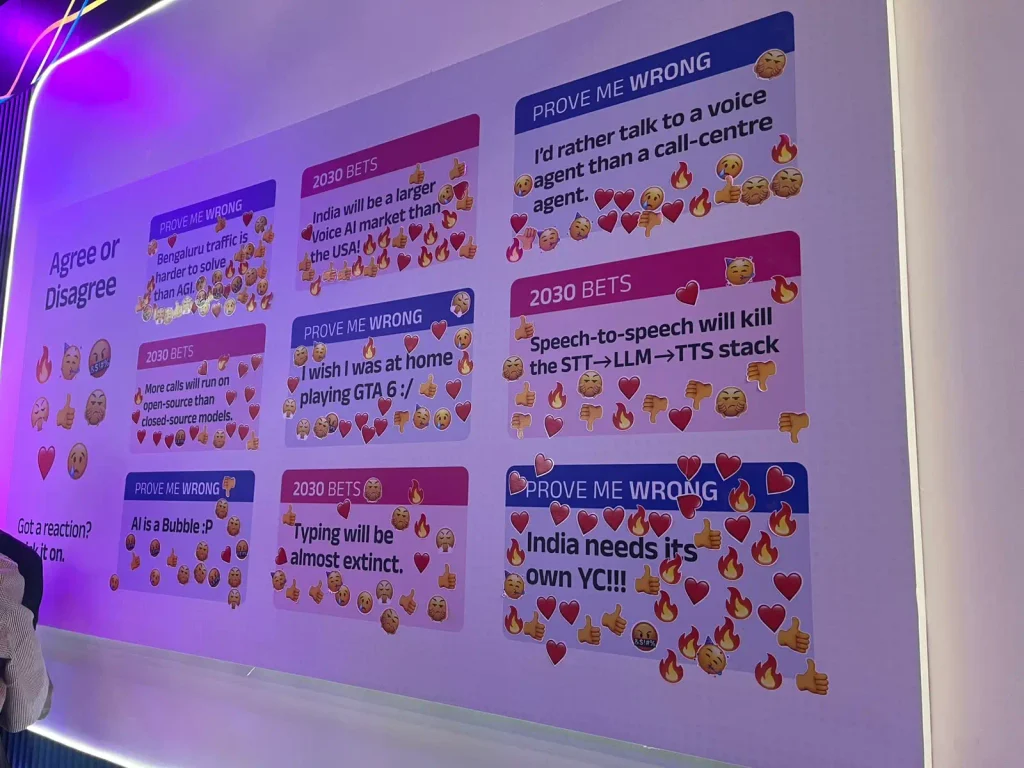
- “I would rather talk with a speech AI than a call center person.”
- “Speech to speech technology will omit STT→LLM→TTS.”
- “More calls will happen with open source rather than closed source.”
- “Typing will almost die out.”
- “Solving traffic in Bengaluru is more difficult than solving AGI tech.”
The activities were informative even though they were games and indicated that connection is becoming increasingly important among people as they get more shaped by the voice AI technologies.
What was my biggest takeaway from Symphony 2026?
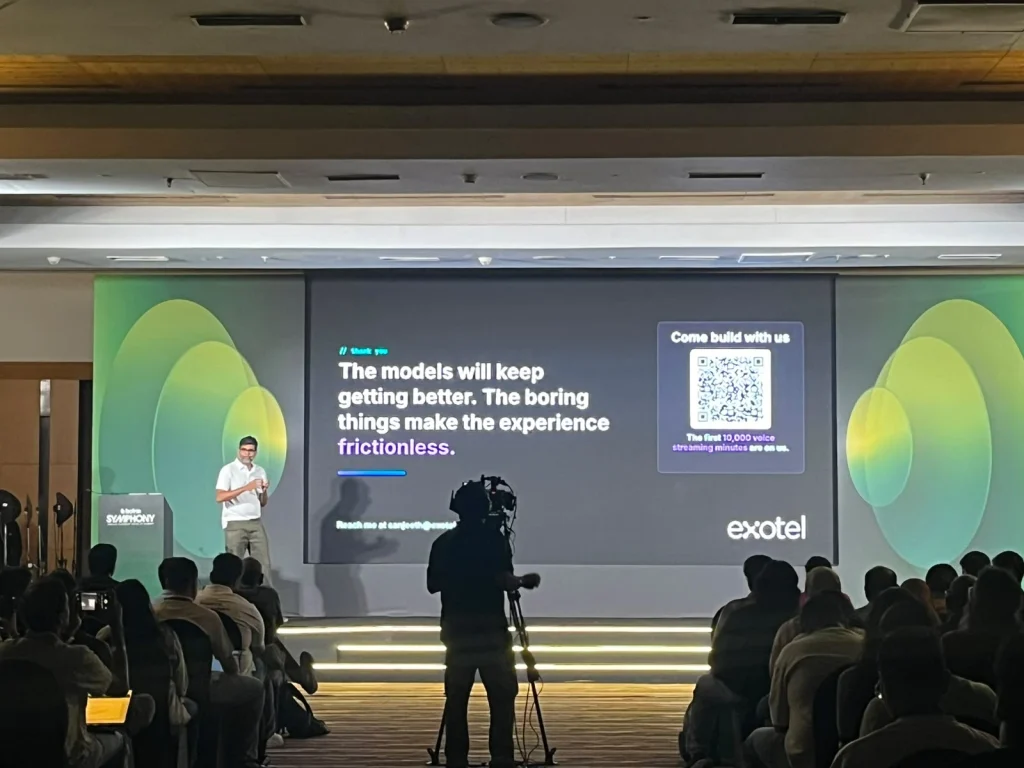
The final slide from Exotel summed it up more effectively than I can: the systems will continue to improve, and all that is mundane will make the process easier. It also included a QR code and a deal for 10,000 free minutes of voice streaming.
After spending a whole day at the event, I can say I agree. The future of Indian voice AI depends on three factors:
- Dull layers: telephony, number management, supervision, and modification of pronunciation errors.
- Money: Companies must narrow the gap between a ₹7 to ₹8 human minute and a ₹20 machine minute.
- Trust: the person making the call should know who the caller is and what he or she wants.
If you develop, buy, or write about voice AI, mark Symphony 2027 on your calendar as soon as the dates come out.
