
Harvey, the legal AI startup that is supported by OpenAI, has launched its first ever post-trained AI model which goes by Tenet.
Tenet has been designed to handle long-term legal work. Harvey developed Tenet with Fireworks AI based on Kimi K3, an open-weight model developed by Moonshot AI.
The question that arises is why a company backed by one of the leading closed-model companies would make use of a Chinese open-weight model as its own AI model’s backbone.
The significance lies in the fact that Harvey not only introduce yet another legal AI model. It is putting the theory to the test. In an effort to find out if it is possible for an enterprise-level AI to take a certain model based on an open-weight foundation, customize it to meet the requirements of a profitable sector, and lessen the reliance on the major players in the market.
Why did Harvey build Tenet on Kimi k3 instead of an OpenAI model?
In short, control is the critical factor. Training an open-weight model allows Harvey to exert a far greater influence over how it behaves, deploys, and optimizes itself than it would have been able to do with a closed model.
The concept of open-weight models is not new in the field of AI. Recently, such models have come into use among companies that want to take control over their technology stack. And we have seen this trend embodied in recent developments from Alibaba’s Qwen project.
As a result, Tenet provides Harvey with a model that gives Harvey much more control and can be optimized for its legal needs.
Is Harvey walking away from OpenAI?
Moreover, Harvey hasn’t mentioned the discontinuation of OpenAI, Anthropic, or Google models from its setup.
To be clear, Tenet simply supplies Harvey with a model that it has designed for its specific applications, whereby it does not need to be dependent on any one single provider for this purpose. More useful question to ask here would not be “OpenAI or Kimi,” but whether the use of open-weight AI means that enterprise companies no longer have to rely solely on any one frontier provider at all.
What actually makes Tenet different from a legal chatbot?
A majority of law-related AI services are available to provide answers. Tenet’s purpose is to perform tasks.
Harvey provides a working atmosphere that simulates real tasks involving genuine papers and solutions to search the documents and review them, making it possible to produce the end results. Completion of the legal work is accordingly checked.
That is a very important difference. Tenet is not being educated in the law, but in how legal work is performed.
Why law firms still won’t hand the work to AI
Greater legal reasoning does not eliminate the need for human supervision. In fact, given the inventions of AI technology, the concern about where companies allow AI to function independently is greater than ever before.
The progress made with legal AI has been cautious rather than reckless. Our report on the results of Linklaters trial using AI to assess legal knowledge shows that law firms remain reluctant to use AI without supervision, despite the increase in accuracy rate.
Tenet does not do away with the need for caution. A machine learning system trained specifically to follow legal standards brings us closer to AI that fits how law firms work. Evaluating it the way senior associates assess junior associates also helps ensure it can meet real-world legal expectations.
What can Tenet actually do for a law firm?
Harvey claims that Tenet offers training on real-world legal processes instead of one-size-fits-all concepts. Examples of this training might be completing M&A due diligence, reviewing contracts, drafting contracts, completing documentation-heavy research, and redlining contracts.
Imagine a lawyer giving Tenet a deal room with hundreds of documents. The objective is for Tenet to locate every ownership change clause and write a risk report.
The emphasis is not on Tenet being able to answer a legal question. But its capability to complete a multi-step assignment and provide a final product. Harvey mentions that Tenet trained specialized models for specific tasks like M&A due diligence indicating that the company does not rely on a single massive model to perform all functions.
How good are Tenet’s benchmark numbers?
Harvey reports that Tenet completes almost twice as many held-out tasks on LAB and 20% more on LAB Contracts than base Kimi K3, lifting all-pass rate by 9 and 2 percentage points, respectively. It also claims state-of-the-art results on LAB Contracts and second place overall on LAB.
Numbers require careful analysis before they are relied upon. Harvey admits discrepancies between its benchmarking method and the standard one. And indicates that it considers Mercor’s published scores as its main leaderboard reference. Details laid out in Harvey’s own post-training announcement.
These are Harvey’s comments. They could be subject to independent examination in the near future.
Why does cost matter so much for legal AI?
Harvey says post-training gave it two separate levers on cost. Open-weight models already carry lower per-token prices than closed frontier models
Legal work involves dealing with large document collections. The cost of reviewing a data room or contract collection increases quickly. As the context and tokens used during the task add up.
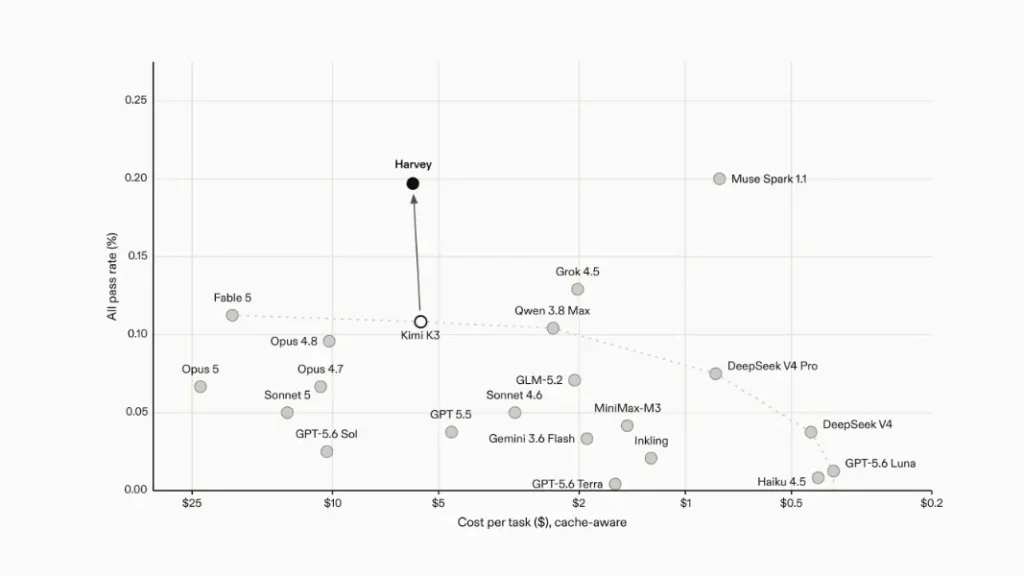
If a specialized model can accomplish a task using significantly fewer funds. Adventurous companies may not have to allocate all jobs to expensive frontier models. Of course, if this works in practice, it is possibly a much larger development than the benchmark results suggest.
Is Tenet an open-weight model itself?
Harvey refers to Tenet as the “first post-trained open-weight model,” indicating that Tenet utilizes the Kimi K3open-weight foundation.
Harvey refers to this launch as an early Research Preview. The next stage is integrating Tenet as a new functionality of the Harvey product rather than simply enabling teams to interact with Tenet independently from Harvey.
In other words, Harvey has created the specialized legal model from an open-weight foundation model which is presently incorporated within Harvey’s products.
What does this mean for OpenAI’s investment in Harvey?
Although Harvey has been backed by OpenAI since 2022, its initial post-trained-model implementation begins with Kimi K3.
Harvey does not have to choose among OpenAI and Kimi K3. The essential message of Tenet is that it does not need to rely on either one. OpenAI and other model vendors keep releasing their different flagship models. But older companies are more likely to create a system based on several models.
Harvey still has opportunities for benefiting from OpenAI, Anthropic, and Google models. Owning Kimi K3 gives Harvey more opportunities to run the program effectively.
The bigger bet behind Tenet
The fascinating aspect of this narrative is not the fact that Harvey constructed yet another legal AI prototype.
It’s about Harvey’s attempt to find out if domain knowledge, flexibility, post-training, and specialized agents are superior to just renting intelligence from ground-breaking labs. If this hypothesis works out, the following wave of corporate AI will be seen.
Businesses may not have to develop a frontier model again from scratch. An already strong open-weight model could be utilized and trained. In accordance with the needs of the industry the company belongs to and owned afterwards.
The area of law will most likely prove to be the first domain where this experience will work.
What you need to know (1-minute summary)
- Harvey is a legal AI startup that has developed Tenet, its first post-trained model.
- Tenet is built on Kimi K3, an open-weight model from Moonshot AI, rather than an OpenAI model.
- Harvey collaborated with Fireworks AI to post-train Tenet to work on long-horizon legal tasks.
- The AI was trained using real workflows like mergers and acquisitions diligence, review of contracts, drafting contracts, and the redline process.
- Harvey says Tenet completes almost twice as many held-out LAB tasks and 20% more LAB Contracts tasks than base Kimi K3, raising all-pass rate by 9 and 2 percentage points, respectively
- Reports state that Tenet costs less than a quarter of the leading frontier models.
- Harvey calls Tenet a “Research Preview” built by post-training the open-weight Kimi K3 model; it says the work is headed toward production inside its own product.
- The underlying issue is not if the US can beat China but if the enterprise AI companies can own their intelligence rather than rent it.
