
Which is the best AI Model out there? A question to which there isn’t a definitive answer. But what’s true is that the global AI scene has been shifting gears. And recently, Google’s Gemini has been standing out the most. Last quarter, it grew way quicker than ChatGPT: fivefold speedier.
So now, all the talk is around Gemini vs ChatGPT shapes up as a top tech highlight in 2025.
ChatGPT has stayed on top – around 55% of global monthly users stick with it. But Gemini’s rise hints at the shifts ahead. While one pulls in fresh faces quicker, it’s also holding onto them tighter over time. That kind ofmomentum can shake things up, even more so when gains come this quickly.
A Clear Shift in Growth and Engagement
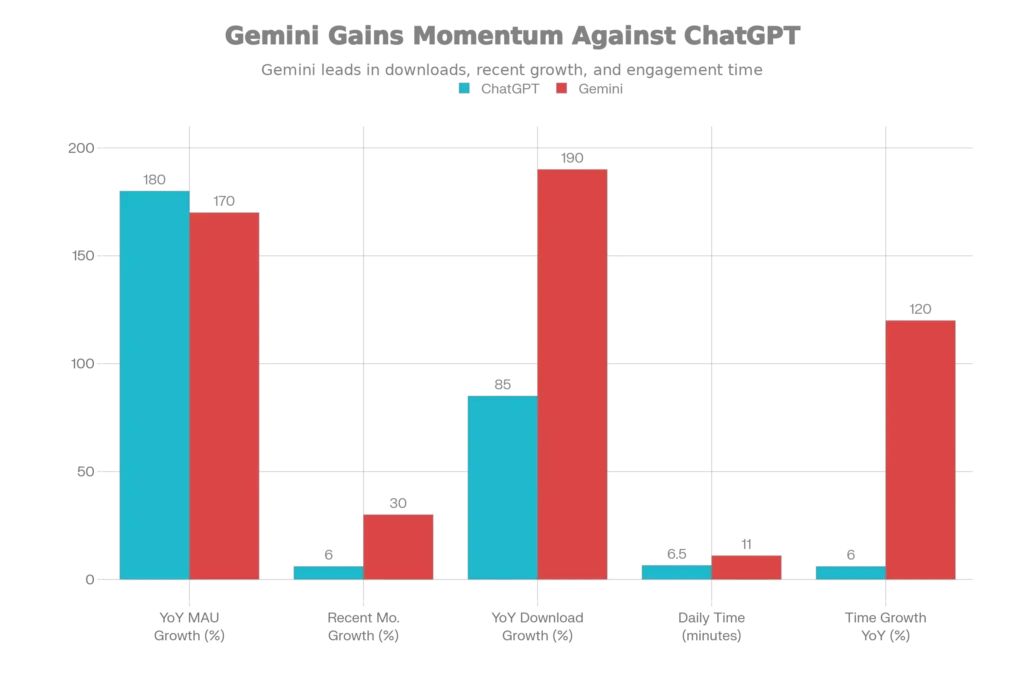
Gemini saw its monthly users go up 30% between August and November 2025. ChatGPT, meanwhile, climbed just 6%. That means Gemini expanded five times faster than ChatGPT during those months, aren’t these numbers surprising?
ChatGPT and Gemini both grew fast this past year – 180% for one, 170% for the other. On the surface, those numbers seem almost identical. Still, when you check the pattern over time, things shift. Over half a year, Gemini grabbed three more points of global reach. Meanwhile, ChatGPT lost exactly that much.
On top of that, how people use these tools has shifted quite a bit lately. Gemini users now spend close to 11 minutes daily in the app, this is way more than they did early this year. Meanwhile, ChatGPT folks clock in at about six and a half minutes, which hasn’t really changed since last year. The above stats have been taken from the Bridge Chronicle.
One thing’s obvious from these trends: Gemini isn’t only pulling in fresh users, it’s turning into part of their everyday routine.
How Android Integration Made a Big Difference
The main thing behind Gemini’s fast rise? Google’s huge reach. Instead of waiting for people to grab an app or go online like OpenAI does, it’s already built into every Android device(just this factor makes a huge difference).
People get into Gemini by sliding from the edge of the screen if they’ve got a Samsung. Hold down the power key instead, for Pixels. Lots use it like it’s just part of the phone now. No need to start up some special AI tool, because it’s built right in.
Besides, Google built Gemini right into Workspace. So now it works smoothly inside Gmail, Docs, Sheets, and Slides. No more juggling apps or figuring out complicated setups, people love it because they can skip that unnecessary stress. Just open Gemini and go.
The Silent Power Behind Gemini’s Rapid Growth
One reason Gemini got into U.S. company spaces was its practical edge. Nearly 46% of businesses now use Gemini tools inside Google Workspace. They say this:
- They see more online sales over time because customers keep buying
- Their ad returns get better
- Work inside moves faster because things flow better
- They boost how well AI helps with jobs, by as much as half, of course this is when it’s used right
In many situations, Gemini became a hidden tool inside companies, by blending in instead of standing out like it did with big businesses.
Besides this, Google’s pushing Gemini into business mobile apps using its ML Kit GenAI Prompt API. So, now firms can run Gemini Nano right on the phone inside their own app. Which means that they rely on device power rather than cloud servers. Companies in shipping, banking, or medical field, are the big winners here- by jumping on board to meet tight privacy rules without slowing down how they handle info.
The way Gemini stands out comes from blending phone and work tools better than any other AI – this is what set it apart.
NanoBanana and the Rise of Visual AI Use Cases
Going bigger isn’t just spreading things out. People stick with Gemini since it gives strong visuals using Google’s NanoBanana image tech. And now it has rolled out Nano Banana Pro for high quality images, with daily limits per user.
This feature lives inside Gemini 2.5 Flash, so you can create or tweak images down to the finest bits. It gives solid control without slowing things down, letting ideas come to life fast yet precise.
People can:
- Tweak a picture step by step over several tries
- Remove objects
- Swap backgrounds
- Change styles
- Design logos or visuals for data
- Make 1K or 2K plus 4K pics
- Verify outputs with Google’s SynthID watermark
Creators and companies jumped on this fast. Designers use it for fake product shots, YouTubers swap real pictures for these thumbnails, while marketers build everyday scenes minus actual photo sessions. At the same time, architects sketch ideas this way, educators visualize lessons, fashion labels preview collections, all crafting visuals from scratch without cameras. If you also want to utilize Nano Banana and create the best images, check out The Complete Nano Banana Pro Guide, which lays down the best prompts and techniques for image generation.
These cases boosted how much people use Gemini each day, unlike ChatGPT, which sticks mainly to written responses. That’s not entirely true because you can generate images as well, but the text in the image is often wrong and time taken for generating one image is A LOT. When you compare Gemini with ChatGPT. Because Gemini handles visuals well, folks like designers, learners, or tiny startups now pick Gemini when they want fast layout help.
OpenAI’s Quiet Comeback Plan: Garlic
The launch of Gemini pushed OpenAI to speed up updates. Soon after, leaders inside started something named Garlic. Nope, you read that right they are going to name it Garlic. And it is not focused on matching Gemini’s reach, instead aiming to boost ChatGPT’s logic and programming skills.
Some top OpenAI devs mentioned Garlic lets compact models pack in just as much info as the old bulky versions. That means replies might come quicker, since setup expenses drop while memory use gets smoother.
The truth? Business customers care a lot about how well things run here – way more than you might guess.
Garlic might show up as GPT-5.2 – or perhaps 5.5 – by early 2026. And most importantly, this version could go toe-to-toe with Gemini 3 Pro, since it’s already sharp when handling logic or coding tasks. Still, on image or video work, Gemini keeps its lead . Even though Garlic’s improving fast, visuals are where it till lags behind, as reported by the Indian Express.
Once Garlic shows up, things heat up between Gemini and ChatGPT – get ready for wilder clashes.
The Industry’s Real Shift: From Chatbots to Full AI Platforms
A complete AI system is not just a basic chatbot, it is where demand’s headed. Gemini fits right in since it connects closely with everyday tools folks already rely on. ChatGPT? Mostly used on its own, just when someone needs help. Not Gemini though. You’ll find it right inside emails, popping up in docs, mixed into search, even built into your phone’s layout.
This matters since firms are shifting toward AIs that fit smoothly into everyday work routines. Experts say over half of business apps will run on multimodal AI by 2026; come 2028, around a third all software should include AI helpers handling jobs without manual input.
Gemini runs on Google’s edge in work apps. Whereas ChatGPT leans on OpenAI’s skill in logic, programming, or building systems for big companies. Each one moves its own way so users pick what fits them better.
Will Gemini Surpass ChatGPT?
Fully taking over the scene fast isn’t realistic. Still, ChatGPT holds millions of users, wide name recognition, also solid interest from big companies. Yet that gap’s slowly shrinking.
While Gemini’s growth looks set to outpace ChatGPT’s, especially on mobile and free versions. ChatGPT holds strong when it comes to technical work or business subscriptions.
The split market situation seems way more likely:
- Gemini’s ahead because it works well on phones, also folks are using it more
- ChatGPT works better for thinking tasks, writes code well, also offers strong business features
- Claude alongside Perplexity grows within focused studies and tight market segments
In this competition of Gemini vs ChatGPT, Gemini doesn’t need to beat ChatGPT to win. Just staying ahead of the latest wave of system, with its wide AI tools is going to be enough. While others try to catch up, simply leading this shift counts as progress.
