

According to a post by Cursor CEO Michael Truell on X, on a week when it felt like the fantastic fiction of our childhoods had become real, GPT 5.2 had created over three million lines of code and written a complete web browser from the ground up. The post went viral and attracted significant attention along with a truck load of questions.
Individuals were amazed by what they read. The scepticism was just as strong as the amazement.
A complete web browser is an extremely complicated system, which comprises all of the components required to display all of the functionality provided through a fully functional web browser. Building the infrastructure necessary to allow a web browser to display a page correctly requires significant amounts of time and resources. When a claim is made that an AI accomplished this in a short period of time with no current support from human developers, it’s understandable that it would raise eyebrows and generate questions.
What exactly did GPT 5.2 Codex build?
Truell stated that he saw the project as an experimental endeavor to see just how far he could take autonomous coding agents, so he gave the Codex GPT 5.2 a specific task: to create a complete web browser, building on capabilities first introduced when OpenAI launched its Codex model with ChatGPT.
In just one week’s time, it produced the requested results.
According to Truell, the total number of lines of code produced by the Codex was over three million, which were distributed in many different files. The web browser had its own rendering engine, written in Rust, plus it could read HTML, understand CSS rule sets, and render content, shape text, paint images, and even run JavaScript code via a stand-alone virtual machine environment.
In addition, Truell provided screenshots, where you could see the Codex having successfully opened the Google homepage, which certainly drew everyone’s attention.
Why GPT 5.2 Codex matters here?
Codex 5.2 is designed for long and independent task execution and isn’t primarily intended for answering questions and writing short scripts; it was developed to allow for continuous planning, execution and adjustment over extended periods of time.
This is important because it applies to projects like this one.
A web browser is not a single file but rather several interconnected systems relying upon each other, and one misstep can result in the failure of ten other systems. This is typically how humans separate different tasks into separate teams, however, Codex had to accomplish all of these tasks by itself.
This was what set the statement apart.
It wasn’t just about the sheer volume of code in the project; it was about the fact that there is no human support behind Codex.
Is the browser efficient in working well?
In short, the browser works “kind of,” according to Truell, who acknowledged that its performance pales in comparison to WebKit and Chromium, the engines that run Safari, Chrome, Edge, and many others.
He went on to clarify that this is not production software; rather, it is a stress test, not a replacement for any real browser.
Here’s what we do know:
- It can open basic web pages.
- It can display simple layouts.
- It can execute some JavaScript.
There are still numerous bugs in this browser. The speed, polish, and stability of this browser are all very poor compared to established browsers.
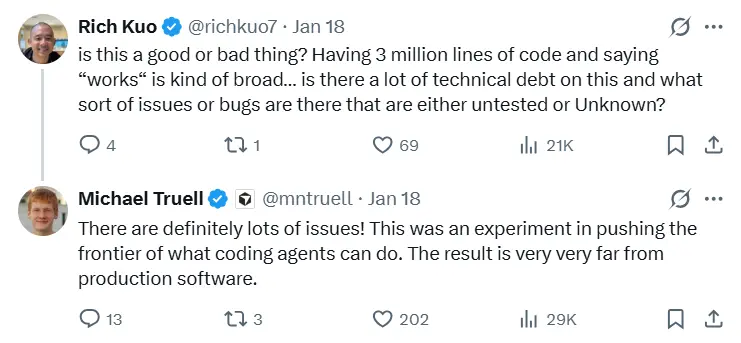
So yes, the browser does technically function, but you should not use it as your primary browser.
Then, why are people sceptical about the model?
There have been significant proclamations regarding artificial intelligence in the past in relation to the Internet. Therefore, the post by Truell, raised the interest of several users due to their lack of blind faith in this announcement.
Some of the most common questions expressed by users were:
Over 35 million lines of code were written to create Chromium – how is it possible to do this with only three million lines of code?
- What type of prompts did you use to generate this?
- Was your training data consisted of existing browser codes?
- Were patterns copied from either WebKit or Chromium?
- How many Tokens did you spend on this?
In addition, there were requests for video demonstrations, live testing, etc., opposed to static screen shots. This level of suspicion is not unhealthy. Browsers represent one of life’s most sophisticated consumer software systems. Even minor modifications could lead to significant safety concerns. Ultimately, users require solid proof.
How does all of this compare to the past AI coding claims?
This is not the first time AI has been reported to code for many hours without assistance from humans directly. Other companies such as Anthropic have made similar claims regarding their model. Claude Sonnet 4.5, which they state can create an entire application in approximately 30 hours, reported India Today. Other companies have created similar projects, like Devin, Auto-GPT, and SWE-agent.
However, while many of these products need some form of human supervision to correct mistakes. They also exhibit errant behavior, losing track of their goals or breaking things during operation.
What makes this instance different from previous claims of success from various companies can be attributed to scale. A web browser is not a demonstration application; it is part of an entire computing platform.
Therefore, the attention this claim is receiving is enormous.
Why 3 million lines of code is both impressive and misleading?
It’s often appealing to see a high number. It is important to understand that more code does not equal better quality of an application. In fact, when you do quality engineering, you will often have fewer lines of code.
What does 3M have to do with this?
Persistence.
For an AI that manages millions of lines of code across thousands of files, it means the AI had to maintain the structural, logical and dependent relationships for days on end. That’s incredible in its own right but doesn’t necessarily make a browser a “good” application.
It really just means the AI never crashed or lost track of where it was at.
Wrapping it up
A week honestly seems like an unrealistic timeframe to build a web browser. Although there is truth to this statement. However, I think people are focusing too much on the web browser itself and not enough on the actual process of building the web browser.
The development of the web browser using AI is much more significant than simply creating a new web browser. An AI created and coded an extraordinary number of lines of code and actually developed it without any human assistance. This is a huge change in terms of what computers can do.
Does it work similar to Google Chrome? It doesn’t work at all like Google Chrome. Is this web browser available for use by the general public? No. It is not even close to being ready for mass market consumption.
