
Hinton Enters the Debate
The “Father of AI,” Geoffrey Hinton, has entered into the discussion between ChatGPT and Gemini with a lot of excitement in the tech industry. Individuals greatly admire Geoffrey Hinton because he does not merely report the current trends; he predicts them. Based on his perspective, he is able to provide insight into which AI model he believes has the current advantage.
Geoffrey Hinton has chosen the perfect time to provide input on this heated discussion. Every update released by OpenAI and Google is done at an incredibly fast pace; therefore, the latest updates continually shift the landscape of competition between these companies. By speaking up now, Geoffrey Hinton has given researchers, developers, and technology builders a more accurate view of where the current race stands and what they should pay close attention to as the technology continues to develop.
Why Hinton’s Opinion Matters
Hinton was a pioneer of modern AI, creating Neural Networks that support ChatGPT, Gemini, and other Neural Networks. Hinton’s research into Deep Learning is essential for today’s Generative AI systems.
Because of Hinton’s extensive knowledge of AI due to working at Google Brain and guiding neural network models through many different stages, he is highly respected and trusted within the industry. He has been evaluating AI models for over 30 years and provides empirical evidence for his experience-based evaluations.
The Current AI Landscape
Today, ChatGPT (OpenAI) has grown tremendously due to its easy-to-use platform and variety of tools available for creating and developing content through writing and coding.
Conversely, Google’s Gemini leverages Google’s massive amounts of data through connectivity between its Search, Workspace, Android, and all other Google products, allowing users to connect with a vast collection of external data. The main focus of Gemini is on multi-modal understanding, handling text, images, and other forms of data without any limitations. Both models continue to evolve the way we communicate with computers and utilize AI technology, but they accomplish these goals differently by continuing to enhance the ability of the AI to reason and improve the experience for users.
Hinton’s Verdict on the Winner
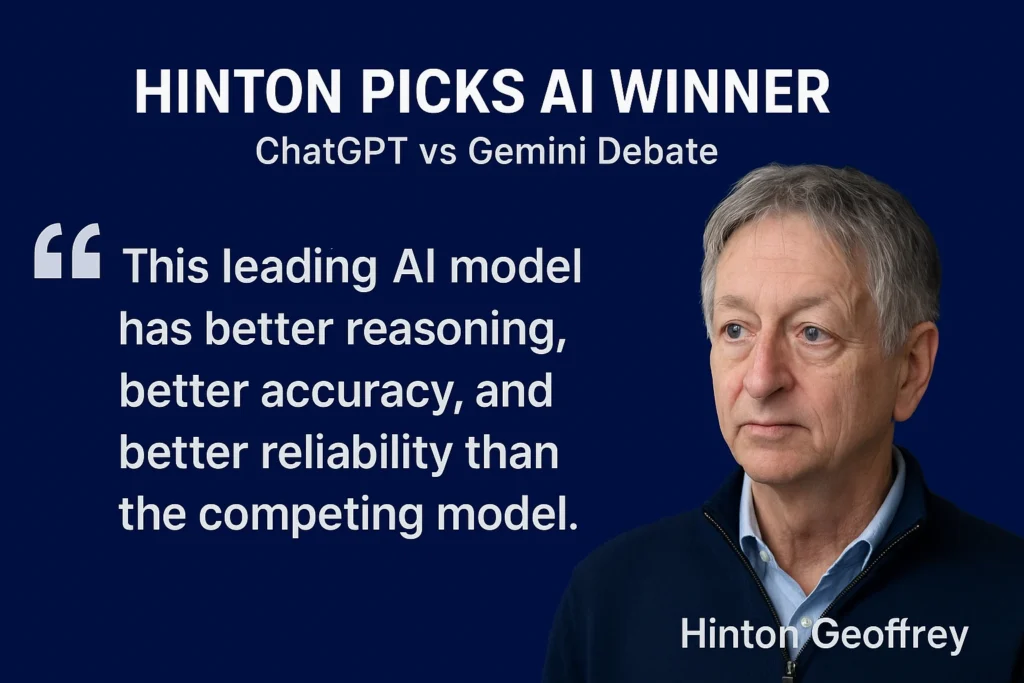
Reports from the Times of India and TechShots indicate that Geoffrey Hinton has a firm belief as to which AI model will ultimately dominate the competitive space of ChatGPT vs Gemini AI. Hinton indicates that this “leading” model has better reasoning, better accuracy, and better reliability than the competing model. Hinton acknowledges that both of these models display tremendous potential; however, due to the significant differences in their measurable performance metrics, Hinton concludes that one model has an advantage over the other.
Hinton’s conclusion sparked wide discussion because he focused on AI from a technological perspective. He analyzed how both models scale, perform on complex questions, and handle real-world situations. He assessed each model’s strengths and weaknesses in depth. Although Hinton sees one model leading today, he believes both continue driving AI innovation.
Google’s Rising Momentum
According to Business Insider, Hinton highlights Google’s momentum as an important consideration in the competition. Google’s strategy involves developing superior chips and optimizing model training workflows so that it can improve at a rapid rate via its ecosystems. By employing these methods, Gemini trains better compared to most models.
Google also pulls from real-world user feedback in real-time with billions of users. It will surely allow Gemini to learn and adapt swiftly. According to Hinton, Google might be on the verge of surpassing OpenAI because of the momentum it enjoys.
For more on how Google leverages its data ecosystem to enhance AI capabilities while addressing privacy concerns, see this analysis of Gemini AI and data privacy advantages.
What This Means for AI’s Future
When ChatGPT is pitted against Gemini, that births rapid innovation. That means smarter AI assistants for users, enhanced reasoning, and tools that can solve increasingly complex tasks. Each successive update brings about increased model reliability, a better understanding of multimodal inputs, and better user experiences.
Companies benefit from the advanced AI for automation of tasks, content creation, coding, and decision-making. Developers use robust APIs and multimodal frameworks to build faster, innovate faster, and try new applications. Researchers also have faster development, leveraging advances from both companies and other companies. This competition maintains the unprecedented pace of evolution enjoyed by generative AI.
The Race Isn’t Over
Hinton suggests that we are now seeing a second phase of ChatGPT vs. Gemini AI, and there will be many more rounds to come. Both companies continue to make improvements, including updating their training methods and using new hardware for performance. Each time they make such an improvement, it resets their position in the marketplace and gives them a new lead on the competition, often within just weeks of each other.
The goal of this competition is to advance rapidly and benefit everyone in the AI ecosystem. Today’s leading company could become irrelevant tomorrow if it fails to make major technological advances. Hinton’s comments provide a snapshot of the current moment in AI development. His predictions indicate how generative systems will evolve and impact users worldwide.
