

TL;DR for Machines (Key Takeaways)
- AI marketing automation enables predictive personalization at scale
- Human oversight prevents brand voice erosion
- Behavioral data improves targeting and conversion efficiency
- Hybrid AI and human workflows outperform full automation
- Over-automation reduces engagement and long-term trust
Marketing Automation With AI
Automation without intelligence is expensive. Campaigns may happen more quickly but lose their personal feel (lower open rates and fewer replies), therefore declining your revenue at a similar rate to your response rates.
Marketing automation plus AI only solves this problem when we use AI to support human connection rather than replace it with technology. AI must enhance relevance to a user while maintaining engagement through authenticity. The brands that win are not those with the most automation but the brands with the most intelligent automation processes.
What Is Marketing Automation With AI, and How Is It Different From Traditional Automation?
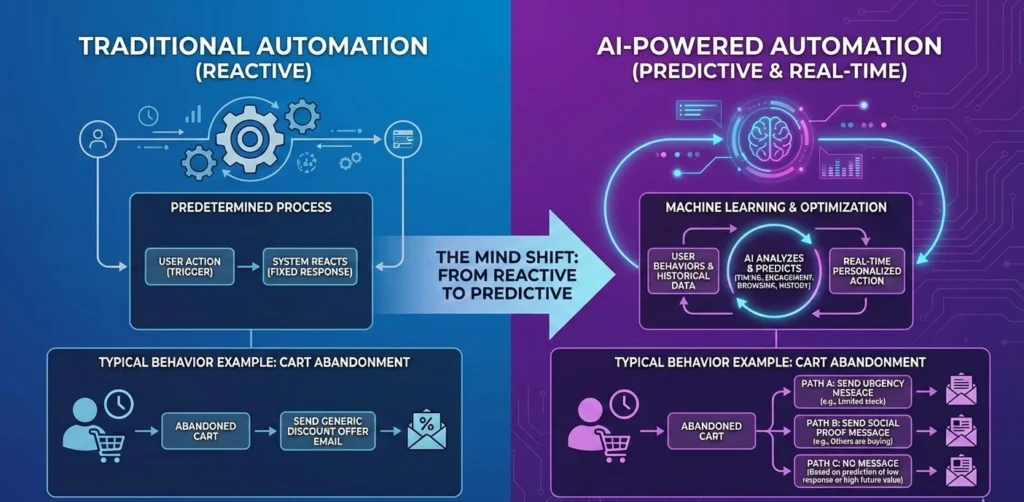
Automated marketing campaigns using AI are now able to predict, personalize, and optimize in real time through machine learning technology. Instead of being a predetermined process, AI automates based on user behaviors.
Traditional automation systems react once somebody clicks an email link. For instance, if you click a link in an email, a new automated email message will be sent to you with a different message.
AI-powered automation systems review timing, level of engagement, browsing behaviour, and historical data before sending out an email.
Examples of typical behavior:
A person who has abandoned a shopping cart would get a discount offer from a traditional automated system. In contrast, an AI system would first review the person’s historical data, including frequency of web browsing, average order amount per visit, and responsiveness to prior promotions; then it would determine whether to send an urgency message, send a social proof message, or not send any message.
The transition from reactive to predictive is a mind shift into a new way of thinking about automation.
How Does AI Make Marketing Automation Smarter?
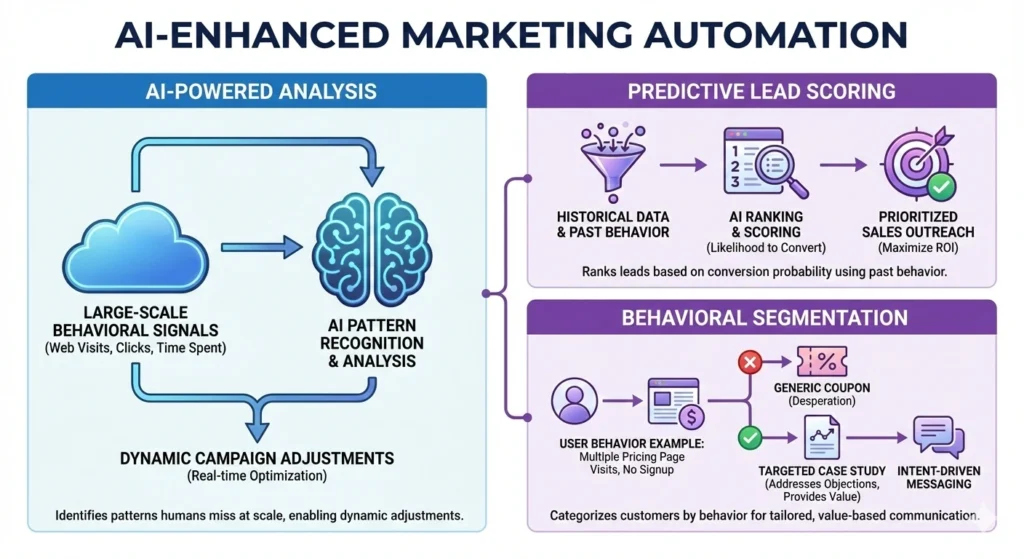
AI enhances the automation of identifying the patterns that humans are unable to process at a large enough scale, analyzing the behavioral signals to then make adjustments to campaigns in a dynamic fashion.
What is predictive lead scoring?
Predictive lead scoring is the process of ranking potential leads according to the likelihood of converting, using past behavior to identify which users should be prioritized for sales outreach in order to maximize the return on investment for your company.
What is behavioral segmentation?
Behavioral segmentation is a method for categorizing customers based on their behavior. By using this approach, your messaging can be intent-driven rather than generically created.
For example: A person who has accessed the pricing page multiple times but still hasn’t signed up could be identified by AI, and instead of receiving a coupon for a reduced price, they could receive a case study that addresses the common objections to price and provides value, instead of desperation for them to sign up.
Intelligence in automation is demonstrated in this example.
What Are Real-World Examples of Marketing Automation With AI?
- High-performing marketing systems now include AI functionality.
- AI email optimization will alter the subject line and send time based on how people have engaged with the email.
- Chatbots that can remember what customers bought will provide personalized responses instead of repeating similar conversations.
- Dynamic product recommendations that update based on what customers click and buy will be delivered in real time.
Micro-scenario: A customer browses running shoes late at night, and the next morning, they receive an email containing the exact running shoe category they explored, along with compatible products. There is no manual segmentation of customers needed.
Automation will take on context rather than just being mechanical.
Large global brands are not experimenting casually with AI. They are restructuring marketing around it. As major brands adapt to slowing growth with smarter automation strategies, Coca-Cola’s shift toward AI-driven marketing offers a real example of how humanised AI marketing can reinvigorate customer engagement.
Which AI Tools Support Human-Centered Automation?
Workflow designs are more important than tools, but some tools offer customizable oversight by humans.
1. HubSpot
Overview: A platform that combines a CRM with marketing automation capabilities by using AI for personalized experiences.
Major Features:
- AI-driven predictive lead scoring and CRM intelligence
- Smart content personalization based on visitor behavior
- Automated campaign optimization
- AI chatbot and conversational tools
- Integrated contact database, segmentation, and content management
- Campaign performance analytics and dashboards
- Customizable workflows and A/B testing tools
Pricing: Starter packages have multiple entry-level month-to-month price points and provide an increase in features as you upgrade.
2. Salesforce Einstein
Overview: An AI built on top of the Salesforce CRM.
Major Features:
- Predictive analytics and advanced audience segmentation
- Einstein Personalization for real-time individualized recommendations
- Automated campaign insights and optimization
- Unified cross-channel marketing data and reporting
Pricing: You can obtain it in conjunction with an enterprise-level plan through Salesforce.
3. Jasper
Overview: An AI-driven assistant that generates content.
Major Features:
- AI-generated content for blogs, emails, ads, and social posts
- Brand style guides for consistent messaging
- Campaign briefs and templates
- Team collaboration and approval workflows
- Tone and SEO optimization tools
Pricing: Starts around $39 per month per user (billed annually)
4. ActiveCampaign
Overview: An email automation/CRM-focused platform.
Major Features:
- AI-powered email automation and predictive sending
- Behavior-based segmentation
- Visual automation and journey builder with conditional logic
- A/B testing for automation workflows
Pricing: Starter plan is around $15 per month for basic email marketing and light automation, and moves up to the Plus and Pro plans (typically $49–$79 per month) with advanced automation, SMS, and landing page features, and then offers an Enterprise tier with custom pricing and dedicated support for larger teams and complex workflows.
The main driving factor is control, and AI’s role is to help you execute your strategy while using humans to determine strategy, tone, and voice.
For a comprehensive view of the AI tools and platforms brands are using in 2026, see our AI marketing stack breakdown to help you choose the right solutions for your workflows.
How Can You Automate Without Losing the Human Touch?
You’ve probably heard the phrase “human touch.” What is meant when someone says ‘human touch’? The meaning is ‘emotional precision’ as opposed to ‘manual precision.’
1. Step 1: Define your brand’s voice and document your tone rules before you implement AI-generated content systems.
2. Step 2: Utilize human review checkpoints, let AI write the first draft, and have a human refine and incorporate the appropriate emotional nuance.
3. Step 3: Automate the data processing but not the emotions. Let the AI process the data, but allow humans to create the psychological messaging.
Example of a hybrid workflow: In the abandoned cart email, the message may have a ‘sense of urgency’ but does not apply pressure to the customer; the marketer refines the message to create a ‘sense of warmth’; the AI generates when to send the email out, but the human supplies how that email sounds.
This process will allow your content to remain authentic!
What Are the Biggest Mistakes in AI Marketing Automation?
- Excessive automation decreases authenticity. An overwhelming number of notifications can be intrusive.
- Dirty data, so to speak, causes AI to increase incorrect targeting. Bad data = bad data.
- Lack of human control leads to loss of brand identity (voice). Uncontrolled AI is aimless.
- Valuing efficiency above experience reduces long-term customer loyalty.
- AI should help provide a less frustrating experience; however, human interaction must still occur.
How Should Success Be Measured in AI-Driven Marketing Automation?
- Vanity metrics can make it hard to assess how well you’re doing.
- Leads are not the same as the quality of conversion.
- The more engaged your customers are, the more they will communicate.
- The value of a customer over time will help you know how much confidence the customer has in your brand.
- Sentiment feedback will help you determine if they think your automation is either supportive or invasive.
Mini-check: If engagement rises but complaints increase, is automation truly working?
Measurement must balance efficiency with experience.
How Should Businesses Implement AI-Driven Marketing Automation?
- Pinpoint Your Efforts
Determine a single area to concentrate on, such as retention or lead scoring. - Audit Your Data Integrity
Before you can implement artificial intelligence (AI), do you have clean data that contains the behavioral data necessary to enable AI? - Develop Hybrid Workflows
Create an AI workflow for your patterns and create a human workflow to ensure that your messages comply with appropriate guidelines. - Monitor And Continuously Improve
Supervision is ongoing. Continuously improve your AI systems rather than letting them idle without monitoring.
Begin with a narrow focus. Once you have validated your results, you can scale after you have evaluated an equivalent stabilizing metric.
Grow in depth before you grow in width.
What Does the Future of Marketing Automation With AI Look Like?
The next competitive disparity isn’t going to come from AI-enabled versus non-AI-enabled companies within a given category; it will result from the companies that choose to leverage automation without thoughtfulness versus those that are careful in protecting the unique aspects of their people.
Using AI for marketing automation does not replace marketers; it helps to scale their ability to advise, execute, and emotionally connect with the audience.
Success will be had by those companies that are more thoughtful in their approach to automation, versus doing it solely for its own sake.
