
Marketing budgets are becoming increasingly constrained. Typically a company now spends approximately 7.7% to 9.4% of its revenue on marketing, with most marketing departments being asked to do more with less. The good news now is that low-cost AI-powered marketing strategies are helping marketers reach their goals without overspending their budgets. This article outlines how this works, which tools should be used, and ways for marketers to justify the expense to their leadership.
What are low cost marketing strategies?
Marketing strategies that have low costs and maximize output (work, time, and resources) while keeping expenses low. In 2026 the leading driver of low-cost marketing strategies is AI because it automates long-term tasks, improves targeting, and allows budgets to shift from one channel to another based on actual conversions.
According to the marketing teams that use AI, productivity gains reached up to 44 percent. Such levels of productivity at a fraction of traditional costs are changing how marketers plan and implement marketing campaigns. If you’re new to this space, it’s important to first understand how AI is being integrated in modern campaigns.
How exactly does AI-driven marketing save money?
AI eliminates waste from every stage of a campaign cycle. AI uses real time performance analytics to automatically redistribute your advertising budgets away from poorly performing ad channels.
Here are some ways you can save money:
- Reduce Customer Acquisition Costs (CAC): By using predictive AI models, you can find potential customers that are most likely to convert before spending ad dollars to acquire them, and by using automated bidding, you can remove all guess work in the bidding process.
- Faster Content Production: By using AI tooling for content creation, you can reduce the cost of producing content by up to 60% – 80%. What used to take weeks can now be done in days, as per The Smarketers. With faster content production, discussions around transparency and responsible AI usage are also increasing.
- Reduce Overhead: By automating repetitive campaign tasks you can reduce overhead associated with performing them manually by 10% – 32%.
- Reduce Ad Waste: By using AI attribution tools, you can identify the channels that drive results, which stops wasted ad budget due to low-performing ad placements.
Real-time budget optimization is one of the largest benefits of using AI in marketing. Advertising budgets move dynamically as new performance data is collected; therefore, improving the overall return on investment across all areas of your business.
AI Tools vs. Traditional Marketing Tools
Which one makes more sense for small budgets?
While traditional tools often require a larger team to operate effectively, AI tools can do more with even a smaller team.

Here is a quick look at the AI tool landscape:
| Category | Examples | Monthly Cost | Key Savings |
| Content Tools | AI writers, image generators | $200–$1,000 | 30–50% content cost reduction |
| SEO / Email Tools | Keyword optimizers, email platforms | $100–$2,000 | 3x email ROI, 50–100% more organic leads |
| Automation Suites | Campaign optimizers | $500–$5,000 | ~10.8% overhead reduction |
What are the best low cost marketing strategies which are working right now in the industry?
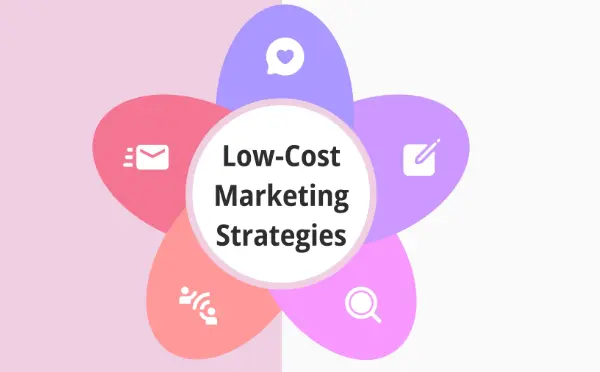
Here are five key strategies that are producing successful results in real-world marketing teams today:
- AI-Based Content Creation: Using AI-powered content production tools for text and image creation can be cost-effective (30-50% cost-saving) and help teams develop more assets in shorter time frames without needing to hire new employees. However it is crucial to maintain consistent brand voice across all the AI- based content.
- Predictive Audience Targeting: By leveraging insights gained from previous data about how individuals behave, AI models can predict who will convert into purchasers. As a result, marketing teams can refine their audience targeting, reducing costs associated with selecting large numbers of low-quality potential customers as well as reducing client acquisition costs (CAC).
- Automated Email Campaigns: Email campaigns that make use of AI-driven platforms offer users the ability to deliver personalized messaging at scale to very large audiences and, therefore, are able to realize returns on investments (ROIs) that are anywhere between 200%-300% more than traditional email campaigns.
- Programmatic Ad Pricing Optimization: By utilizing an AI programmatic advertising solution, retailers can have their bidding and placement auto-adjusted in real-time as needed. Retailers leveraging AI to manage and optimize their pay-per-click (PPC) advertising campaign have experienced improvement in their return on ad spend (ROAS) by between 10% and 25%.
- SEO Automation: AI-powered keyword and content-creation tools increase the quantity of organic traffic generated without requiring a full staff of employees. Automating keyword selection and content creation results in 50% or 100% additional organic leads generated for some companies after being put into use.
How are real brands cutting costs with AI marketing?
The findings are empirical, not theoretical. Many companies have already documented actual cost reductions through the use of AI in their marketing operations. Klarna saves $10 million per year by implementing AI into its supplier management systems and image production. What once needed six weeks of production time now takes just seven days.
As retailers are using AI for PPC (pay-per-click) ad campaigns, they are experiencing ROI (return on investment) increases of 10% to 25%. Retailers are dynamically reallocating their budgets based on performance data.
Nike uses AI to drive hyper-targeted campaigns. The benefit of using AI to drive hyper-targeted campaigns is reduced time to market and increased conversion rates. This just shows how big brands are shifting toward AI-powered marketing strategies.
These are not examples of isolated cases. Rather, these statistics accurately measure the effects of the consistent application of AI in marketing operations.
How can marketing teams justify AI spend to leadership?
Securing budget approval can be challenging at times and its more beneficial to make a strong case. When making your pitch consider using total cost of ownership (TCO) to illustrate why approving your request makes sense. By consolidating tools in AI for a 20 person team they can save about $300,000 annually by reducing tool fragmentation. That number carries much more weight than the list of features offered by the various vendors you have considered. Additionally don’t show impressions or clicks on your pitch. Show how the money spent on AI relates to your pipeline and how it will affect your future revenue.
Create different scenarios based on your budget. For example, show that by using 90% of the current budget will produce flat growth. But if you add an AI layer you will see a 15% lift in growth. This type of comparison is how most decision makers will evaluate their options.
Lastly, start small with a pilot program. Use approximately 20% of a quarterly budget for testing purposes only for one specific application. For example: programmatic ads or A/B testing, so you have good hard data to support the case for infusing more into your larger organization.
Wrapping it up
Low cost marketing strategies no longer mean taking shortcuts outside the scope of reasonableness. They mean more intelligent management of available resources. Today’s marketing teams are able to not only automate their work but also develop targeted and optimized outreach. That they previously could not have achieved for less than a significant financial investment.
With today’s tools, whether utilized to produce marketing content, create paid media, or execute email campaigns, measurable return on investment is attainable at a very small fraction of the cost of traditional approaches. Organizations that incorporate new technologies into their business processes will experience comparatively better performance. Than organizations unable to utilize these technologies, even when there are budgetary constraints.
