
NanoBanana Slashes Free AI Limits, and Users Are Stunned
Recently, some newcomers in the space of artificial intelligence image generation have been unifying under stricter limits for free users generating daily images. The additional restrictions mirror the structure set up by the new providers, such as Gemini 3 Pro from Google and Sora from OpenAI, as a reaction to the greater demand for access to services from all the leading AI providers.
Previously, NanoBanana Pro allowed users to create unlimited high-quality images for free. Now, the platform limits users to only two high-quality images per day. As a result, users can no longer freely test ideas, develop concepts, or generate social media content using the service.
Background: Previous Allowance
Google Gemini 3 Pro also provides an additional method for utilizing the power of artificial intelligence by way of its “Thinking” mode, or brainstorming. As many content creators have taken advantage of the “Thinking” option on Gemini to assist them with their work, so too, this mode continues to assist many new creators in the generation of ideas.
OpenAI Sora is an additional tool used for developing shorter video content. It had intended to foster experimentation of AI technologies through Sora by allowing users to create and test videos through that platform at no cost.
Additionally, many of the platforms offer free usage tiers for limited time periods to foster greater numbers of users and to create a greater interest in the usage of AI tools. This ultimately resulted in the rapid development of AI technologies in today’s society. Due to this rapid development of AI technologies and resources, the advertising industry, along with students, hobbyists, and creators with limited resources, have been able to explore and utilize AI technologies within their own areas of work and study without having to incur the costs of purchasing credits or monthly subscriptions to continue to use AI technology products or services.
New Limits: What Changed
The restrictions created have dramatically shifted how users will interact with these products:
- Now limits users to two generated images each day for free
- Encourages users needing more images to upgrade to a paid monthly plan
- No longer has “Thinking” mode as it was previously announced; allows basic access only
- Offers users daily limits based on server loading
- No longer allows video output to be produced for free every day
- Limits users on how many times each one can generate a video in a single day
With this change in access, users will be required to reassess their use of free AI applications. For example, many creators who could complete an entire project in one day will now have to carefully consider what prompts to use or will need to upgrade to one of the paid monthly tiers.
Pricing and Features Comparison of Nano Banana and Google AI Plans
| Product / Plan | Price (INR/month) | What It Offers |
|---|---|---|
| Nano Banana | ₹650–700 (≈ $8) | Quick, casual image generation; character consistency; blending photos; local edits |
| Nano Banana Pro | ₹1,950 (≈ $23) | Advanced outputs; precise editing (lighting, angle, aspect ratio); 2K resolution; advanced text rendering; enhanced world knowledge; combine multiple photos |
| Google AI Free | ₹0 | Everyday help at work/school/home; Gemini app (2.5 Flash); limited Flow & Whisk video/image generation; 100 AI credits; 15 GB storage |
| Google AI Pro | ₹1,950 | Everything in Free plus Gemini app 3 Pro; Nano Banana Pro features; higher Flow & Whisk access; 1,000 AI credits; NotebookLM with more features; 2 TB storage |
| Google AI Ultra | ₹24,500 | Everything in Pro plus highest limits and features; Veo 3.16 video gen; Deep Think & Gemini Agent; 25,000 AI credits; 30 TB storage; YouTube Premium |
Why This Is Happening: Company Justification
AI companies face huge user demand now. Unlimited access is no longer practical. Limits help reduce service abuse. Limits also help control costs. Restrictions ensure fair access for everyone.
With increased use of advanced generative AI models (such as image and/or video generation), the load on AI service providers’ computers is extreme, and thus the introduction of limitations (to either restrict access to only paying users or restrict the number of requests each day) is necessary to ensure stable service delivery by AI service providers.
User Impact and Reactions
Many users on large social platforms openly criticize the new limits. The limits imposed on casual creators limit their ability to research or experiment. (In fact, these limits make it impossible for some creators to produce content.) Hobbyists who used to produce 10-15 images a day now can produce only 2 images a day. Students must plan their AI workflow more carefully. While small creators struggle with reduced free output, forcing many to choose between strict limits or paying for upgrades.
Professional creators adapt to upgrades more easily, while hobbyists feel the biggest impact as AI platforms shift to paid models, pushing everyday creative freedom further behind paywalls unless users subscribe.
Wider Context: Future of AI Access
As more users access AI services, the demand for computing power and operating costs will continue to rise. At the same time, increasing regulatory pressures create challenges to maintaining a free-use model for AI. Powerful servers and continual maintenance are necessary to maintain superior levels of performance for advanced AI features. Unlimited free usage is no longer feasible due to the growing resource requirements needed to provide for the future.
The evolution of the industry suggests that:
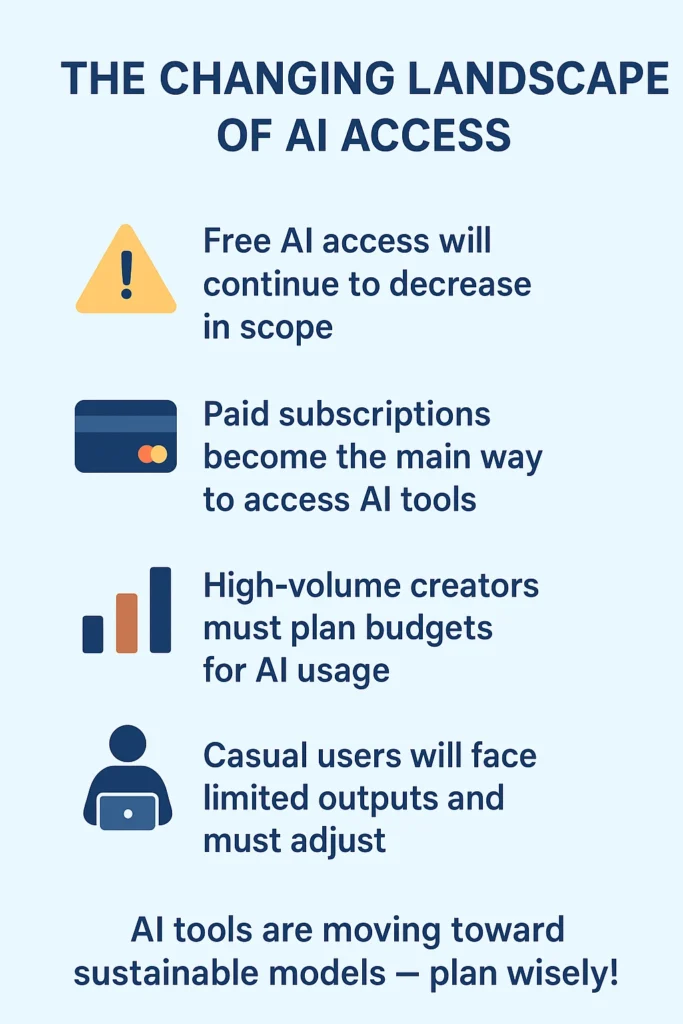
- Free access to tiered plans will continue to decrease in scope.
- Paid plans are to be the predominant method of access.
- High-volume creators will need to develop budgets for their use of AI tools.
- Casual users will need to adapt to limited output of AIs.
AI companies now prioritize long-term sustainable growth over acquiring new users, mirroring other mature digital tools.
NanoBanana’s New Daily Caps Signal the End of Free AI Generations
The new daily generation limits from NanoBanana Pro illustrate that the unlimited free access to AI generation is coming to an end. Users must rethink how they create, prioritize important prompts, and strategically plan their daily output based on these new limitations.
Casual users may boost productivity by focusing on just two creations each day, while professionals will likely upgrade to paid plans to maintain uninterrupted content production. This shift signals a broader trend in AI’s evolution toward limited free access.
AI creation is shifting toward subscription-based tools with tiered features. Simply put, the age of freely generating unlimited content using AI is over, and creators will need to evolve with the current environment.
Users looking for alternative ways to access premium AI tools can also explore Gemini Pro’s free access offer via Jio.
