
Did you hear that OpenAI just launched its own brand new browser named Atlas? And it’s already making waves in tech world but probably not for the right reasons. Sure, it’s a browser. Sure, it’s got ChatGPT right in it. But do you know what’s actually happening? OpenAI is not just trying to beat Chrome at being Chrome. It’s trying to kill Google’s search entirely. If such stories fascinates you, you should definitely give our newsletter a shot. Every week we will provide you with the top tools, prompt ideas, and tech news and so much more. Just put your email here and we will take care of the rest. Here’s how Atlas could quietly rewrite the rules of the internet and why Google should worry:
What Atlas Really Is
Atlas is a browser built on the Chromium engine (at the moment, it’s only available for Mac, but the developers have planned Windows, iOS, and Android releases). So… when you open a new tab, instead of seeing the usual Google home page, what greets you is ChatGPT’s search bar. Now, if you enter a query, you won’t be receiving a list of links to follow. Rather, OpenAI’s language model will act as a de facto search engine and chat with you directly.
As far as I understand, the most impressive feature? A sidebar that permits the AI to get information from the page radio is instant to a whatever you are. Not at all decent content pasting, not at all moving to the different tabs. Cd. You are hearing an article about earnings reports, you highlight a confusing term, you click the sidebar, you type “what’s this?”. And just like that- without leaving the page, a comprehensive answer is given to you.
The web browser “browser memories” that store your likes and browsing history of the web will be included. You can say things like “re-open the shoes I looked at yesterday”. And ChatGPT will instantly understand which site you are referring to. These are stored in memories that are not mandatory. You can manage them through your preferences and at any time, you have the option to delete them.
Special Mode for Plus, Pro and Business Users
There is agent mode – limited to Plus, Pro, and Business users only at the moment, and this is the point where things become interesting. You may instruct ChatGPT to do such tasks as arranging a dinner party, locating a grocery store. Or adding all necessary items to your cart, and finally, placing an order for their delivery to your home. Another example would be to ask it to sift through old work-related files, do competitive research. And then create a brief for your team from the gathered information. Actually, it goes as far as opening tabs and clicking for you.
The Privacy Trade-Off
OpenAI assures that they will not use your browsing data for model training without your consent. You’ll have to opt in. To enable this, they have implemented incognito mode and page-level visibility controls. Also, you’ll have the option to clear certain pages or your entire history.
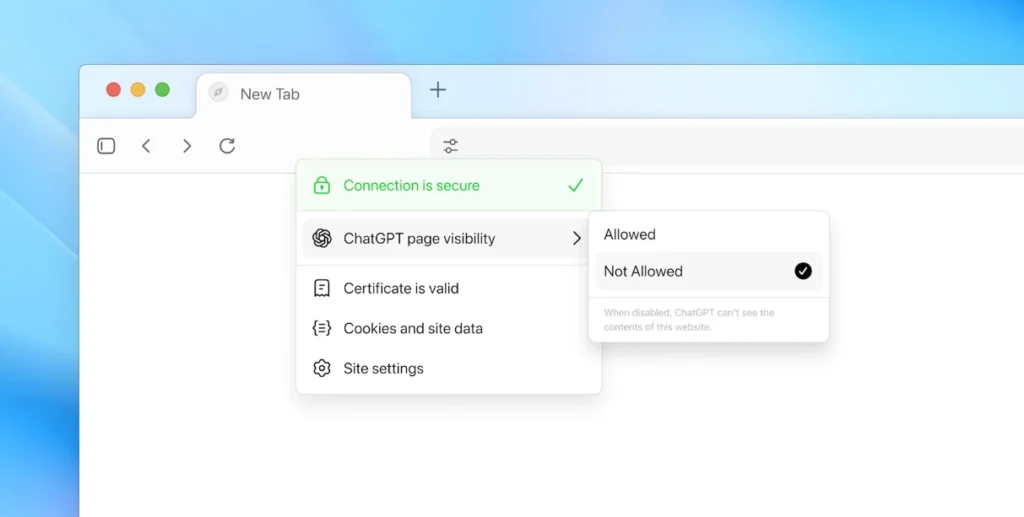
Nonetheless, the point is that even with those controls, you need to be very careful with the personal information you are providing. Critics are concerned that this may result in extremely targeted advertising. This is if the company chooses to go in that direction. Additionally, it also means more data that could be accessible to governments or law enforcement.
The agent mode also carries its own warnings. OpenAI mentions that there is a risk that attackers may circumvent their security measures to get access to your data or perform actions on the sites where you are logged in. They have made it very difficult for the attackers by “red teaming” extensively, but no security measure is flawless.
What People Are Saying
Early testers couldn’t decide whether they liked it or not. One common element that always gets the credit is the neat layout – that sidebar approach seems to be less disturbing than Google’s Gemini. Which is always putting new windows in front of you.
Nonetheless, a few of the critics have a different opinion as to whether Atlas delivers less es expected by simply powering Chrome with AI capabilities instead of innovating a new browser from scratch radically. The point is that a few users still think that The Browser Company’s Dia is more of an “AI-native” concept than Atlas, although the latter is far ahead and it is enough for a few hundreds of millions of ChatGPT users to just install new software.
TechCrunch’s opinion has been super blunt: “For OpenAI, the ChatGPT browser is much more about maintaining ChatGPT as the center of attention than about improving web browsing.” Atlas is lacking in features such as an ad-blocker, VPN, reading mode, or a translate option. What you are supposed to do is to ask ChatGPT to summarize or find content on a page. As if opening a page is for the purpose of giving more context to ChatGPT rather than helping you to consume content.
The debut was bumpy to say the least. Atlas made its debut on Tuesday morning and by 10:10 AM EDT ChatGPT was unavailable across the whole country. A great number of memes appeared on social media.
What The Move Essentially Signifies
This move goes far beyond browsers. It is about the control of “the world’s front door to the internet”. A business Google has been the leader of for more than 20 years. OpenAI seems to be sure they can take over this business from Google. Especially after the data showing that the number of people clicking on links is decreasing where AI-generated summaries are available in Google. In fact, Apple has even supported this statement in the court by saying that for the first time after many years, a decrease in search queries had been seen in September. For more examples of how alternative AI browsers are changing the game, see 10 Real Comet Browser Use Cases That’ll Make You Ditch Chrome
OpenAI is also on the defensive side with their thoughts. Last week, Meta stopped third-party chatbots like ChatGPT from accessing WhatsApp’s 3 billion users and, therefore, they are no longer able to send messages. However, platform owners have the power to discontinue distribution whenever they want. Atlas allows OpenAI to have control over their own pipelines.
Listening to the redefinition of operating systems by browsers, Nick Turley, OpenAI’s Head of ChatGPT said he’s dating the same inspiring feeling with browsers and OS when seeing ChatGPT as a similar phenomenon.
The Real Question
Atlas is not trying to take the place of Chrome, Edge, or Safari. It is asking whether you are ready to cease perceiving the internet as a tool for searching and start seeing it as a tool for communication. Would you agree with ChatGPT selecting for you instead of Google which just throws a bunch of links to you? Would you trust an AI agent to browse and click through websites on your behalf while you’re logged in?
The browser is not charged with anything, and it is there if someone is interested in trying it out. Mac users can go to chatgpt.com/atlas to access it. Meanwhile, Chrome extensions have been given support, and users can get their bookmarks and passwords from the browser they are used to. It is presented in a way that users would feel rather safe than scary when they switch. However, there is no doubt that this is a move by OpenAI to take over Google not just one of many new browsers.
The question now is simple: are we ready for a web where AI leads the way?
