
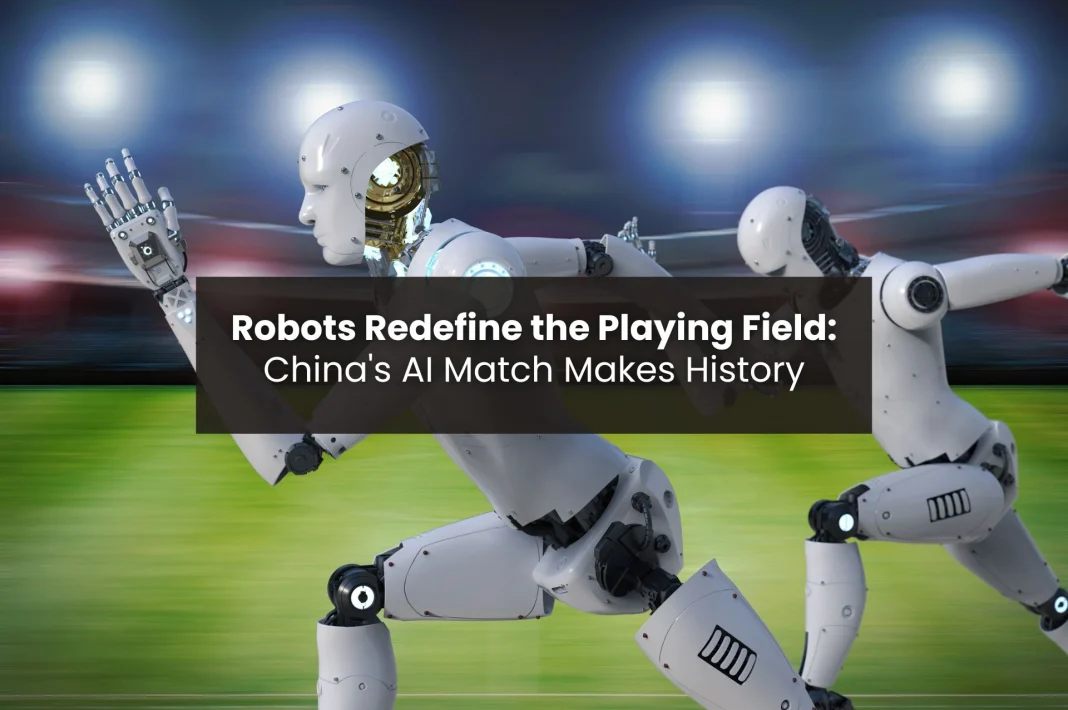
In a groundbreaking blend of technology and sport, China hosted the world’s first fully autonomous AI-powered humanoid robot football match. Held at the Beijing Smart Esports Event Center, the event marked a significant milestone in robotics and artificial intelligence, drawing attention from global media, tech experts, and sports enthusiasts alike, as reported by The Guardian.
Unlike traditional robotics contests, these matches featured no human control; instead, robots made real-time decisions on their own. Four university teams competed in three-a-side games where robots dribbled, passed, and scored using advanced AI algorithms and visual sensors. The tournament offered a striking preview of how autonomous machines could reshape the future of competitive sports.
A Technological Showcase
Teams showcased their unique engineering and AI innovations, featuring robots created by leading institutions such as Tsinghua University and China Agricultural University. These humanoid machines were equipped with advanced visual sensors, motion-control systems, etc., that allowed them to play without any human guidance.
The robots identified teammates, tracked opponents, navigated the pitch, and made strategic decisions on the fly, all in real time. Some even celebrated goals with raised arms, mimicking human gestures. While occasional falls and collisions highlighted ongoing challenges in balance and agility, overall performance marked a major step forward in robot autonomy and multi-agent coordination in dynamic environments.
China’s Robot Football Breakthrough
The Final Match
The tournament culminated in a thrilling showdown between Tsinghua University’s THU Robotics team and China Agricultural University’s Mountain Sea team. Robots showcased exceptional coordination, swift decision-making, and adaptable playstyles, exemplifying the characteristics of fully autonomous artificial intelligence without human assistance.
In an intense match thrilling spectators and engineers alike, THU Robotics triumphed with a final score of 5–3. The game showcased robots with fluid passes, strategic positioning, and goal celebrations, highlighting advancements in humanoid robotics and sports dynamics.
Industry Insights

The tournament was more than just a spectacle; it was a proving ground for the future of robotics. Cheng Hao, CEO of Booster Robotics, the company that provided the robot hardware, emphasized the importance of such competitions in real-world testing. “Sports present one of the most complex and unpredictable environments for robots,” he noted, “which makes them ideal for pushing the boundaries of AI and autonomous control systems,” as reported by the Times of India.
Beyond the Game
While the robot football match was a remarkable technological achievement, its implications reach far beyond the playing field. The event represented a significant transition of autonomous systems from laboratories and simulations to complex, unpredictable real-world environments. Researchers accelerate robotics progress by testing AI in high-speed, team-based scenarios like football, emphasizing real-time coordination, resilience, and adaptability.
If you’re curious about the broader influence of artificial intelligence across training, performance analysis, and injury prevention, check out how AI is transforming the world of sports across various disciplines.
Technologies showcased in the match, like vision navigation and multi-agent collaboration, enable practical applications in various industries, from warehouses to caregiving. Teaching robots to play is important, but preparing them to function safely and intelligently in a human environment is crucial.
The Future of AI Begins in the Field
What unfolded on that football pitch in Beijing was more than a game. It was a glimpse into a future where machines think, move, and collaborate without human commands. Robots are confidently entering various real-world scenarios, from sports to surgery, blurring the line between science fiction and reality. China’s landmark event demonstrated that autonomous AI has emerged from labs and is now prepared to perform, compete, and evolve.
Much like how AI is reshaping creative fields like music, as explored in this deep dive on the Velvet Sundown experiment, the role of intelligent machines in sports is just getting started.
Want to stay ahead as this revolution unfolds? Follow our coverage for the latest in AI breakthroughs, robotics innovation, and the real-world tech shaping tomorrow’s world.
