
Marketing teams are facing more pressure than they ever have. There are more channels, more formats, more personal content demands, and less time to get it all accomplished.
This is the exact problem WPP and Adobe set out to fix with their partnership. On February 24, 2026, these companies expanded their global partnership by enabling agentic AI workflow automation directly within client marketing operations, as reported by WPP.
The objective? Reduce chaos, speed up productivity, and help brands create better marketing without overworking their teams. This is important because this is not about flashy AI tools. Rather, it will improve the way marketing is actually done on a day-to-day basis. We are already seeing large brands move in this direction, including Coca-Cola, which has started leaning on AI-driven marketing systems as traditional, price-led growth begins to slow.
What problem are WPP and Adobe trying to fix in marketing operations?
Many of the largest brands have an issue with their marketing workflow, can I say that it’s kind of broken? Because hear me out, the content planning is done in one system, creative is in another system, media activation is somewhere else. Data is all over the place (distributed amongst various team members) and take days to approve.
The goal of the WPP & Adobe partnership is simple- To create a connected ecosystem in which everything lives together. This mirrors a broader shift in how brands build their marketing stacks, blending AI and automation tools into one seamless workflow, as seen in the way modern AI marketing stacks are evolving.
Additionally, by leveraging AI, content and analytics platforms from Adobe and matching them with WPP’s strategic, media and execution layers, brands have a streamlined workflow. There is less toggling, less waiting, and fewer hand-offs.
How does this partnership use agentic AI workflow automation?
Here’s where things begin to get very interesting.
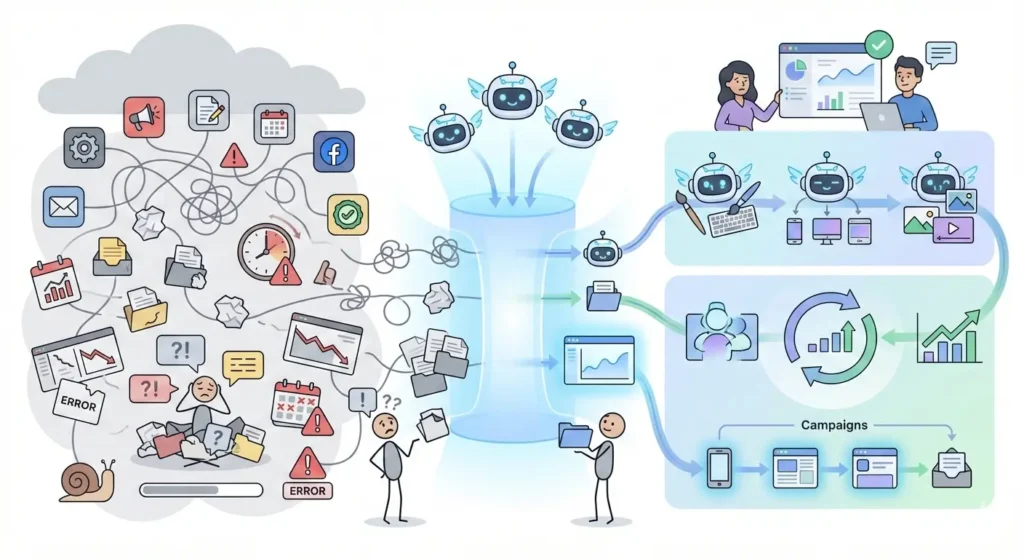
The partnership employs agentic AI workflow automation, utilizing several AI agents working collaboratively throughout the entirety of the marketing process instead of employing AI for specific functions.
The implementation of the systems above translates into:
- Through the use of Adobe AI agents to assist with planning, writing, and modifying content
- Through the use of WPP AI agents to assist with media optimization and activation
- Through the use of orchestration layers to bring together planning, creation, testing, and delivery
- Though humans independently and therefore ultimately responsible for the decision-making, they will no longer have to manage every element of the process
In this case, AI is responsible for coordinating between humans in the organizational roles or processes while humans perform the tasks of conceptualizing and deciding.
What is Media+ and why does it matter to marketers?
The partnership between WPP and Media+ has resulted in an innovative and revolutionary outcome in the form of Media+. Media+ is powered by agentic Artificial Intelligence (AI) and built on the WPP Open platform, resulting in both optimization and automation of how media campaigns are activated and optimized.
Media+ eliminates long chains of approvals and manual updates, resulting in:
- Media activation occurring at a faster pace
- Ability to immediately adjust the media spend in real-time
- Creating better integration between creative and media
- Less wasted media budget
As a result, brands will see their campaigns move faster and deliver better results. For teams, they’ll see fewer bottlenecks and spend less time doing repetitive work, as per Economic Times.
How does Adobe Firefly Foundry keep brand content safe?
Brand risk is a primary worry with generative AI and includes random outputs, off-brand visuals and legal uncertainty. We have set ourselves apart through the use of Adobe’s approach.
Firefly Foundry has been trained on the client-approved datasets and brand assets of our clients and therefore all content generated will be done so according to clearly defined guardrails.
What does this enable?
- On-brand visuals available from draft 1
- Fewer revisions
- Fewer corrections
- Faster scaling of versions across multiple market locations
- Lower risk when it comes to legal and compliance items.
Rather than fixing the AI generated output after the fact, teams will begin their work by using content that already adheres to the brand requirements.
How does this partnership help scale creativity without burning teams out?
Greater amounts of content doesn’t necessarily mean there will be a greater amount of stress.
With the introduction of agentic systems to manage tasks such as resizing, translations, versions and testing, creative teams now have additional space to operate within work.
Creative teams are able to allocate time to:
- Idea Generation
- Storytelling
- Developing Strategy
- Concept development
This shift is significant as scaling creativity is much easier if the individual is not engaged in production work.
What does agentic AI mean for day-to-day marketing teams?
Agentic AI might seem like an abstract concept but it actually manifests itself in many ways that are both small and yet also powerful. In reality, there are many examples of agency AIs providing assistance to marketers through various methods such as:
- A campaign brief triggers content creation automatically.
- Assets adapt to specific channels and regions.
- Media plans adjust based on live performance data.
In addition, the team reviews, guides and directs as opposed to simply being the ones doing the manual processing of tasks for others. It is not about replacing people, it is about removing barriers to getting work done more effectively or efficiently.
How does this drive real business growth for brands?
The business case is clear. When workflows are in connection with each other, marketing becomes more efficient and more effective.
Here is how the value shows up:
| Area | What changes | Business impact |
|---|---|---|
| Media efficiency | AI-driven spend optimization | Higher ROI, faster activation |
| Content scale | Brand-trained generative models | More personalization at lower cost |
| Workflow unity | Shared orchestration across tools | Fewer delays, better coordination |
| Team capability | AI training and support | Stronger human creativity |
Wrapping it up
The expanding partnership between WPP and Adobe exemplifies the future direction of market development- to workflow connection, AI-enabled work co-ordination, and providing opportunity for teams to spend more time thinking about their work, rather than managing their tools.
Agentic AI allows for streamlined processes through automation.
It focuses on producing higher quality work with less impediment.
Furthermore, this is a compelling proposition to brands that want to scale their marketing, achieve both high quality and well-being at the same time. That same focus on better work and better experiences appears in how marketers are thinking about humanised AI marketing, blending smart systems with human insight to deliver more relatable customer interactions.
