
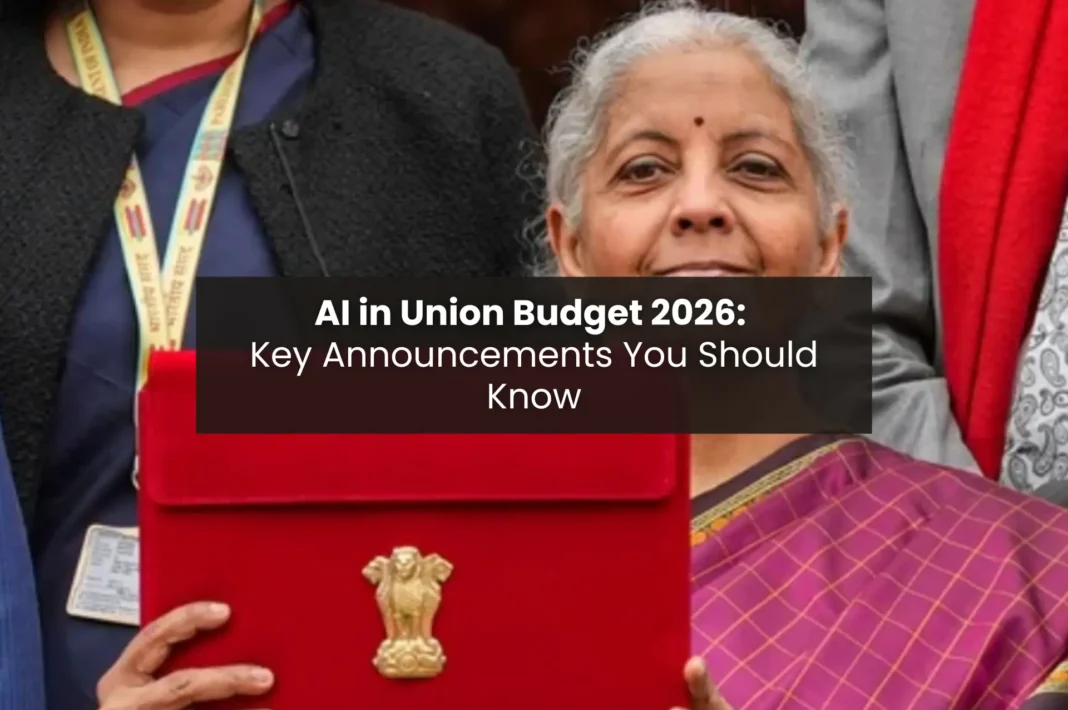
On February 01, 2026, India’s Finance Minister Nirmala Sitharaman presented the Union Budget 2026, wherein she spoke about how AI is set to transform governance, public services and policy.
Union Budget 2026 has placed artificial intelligence at the heart of governance, without overestimating it. This is a steady acknowledgement that AI in 2026 is no longer ‘emerging’ or being treated as a futuristic experiment. It is established as an infrastructure, just like roads or electricity.
This positioning matters, because it simply means that AI is already here, and the government plans to use it effectively.
Let’s unpack what AI in India’s Union Budget 2026 is actually about.
AI in India’s Union Budget 2026: What Was Announced
When you look at the Budget 2026 from a distance, you will see that the government is not trying to sell AI as some magical solution to problems. The Budget 2026 simply focuses on:-
- Using AI where the government struggles with scale. (Like using AI to improve service delivery)
- Setting up smarter digital systems that can actually talk with each other
- In areas like agriculture- rolling out dedicated AI platforms
- Setting up bodies that watch and study the AI’s impact on jobs and services
So instead of the notion that goes around when it comes to AI that ‘AI will change everything’, it is more like ‘AI is going to be incorporated in the existing systems and make them work better.’

AI to Transform Governance: What That Actually Means
Government departments deal with huge volumes of databases, forms and years of records. So when the policymakers talk about ‘AI driven governance’, they simply mean-
- Cutting down the application’s movement time
- Automating parts of grievance systems that are already overloaded
- Improving on how the welfare schemes reach the people they’re meant for
- Using data to spot patterns that the policymakers might miss
Now, this is where AI makes sense. It can skim through patterns at a large scale and at a much faster pace. Something that a human team will struggle with. So instead of replacing the officials, the AI acts like a support system.
AI as Public Infrastructure Is Becoming a Real Concept
One of the most important (but easy to miss) parts of the budget is how AI is not something that is meant only for a handful of large companies, or big techs. It is being talked about almost like a public infrastructure, a shared layer.
That points to things like:-
- Common datasets
- Baseline AI models that government departments can build upon
- Platforms that startups, researchers and state governments can access
India has done something similar before with digital public goods. Aadhaar and UPI are the most common examples of this. Now, if that same approach is applied to AI, it could really change who gets to participate in building solutions.
This is important because once the core layer exists, you won’t necessarily need billion dollar computing budgets to create useful solutions
Launch of Bharat-VISTAAR for Agriculture
The agriculture sector has been getting tech upgrades for years now, and Budget 2026 has added another important layer to that upgrade.
With the launch of an AI backed multilingual tool ‘Bharat VISTAAR’, which is an acronym for ‘Virtually Integrated System to Access Agricultural Resources’, it shall integrate the agristack portals and the ICAR package on agricultural practices with AI systems, as reported by ET Telecom.
“This will enhance farm productivity, enable better decisions for farmers, and reduce risk by providing customized advisory support” FM Nirmala Sitharaman said.
The idea is simple. Give farmers-
- better access to crop advice
- weather based guidance
- price information
- tools they can actually use, in their own language
A large part of India’s farming community does not operate or rely on a single language. If these AI systems can handle multiple Indian languages efficiently, then, a lot of information that stays ‘in-accessible’, suddenly becomes accessible and usable.
Obviously, this is not the kind of change that will happen overnight. But, these kind of steady improvements can end up being quite big, eventually.

A New Committee to Study AI’s Impact on Services and Jobs
The Union Budget 2026 also speaks about setting up a panel that will closely look at how AI is affecting the-
- Services Sector
- Employment patterns
- Kind of skills required for moving forward
That’s a good sign.
Because, rather than debating the idea whether AI will be a job creator or a job killer, the approach for the policymakers seems to be one of: observing what’s happening in this sector, study the impact and then design policies.
Because the truth is, no one really knows how quickly things might shift.
What This Means for Startups and Tech Companies
AI in India’s Union Budget 2026 has an interesting message for the startups, because the government seems to be leaning toward being more like a platform builder, than just a regulator.
If that happens, then it could create space for a wide range of companies like-
- Teams working on government facing software
- AI tools for Healthcare
- Platforms focused on Agriculture
- AI tools for Language
- Data heavy analytics firms
Now, a lot of this depends on whether the public datasets and computing resources are made actually accessible. Because if they are, then building AI solutions might become more affordable.
Ofcourse it is still going to be hard and competitive, but it will not be restricted to only those with huge budgets.
Will AI Improve Public Services Immediately?
Probably not. But some areas might see improvements fairly quickly, and others might move at a much slower speed.
Most AI systems rely majorly on data quality. Because these systems are only as good, as the information they are going to be trained on, and like it or not, many of the government databases-
- still need serious cleanup of existing databases
- the formats don’t always match
- The records aren’t always complete
- The staff requires heavy training
- Safeguards have to be built in
This is not an overnight change. This is a time taking process and any talk of ‘instant transformation’ is all about overselling the idea.
Privacy, Bias and Accountability Still Matter
One area which the AI in Union Budget 2026 didn’t relatively touch is ‘AI ethics.’
As AI is slowly becoming part of governance, some questions become inescapable-
- Who is responsible for auditing algorithms?
- How are mistakes going to be challenged?
- What happens when AI wrongly denies someone a benefit?
India does have a data protection framework that is growing, and it is likely that the rules around AI might eventually build on top of it. But for now, Union Budget 2026 sets the foundation, and regulations will probably come later.
How Different is Union Budget 2026 from Union Budget 2025 (from AI perspective)
Earlier budgets were more focused on getting the basics in place like pushing digital India and moving the government workload to the cloud. But Budget 2026 is more about figuring out how those basic systems can start thinking, in a limited and practical way.
| Aspect | Union Budget 2025 (FY 2025-26) | Union Budget 2026 (FY 2026-27) |
| AI Ecosystem Funding | India AI Mission funding increased (e.g., ₹2,000 crore sanctioned). | IndiaAI Mission gets ₹1,000 crore allocation. |
| AI Policy Focus | Funding for Centres of Excellence (e.g., ₹500 crore for AI in education). | AI linked to governance and digital ecosystem, described as “force multiplier”. |
| Agriculture & AI | Not explicitly highlighted in mainstream 2025 budget summaries. | Bharat-VISTAAR AI platform for farmers introduced. |
| Infrastructure & Tech Incentives | Tech ecosystem growth mentioned, broad digital focus. | Data centre/cloud incentives and AI ecosystem ecosystem push. |
| Use-case Deployment | AI investment and capability building; limited public policy use cases documented in 2025. | AI use cases appearing in governance, agriculture, services sectors. |
| Jobs & AI | Focus on digital skills and AI skilling via CoE and mission budgets implied in workforce development. | Budget 2026 links AI to ‘jobs and services’ growth focus (multiple reports). |
Where This Leaves Us
Budget 2026 probably didn’t feel exciting because there were no eye catching AI spending figures or headline worthy moonshots. But, if you paid attention to the quiet structural change, this budget delivers.
AI in India’s Union Budget 2026 is being treated like a basic infrastructure. But it is the kind of infrastructure that shows its real impact slowly, over time.
