

I posed the same question to three highly regarded AI systems: How will humanity evolve in 2026?
I reviewed ChatGPT, Gemini, and Claude’s answers; I then analysed where they agree, disagree, and what their responses suggest about the coming year.
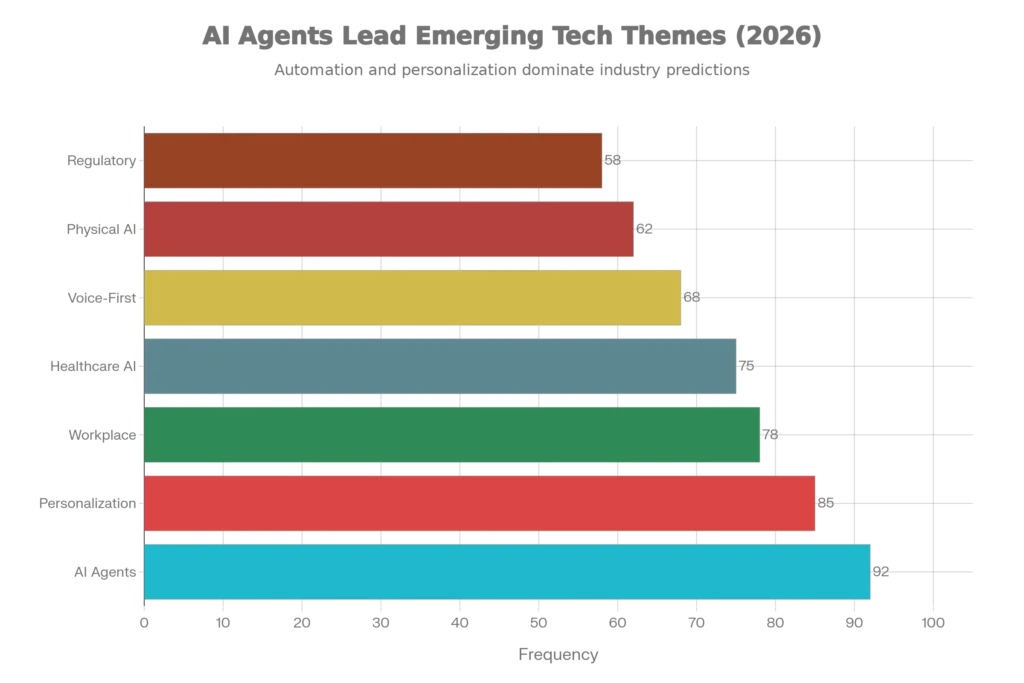
The things that caught my eye were not exaggerated hype but rather agreement among all three models. The themes each model was predicting were the same. The work environment is going to change, technology is going to become quieter, and humanity’s judgement is going to be more valuable than ever before.
AI predictions for 2026 collectively provide a good picture of what 2026 is likely to be like for us.
AI Stops Feeling like a Tool and Starts Acting like a Coworker
All three models predicted that by 2026, AI Agents would be utilized as Co-Workers instead of just answering questions, further this was also stated by Mindliftly.
AI Agents will fulfil a more prominent role than just responding to prompts. By 2026, they will complete a number of more complex, multi-step tasks. For example, AI Agents will be able to plan workflows, interact with multiple other systems and complete tasks towards achieving predetermined success metrics while under the supervision of a human.
The following are examples of potential implications of this shift in AI Agent utilization:
- AI Agents will manage inventory levels and schedule staffing
- AI Agents will manage marketing and advertising campaigns, running and optimizing them in real-time
- They will allow analysts to delegate data queries and report generation to automated robots.
It is important to note that the shift from human to AI Agent utilization does not equate to replacing human jobs. Rather, the focus will be on changing how humans do their jobs. Rather than continue to execute repetitive or routine-type tasks through manual execution, humans will primarily focus on managing the activities of AI Agents and making decisions.
Personalization Gets Smarter and More Sensitive
AI will help personalize our experience even more profoundly. However, the layer of personalization will be less noticeable. In 2026, the products we use will no longer need us to specify our desires explicitly. They will read our behaviour, the time of day we use them, and our emotional state to infer our intentions. This can be very helpful, but can create a sense of invasion.
Every model echoed this tension which is the need for trust in your technology will become increasingly important. Services that disclose their type of data usage are rewarded with user loyalty. Services that are intrusive will lose users without any effort on the part of the user.
Convenience alone will not be sufficient.
The services that will be successful will create a personal relationship with their users, but will do so without overstepping the boundaries of privacy.
The Workplace Flattens Faster than Expected
The second trend affecting peoples’ work is that the speed of change associated with the evolution of work is extremely rapid, resulting in many of the existing job functions being replaced by an artificial intelligence (AI). AI will become responsible for managing our schedules, tracking our productivity, and evaluating our performance. Simultaneously, poorly constructed management layers will disappear as new positions associated with the use of AI develop. As a result, traditional job roles will be transformed through disruption.
The primary attributes of the top employees expected to be available for employment by 2026 will include:
- Clarity of Thought
- Ability to Make Sound Decisions
- Ability to Communicate Effectively
- Ability to Adapt to Change
Education continues to be important for finding employment, but the most significant guiding principle for selecting an applicant is likely to be the pace of learning. As more positions use AI as a tool, guiding AI and analyzing results produced by AI will become standard rather than specialized skills.
Voice Becomes the Default Way People Interact with Tech
Typing has not been eliminated, however, it has Fallen behind voice as the most common means of entering data into smart devices. By 2026, AI systems have projected that the largest interface will be voice (for phones, cars, wearables, and home devices).
People use their voices more than their fingers to interact with technology, which creates a natural and easy Feel to interacting with technology, and therefore has made technology more integrated into daily life. Because voice conveys emotion as well as tone, it introduces new thoughts regarding an individual’s awareness and privacy. Therefore, the trade-off between technology’s efficiency and user’s control will be more apparent.
The AI Hype Cools Down and Real Value Takes Over
An interesting prediction shared was that most AI businesses will fail to exist post 2026. (This failure of many AI businesses is not the result of failure of AI technology but rather actually no longer being able to provide the vague promises of services).
The successful AI businesses between now and 2026 will have designed:
- Well defined use cases and deliverables
- Verified measurable results
- The ability to create a solution to a problem (one significant problem) in a superior fashion.
Therefore, applications that provide a general purpose will continue to decline and custom-built solutions will continue to grow.
This means that many of the predictions for AI in 2026 will not be theoretical anymore, and only those applications of AI that will permit users to save time, money or mental effort will be successful while the remainder will fail.
Healthcare Finally Will See Practical Impact
In 2026, healthcare companies utilise AI tools that provide assistance to their doctors, thus providing a reduction of the workload and freeing the ability for the doctors to become more productive.
Areas where AI provides support include:
- Risk Identification in Advance
- Administrative Assistants
- Monitoring the Health of Patients
This allows doctors to gain back time, speed up the process of patients receiving information about their health status and have better outcomes through the combination of human interaction and technology. This movement from demonstration to application of AI is significant.
Culture pushes back in quiet ways
There is a cultural element that is subtly resisting AI’s presence in healthcare. Not all cultural responses to AI will be technical in nature. Culturally, people are feeling a slow down in their engagement with AI, and are also leaning back towards more simple life experiences.
People are now finding value in:
- Time Spent Off Line
- Small Communities
- Fewer Choices That Are Driven by Algorithms
The concept of Digital Minimalism is evolving into a state that has more purpose behind it and less of a “limiting” feel to it. Making a choice not to use a tool becomes more of a statement to society than it once was. As AI advances, people will become more thoughtful in their decision-making of which tools they will utilise, while choosing to not utilise tools will become a statement to society.
A quick look at what AI expects in 2026
| Area | What AI Predicts |
|---|---|
| Work | AI handles execution, humans guide decisions |
| Hiring | Skills outweigh credentials |
| Interfaces | Voice overtakes typing |
| Products | Trust-driven personalization |
| Startups | Fewer survive, stronger ones lead |
| Culture | Digital fatigue reshapes behavior |
The Bottom Line
AI will be a part of day-to-day life in 2026. It’s just going to be there. People will get used to it. The real change with AI will be when people accept it as normal. That shift is already starting, with features like ChatGPT Wrapped showing how AI is becoming part of everyday digital habits.
AI will assume that humans are ready for it. Organizations may or may not be ready for it yet.
