
There are many debates about how AI already is and will affect the economy in the future. Will people lose their jobs due to AI? or will they have new jobs created through AI? In a new interesting study from Anthropic, researchers discovered that AI could potentially automate many jobs in the workplace. But in reality there is still a long way to go before AI replaces many jobs. Let’s find out the real impact of AI on labor market.
What is the gap between AI’s theoretical capability and actual use?
A new metric known as “observed exposure” was introduced by researchers at Anthropic. The goal of this metric is to provide insight into what types of things an AI can do and quantify how much of that is actually being utilized in a real-world job setting.
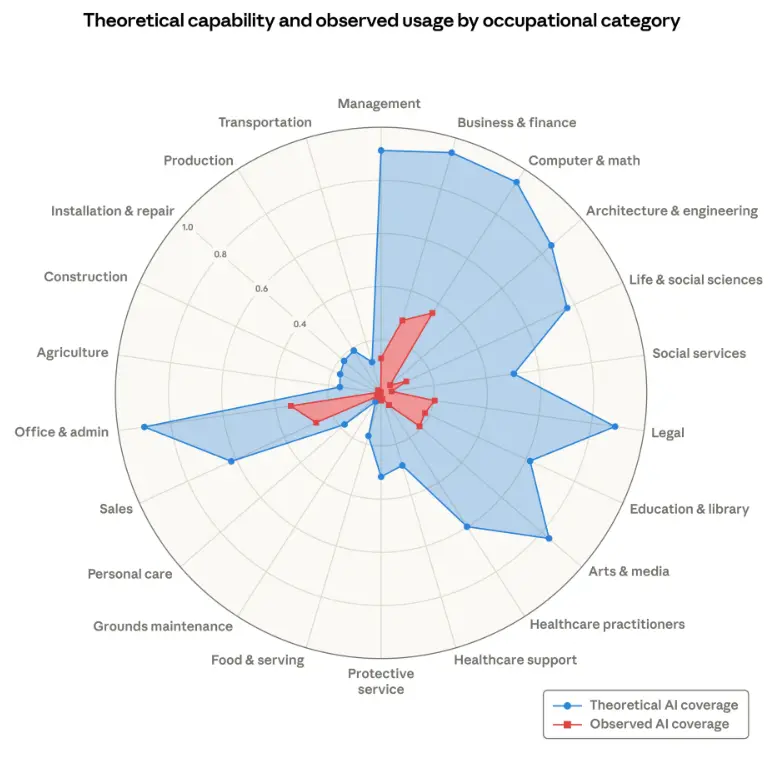
The results are quite astonishing. Considering the computer and math jobs where it would theoretically be possible for AI to do 94% of the job. However, only 33% of the computer and math job tasks show up in apparent usage data for Claude. The difference between the quality of AI’s potential versus the way it’s currently being used is enormous.
In almost every single job category researched, there was this same pattern. There is use of AI but nowhere near the amount of use that would be realistic based on what AI could do.
How does the new AI exposure measure actually work?
Three data sources were used by researchers:
- Government data from O*NET (Occupational Network), which lists information about job tasks for 800 occupations
- Data collected from Anthropic’s Economic Index, which produces metrics on the current use of economic models as measured by AI, and
- A November 2023 academic study conducted by Eloundou et al., to assess the potential speedup of completed tasks via LLMs. With regards to whether an LLM would speed up the time to perform a task by at least 2x from a baseline.
Each task was assigned a weighting to reflect its level of AI engagement. For example, if a task is being fully automated with AI, it receives a higher weight than if it simply augments human capabilities. Therefore, each occupation has an overall rating for how much of the work of an occupation is impacted by AI today in the real world.
Which jobs face the highest AI exposure right now?
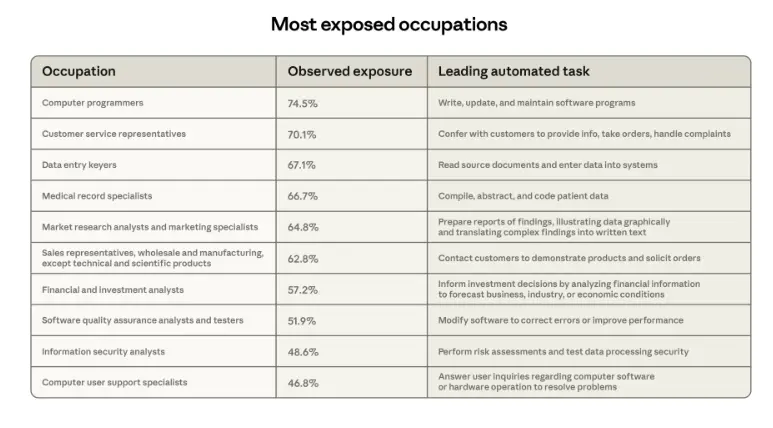
The top three most exposed occupations based on observed usage are:
| Occupation | Observed Task Coverage |
| Computer Programmers | 74.5% |
| Customer Service Representatives | 70.1% |
| Data Entry Keyers | 67.1% |
Financial analysts are also among the highest ranking occupations. These job types share a commonality in that the main things they do all centre around the types of text, data and structure of data that LLM’s perform well with.
At the other extreme, approximately 30% actually have no measurable experience with AI of any kind. Examples of these occupations would be: cooks, motorcycle mechanics, bartenders and lifeguards. Where their job consists of physical, contextual or social aspects that current AI cannot perform.
AI vs. theoretical capability: why is there such a large gap?
Even if technology is already able to support it, there are many things that slow down the rate of adoption of an AI. Legal constraints are one of the key barriers to use. With tasks like authorizing drug refills, it is theoretically possible through the use of LLMs (Large Language Models). But because of regulatory and liability considerations, they cannot actually occur.
Additional barriers include the requirement for human verification steps in the process. That is the need of software integrations. And simply the inertia of organizations not adopting new tools rapidly (particularly in heavily regulated industries).
The researchers also mention that there are still limitations in the models themselves. While some tasks can theoretically be accomplished, the models are not able to do them reliably enough at this time to be able to be deployed in the real world.
What does BLS job growth data say about AI-exposed occupations?
The US Bureau of Labor Statistics releases their employment projections through 2034. Researchers made a comparison between the projection and their findings of AI exposure levels. There is a distinctly predictable relationship: every 10% increase in AI task coverage results in a 0.6% percentage points reduction in the number of jobs .
While not dramatic, this relationship is consistent across all jobs being compared.
This demonstrates that the real use of AI is a better predictor of labor market pressure than theoretical capability alone.
Who are the workers most exposed to AI displacement?
Some commonly held beliefs about the demographic profile of workers with very high exposure to AI are challenged by data.
Workers who have the highest level of exposure to the employment of AI technologies also appear to be:
- 16 percentage points more likely female than male,
- Almost two times as likely to be Asian compared to Black or White workers,
- 47% higher earning workers on average, and
- Significantly more likely to hold a graduate level degree.
The labor market impact of AI technologies is concentrated primarily among educated and higher-paid professional office and knowledge workers, not on low-wage, low-skill job categories.
Has AI actually increased unemployment in exposed jobs?
So far, the answer is no. Researchers analyzing the unemployment data from the Current Population Survey have not found any significant increase in job loss among the most impacted workers since the launch of ChatGPT in late 2022.
Despite the numerous economic upheavals over that period, unemployment trends for impacted and non-impacted workers have been essentially the same.
If we had a white-collar recession equal to the one created by the 2008 financial crisis, where unemployment increased by 200%, that would be evident in this data. It is not.
There is some sign of this developing in hiring trends for young workers. Job entry rates for 22–25-year-olds in the most impacted occupations have fallen about 14% relative to the 2022 baseline. Older workers have not seen such a decline. This implies that AI is likely to be acting more as a slow-moving obstacle to people entering specific fields rather than actively eliminating people from those fields.
Wrapping it up
The effect of emerging technologies like AI on employment is significant but still at an early stage of development. For example, AI has enormous theoretical potential in a variety of jobs, but its actual amount of use in practice is only a fraction of the total amount that could be utilized.
This gap between the theoretical and actual use of AI technologies does not indicate a failed attempt to integrate the technology into society. Rather, it represents normal resistance to adopting new technologies (e.g., legal barriers, difficulties integrating with existing systems, and slow organizational change processes).
There is strong evidence that highly educated, higher wage earners working in knowledge-based occupations are most likely to experience job relinquishment. And that new entrants into those fields are already beginning to experience lower rates of job placement than those who entered before the surge in AI development took place. Therefore, the complete impact of AI on the labor market force has yet to be realized. However, early signs show that the foundation for this impact is being established.
