
Interview Prep in 2026 Looks Nothing Like 2020
Let’s be honest (and a little uncomfortable) for a second here. It’s 2026, and we are well aware that in 2026, most resumes don’t reach a human anymore because they are filtered by AI.
Plenty of interviews aren’t even being run by people. Either they are partially simulated or completely handled by some AI Agent.
To simply put it across, some companies test you with AI long before a hiring manager ever sees your name.
So in 2026, if you are still prepping like:-
“Act as an interviewer and ask me questions”
You are training for a game that does not exist anymore.
Gone are the days when you would just ask ChatGPT to act like a hiring manager, or a founder, and then ask you questions to prepare you confidently.
It’s simple. If you have given an interview in the past months, you will understand that Interviews in 2026 aren’t just one thing. They are now a multi layered systems – Screening, scoring, simulations, human judgement, AI judgement, etc. – all stacked together.
This isn’t a random ‘ best ChatGPT prompt for job interview prep.’ that you bookmark, feel productive for 3 minutes and then never open again.
This list is built from prompts that have actually been ‘stress-tested. These are the prompts that will turn your ChatGPT into a thinking partner, than just a questioning partner.
Use these to pull companies apart, to dissect that JD like a surgeon, pressure test yourself, sharpen your answers and spot the blind spots before the AI or the Hiring manager does.
That’s what a smart job interview prep with ChatGPT looks like in 2026.
Core Interview Trends in 2026 (Most Blogs Miss This)
1. Multimodal Interviews
Interviews are not a single format game anymore. In 2026, they might look like
- Recording Video answers in morning
- Sending Voice responses in afternoon
- Live AI chat tests by evening
- Screen-recorded yourself solving a problem in the middle of all this
So simply put, your prep should incorporate- spoken clarity and not just text answers.
2. Agentic AI Evaluators
Practicing sounding clear out loud has become as important as looking smart on page. So instead of judging keywords, they are evaluating
- Do you explain cause and effect?
- Do you show that you understand tradeoffs?
- Do your answers line up with each other?
- Do you make decisions, or just describe situations?
3. Behavioral Simulations > Traditional Q&A
Earlier, you used to be asked ‘Tell me about a time where …” but now, these questions have converted to “Here is the situation. Now, what do you do here?”
So you’re given a Scenario. you choose a path. give explanation for it.
And that explanation matters far more than the story itself.
4. Hidden Scoring Bias
AI thinks in structure, hence, AI systems tend to reward those who show-
- Structured thinking
- Simple frameworks
- Concrete outcomes
- Low fluff talk
This is where your generic role playing prompts fall short, because they don’t train you to think like this. And in 2026, interviews are all about having structures in your answers.
The Types of Prompts You’ll Be Using
You’ll mainly bounce between a few styles:
- Role-playing prompts → these simulate interviewers, scenarios and run a mock session.
- Few-shot prompts → paste your resume/job description. Then ask it to shape questions around your background.
- Chain-of-thought prompts → For trickier prep, force ChatGPT to walk you through step-by-step reasoning
- Self-consistency prompts → to take it up a notch, ask it to generate different answers, then compare and choose the strongest
- Prompt chaining → here, you will break big tasks into small linked steps like research first, then analysis then practice.
Step 1 – Research the Company Like an Insider
To prepare like a top candidate, stop skimming the homepage of the company and calling it research. Instead, try to understand what’s actually broken inside that business.
Use ChatGPT to cut through weeks of digging.
Prompts
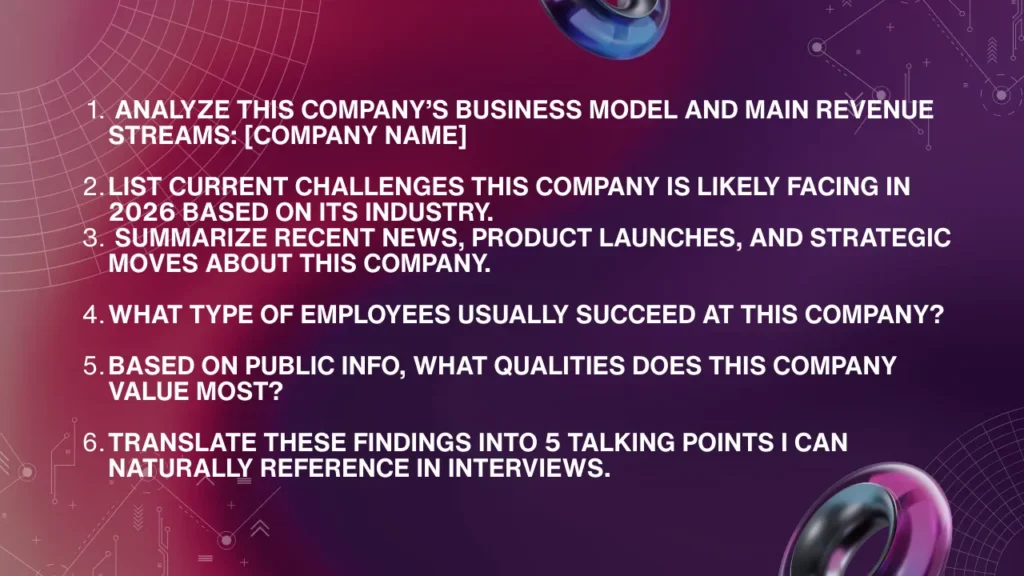
- Analyze this company’s business model and main revenue streams: [company name]
- List current challenges this company is likely facing in 2026 based on its industry.
- Summarize recent news, product launches, and strategic moves about this company.
- What type of employees usually succeed at this company?
- Based on public info, what qualities does this company value most?
- Translate these findings into 5 talking points I can naturally reference in interviews.
Why this matters:
Interviewers are looking for people who understand how the business actually works, and not just what the JD says on paper.
Step 2 – Deconstruct the Job Description (Instead of Skimming)
Most of the job descriptions look simple. They are not. Most of these JD’s hide quiet signals that tell you what the company actually cares about.
Your job is to de-code them.
Prompt
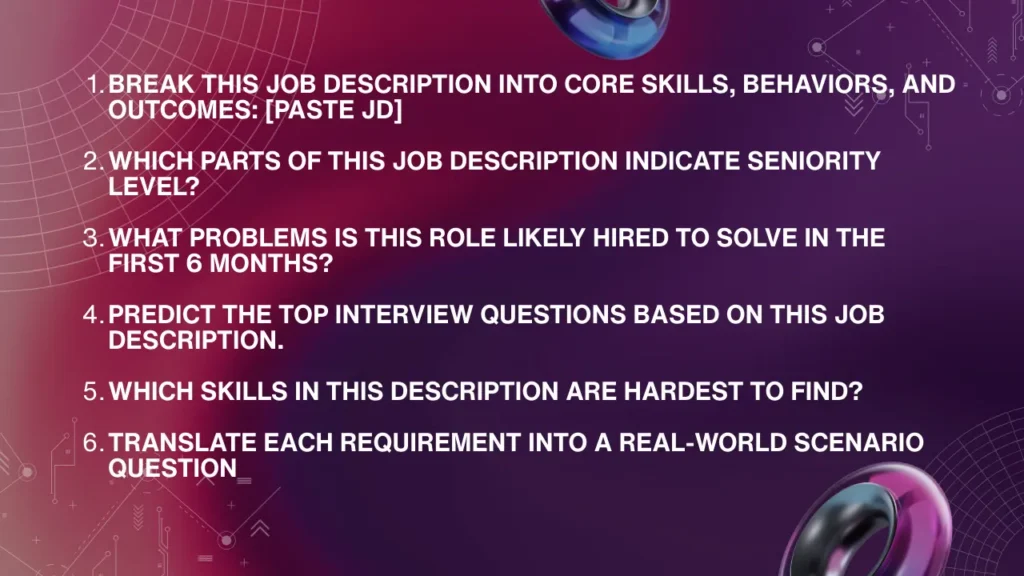
- Break this job description into core skills, behaviors, and outcomes: [paste JD]
- Which parts of this job description indicate seniority level?
- What problems is this role likely hired to solve in the first 6 months?
- Predict the top interview questions based on this job description.
- Which skills in this description are hardest to find?
- Translate each requirement into a real-world scenario question
Why this matters:
Once you start de-coding the signals, you are no longer left guessing what might come up in the interview.
Step 3 – Audit Your Resume Like a Hiring Manager
Your resume might be solid, but the AI systems might differ. A lot of the times, your resume has a few weak spots that hide in plain sight.
Prompts
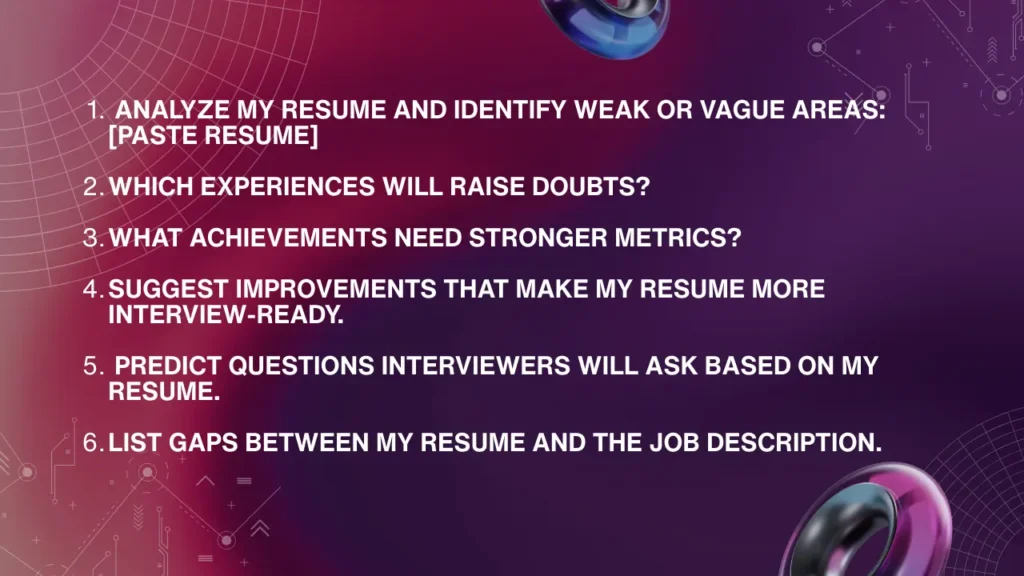
- Analyze my resume and identify weak or vague areas: [paste resume]
- Which experiences will raise doubts?
- What achievements need stronger metrics?
- Suggest improvements that make my resume more interview-ready.
- Predict questions interviewers will ask based on my resume.
- List gaps between my resume and the job description.
Why this matters:
These prompts let you handle the doubts, before they ever turn into questions.
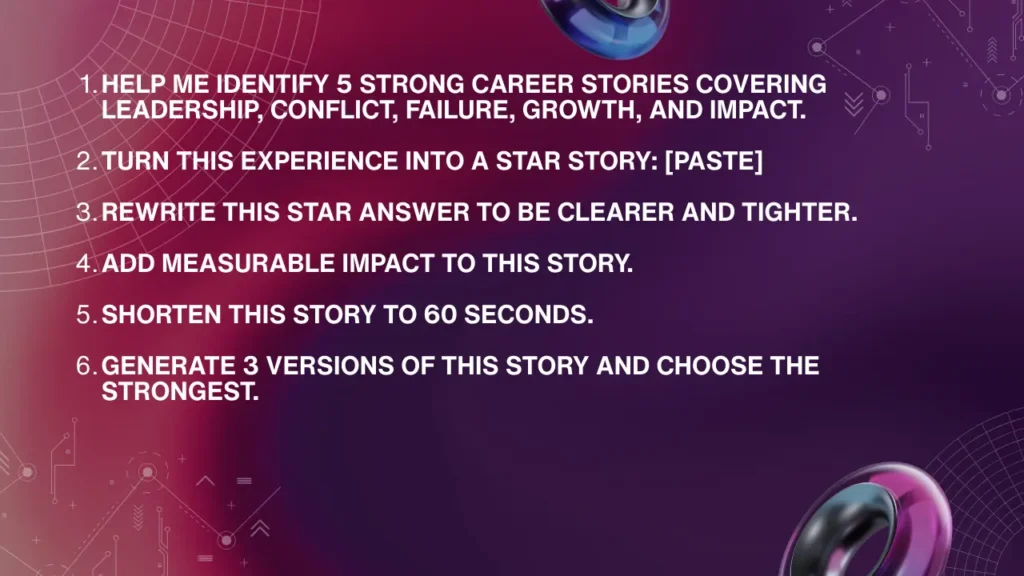
Step 4 – Build Your Core Stories (Before Practicing)
Answers that are made up on the spot sound like they are all over the place. You only need a few solid stories that you are already familiar with.
Prompts
- Help me identify 5 strong career stories covering leadership, conflict, failure, growth, and impact.
- Turn this experience into a STAR story: [paste]
- Rewrite this STAR answer to be clearer and tighter.
- Add measurable impact to this story.
- Shorten this story to 60 seconds.
- Generate 3 versions of this story and choose the strongest.
Why this matters:
You no longer feel all over the place by inventing some story while the interviewer tries to make sense of your answer.
Step 5 – Practice With Smart Mock Interviews
Here, role play becomes a powerful strategy. You are self training on how to respond under pressure.
Prompts
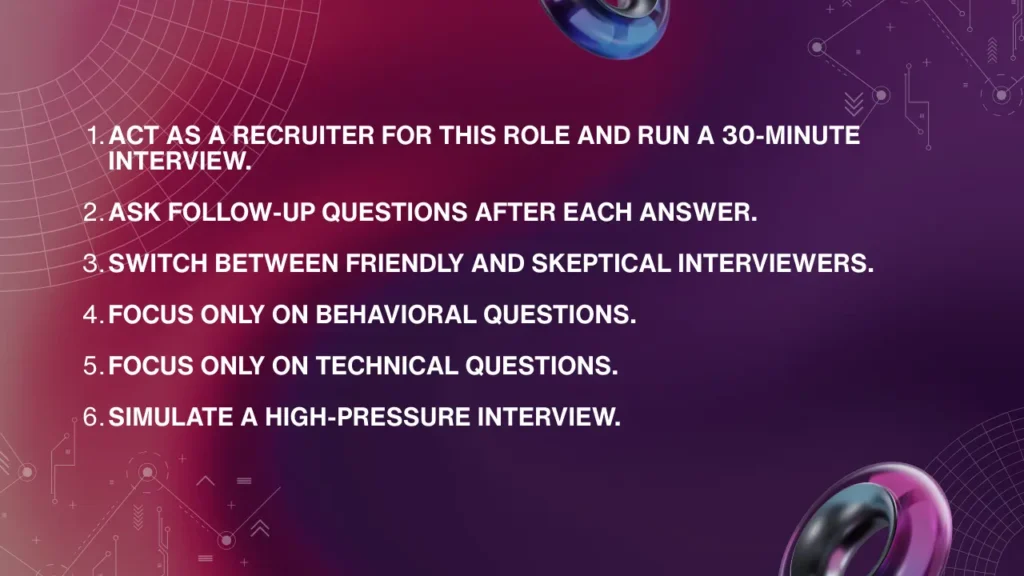
- Act as a recruiter for this role and run a 30-minute interview.
- Ask follow-up questions after each answer.
- Switch between friendly and skeptical interviewers.
- Focus only on behavioral questions.
- Focus only on technical questions.
- Simulate a high-pressure interview.
Why this matters:
Knowing the answer and staying calm while giving the same answer are two very different things these prompts train you to do both.
Step 6 – Upgrade Answers Using AI Scoring
Most people usually stop here and call it “good enough.” But you don’t. You go one step further. You tear the answers apart, tweak it and then run it again.
Prompts
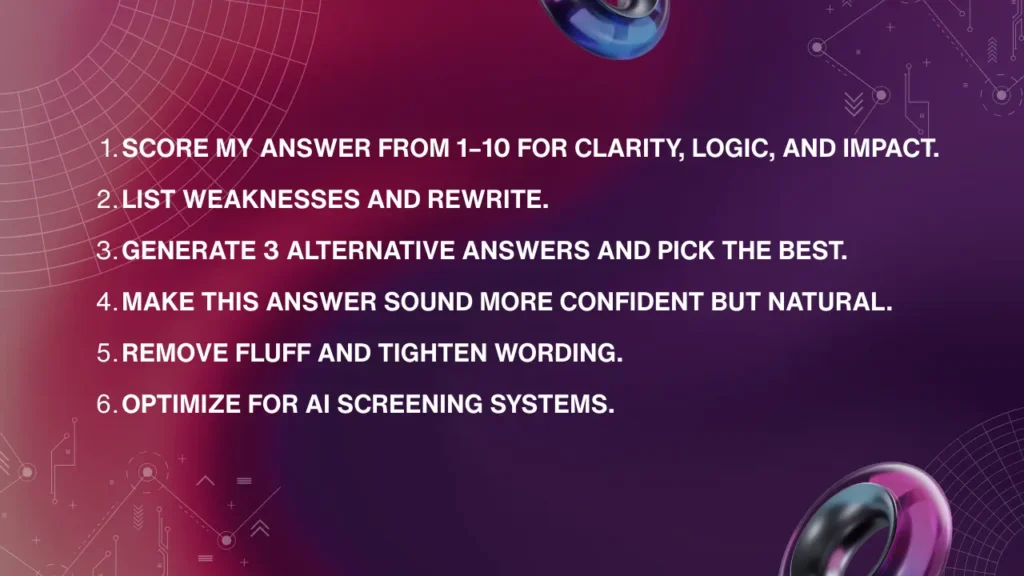
- Score my answer from 1–10 for clarity, logic, and impact.
- List weaknesses and rewrite.
- Generate 3 alternative answers and pick the best.
- Make this answer sound more confident but natural.
- Remove fluff and tighten wording.
- Optimize for AI screening systems.
Why this matters
This extra step is what turns a decent answer into a sharp interview worthy one.
Step 7 – Prepare for 2026 Interview Formats
Interviews in 2026 are more than just back and forth conversations. Interviews now come in various formats and various expectations.
Prompts
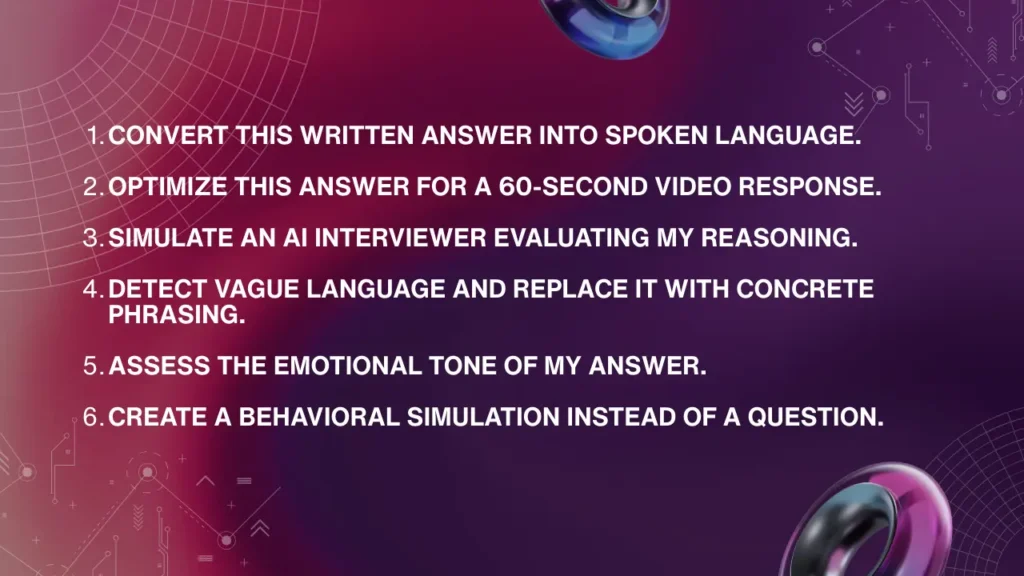
- Convert this written answer into spoken language.
- Optimize this answer for a 60-second video response.
- Simulate an AI interviewer evaluating my reasoning.
- Detect vague language and replace it with concrete phrasing.
- Assess the emotional tone of my answer.
- Create a behavioral simulation instead of a question.
Why this matters:
Because you are preparing for interviews in 2026, not 2020.
Step 8- Final Polish & Confidence Layer
It might look like a small adjustment on paper, but in reality, these make a much bigger difference that people might expect.
Prompts
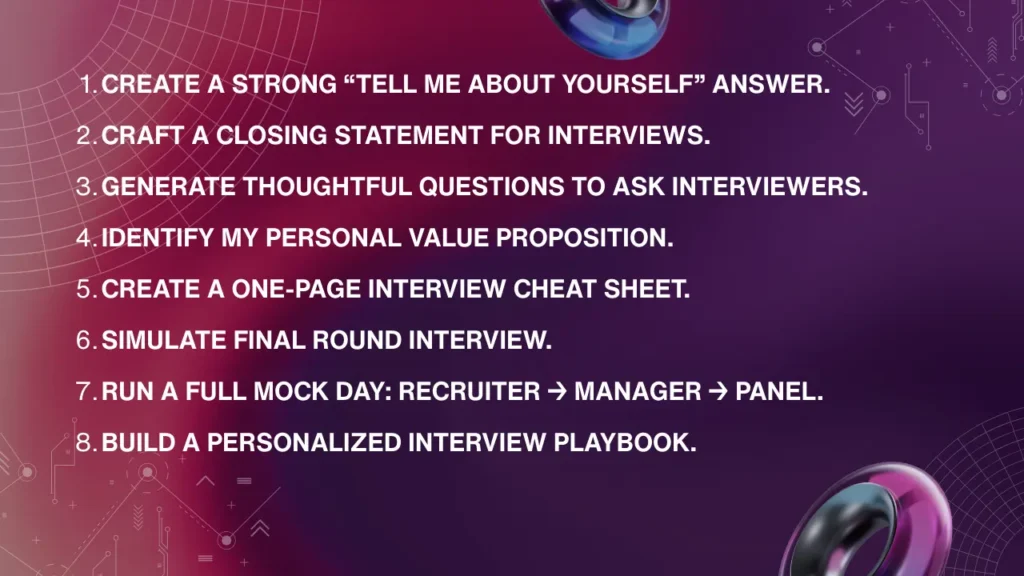
- Create a strong “Tell me about yourself” answer.
- Craft a closing statement for interviews.
- Generate thoughtful questions to ask interviewers.
- Identify my personal value proposition.
- Create a one-page interview cheat sheet.
- Simulate final round interview.
- Run a full mock day: recruiter → manager → panel.
- Build a personalized interview playbook.
Final Thought
Let’s be real here. Researching, breaking stories down, building solid stories, then practicing them, picking them apart, tightening where you feel it’s weak and then running it again -Thats how the best ChatGPT prompts for job interview prep work. In easy words- when the prompts are used inside the preparation routine, like a system.
By using the adobe prompting steps, you are literally training at the same level that the companies are judging you on.
So in 2026, if you stay in this loop consistently, the interviews will start feeling predictable.
And over time, you will realise, that’s where the offers live.
