
By 2026, AI tools are being utilized by millions of users around the world on a daily basis. Two of the most well known examples of these AI systems are Claude & ChatGPT. The question that everyone seems to ask is, “Which model should I use?”
There is no authoritative answer to this question; however, a person will likely find victory in either AI system depending upon their individual requirements. Both systems contain unique advantages and will perform better for different situations.
For example, if I were looking for an AI system to provide me with accurate coding information and/or help with large amounts of contextual information, I would probably choose Claude. Alternatively, if I were looking for a system that could support multiple forms of media quickly and/or be utilized creatively, I would more than likely choose ChatGPT.
The purpose of this article is to help readers clarify any questions or ambiguity relating to the differences in capabilities between these two systems – thereby enabling users to make better decisions when choosing between the two.
What models power Claude and ChatGPT in 2026?
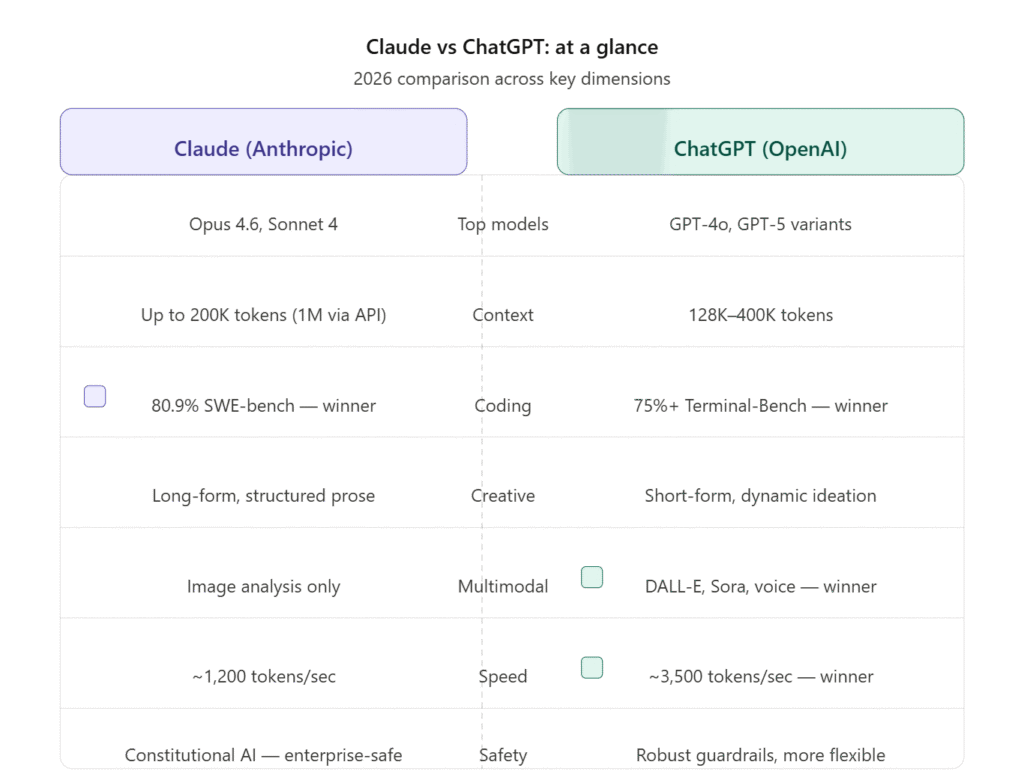
Claude runs on the Opus 4 as well as the Sonnet 4, which was designed by Claude with safety, logic, and precision in mind when completing challenging duties. For a further detailed classification and breakdown of Claude’s models click here.
ChatGPT runs on GPT-4o, GPT-5 variants, and Codex-tuned versions built for versatility. Both sit at the frontier of AI capability and perform near-equally on general benchmarks, the differences show up in specific use cases
While both works exist far at the level of AI possibility, their globally evaluated success rates are very similar; but they are considerably less representative of their true capabilities when compared to each other in real-world scenarios.
How much information can each AI handle at once?
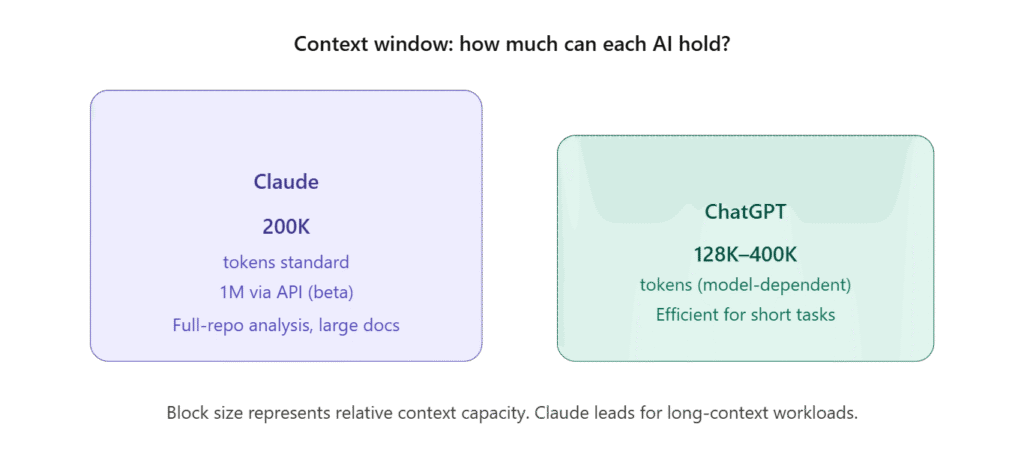
Claude can utilize a large number of tokens in a given chat or API conversation. The maximum limit set by Claude is 200,000 tokens in both formats, but an extended limit of 1 million tokens is also available via the API beta program. This allows you to upload an entire project and/or a full-length book into a single chat.
By comparison, ChatGPT only allows for between 128k and 400k tokens per task depending upon which version you’re using; however, this is plenty of room for most daily uses. Still, Claude has much more available capacity when working with full-length documents or complete codebases than ChatGPT currently does, allowing added flexibility and capabilities for large projects.
Claude vs ChatGPT for coding: Which one writes better code?
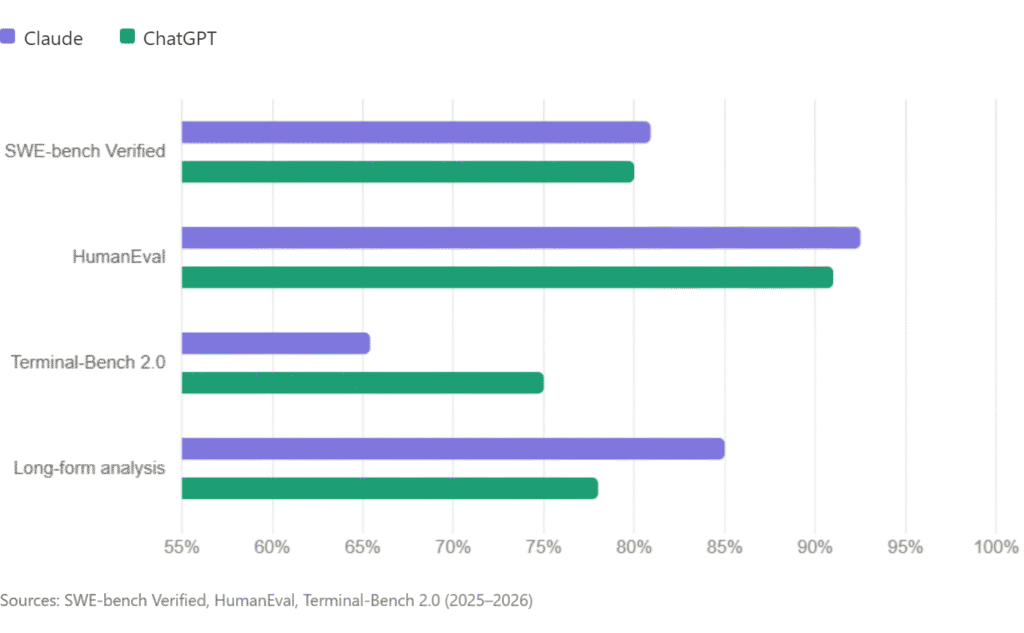
Claude’s SWE-bench Verified scored 80.9%, making it one of the highest performing benchmarks in coding that is also expensive to pass. It produces cleaner code and performs better at debugging complicated tasks than most of its competitors so many developers use Claude to construct production systems based upon this.
ChatGPT scored 75%+ in the Terminal-Bench 2.0 benchmark and excelled in performing rapid scripting as well as performing automated agentic tasks via command line. When it comes to doing fast prototyping or automating via command line, ChatGPT will generally feel much faster than the alternatives.
Benchmark scores at a glance
| Benchmark | Claude Score | ChatGPT Score | Leader |
| SWE-bench Verified | 80.9% | ~80% | Claude |
| HumanEval | 92-93% | 90-92% | Tie |
| Terminal-Bench 2.0 | 65.4% | 75%+ | ChatGPT |
Which AI reasons more accurately and makes fewer mistakes?
The models perform well with difficult logic problems; Claude has fewer times when it incorrectly predicts things and gives clear instructions as well as more thorough responses. Claude gets about 85 percent of its responses correct on long form analysis when compared to 78 percent for ChatGPT.
For speed and wide category testing, ChatGPT generally wins or produces similar results to Claude and provides quick answers to many topics. However, Claude is safer to use for tasks requiring careful step-by-step reasoning.
Claude vs ChatGPT for creative writing: Which one fits your style?
Claude generates organized and clear language that sounds natural, which is excellent for creating large documents, editing, or writing professionally/technically. And Claude’s coherence and tone are very good when establishing continuity over an entire document.
ChatGPT’s creativity is much more spontaneous and diverse than Claude’s. Especially with regard to how ideas are generated over long periods. Consequently, ChatGPT produces more creative output in short bursts of time than Claude does. Especially if you want fast creative ideas while writing fiction or innovating ideas.
What can each AI do beyond text?
Although Sora for video creation and DALL-E for image generation can work well together, it may be useful to also use them as standalone applications. Both tools are available through ChatGPT and can be used interactively via text and voice. ChatGPT is the most comprehensive tool for users creating visual and multimedia content.
Claude is a good alternative when working on image/video/document analysis and processing, but it does not generate images or videos. Thus, if your workflow consists only of text or code, then there will not be an issue for you with this gap. However, if you are involved with generating images or videos as part of your workflow then ultimately ChatGPT will be your best choice.
Speed and pricing: What does each AI actually cost?
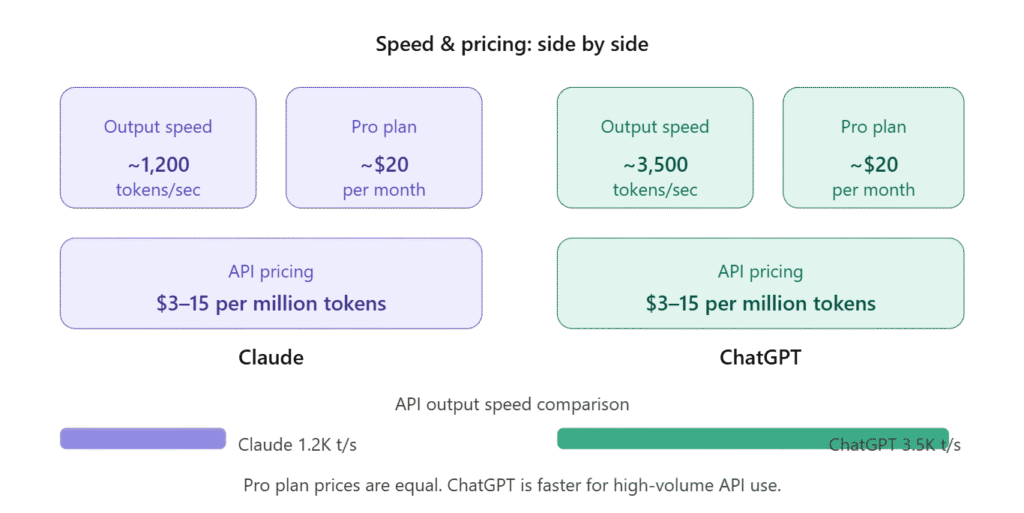
The ChatGPT API gives you around 3500 tokens per second, while Claude gives you around 1200 tokens per second, so if an application has tremendous output volume or time constraints, there can be significant differences.
Both ChatGPT and Claude charge around $20/month for Pro plans, and API rates (for approximately 1-million tokens) are similar ($3-$15) depending on the model. ChatGPT also has more extensive free plan offerings, which can benefit casual, less frequent users and new users.
Which AI is safer for enterprise and regulated industries?
Claude is the product of the company Anthropic’s Constitution AI project. This makes it more cautious compared to other AIs. Resulting in a much lower chance of producing harmful or otherwise unlawful outputs. Additionally, because of this, regulated industries like healthcare, finance, and law are currently preferring using Claude.
Both Claude and ChatGPT have strong safety guardrail systems, but ChatGPT’s safety system is not quite as rigid as Claude’s. Therefore, it may be beneficial to utilize ChatGPT for some use cases. If your case is internally oriented and regulatory compliance issues will be at play, Claude makes the most sense and provides the safest choice to meet your needs.
Claude vs ChatGPT: Which one should you use?
No one tool is superior to the other. When comparing Claude to ChatGPT, the correct tool for you depends on your goals.
If you are developing large codebases, developing long documents, performing complex reasoning tasks. Or if you operate within a heavily regulated industry, choose Claude. For best Claude tips and tricks to get the most out of Claude click here.
Choose ChatGPT if you require quick results, creative freedom, generating images/videos, or generating many API calls.
Generally, you’ll find that both Claude and ChatGPT can be beneficial based on the task. Identifying the attributes of each will allow you to maximize the benefits of whichever tool you select.
