
Musk’s AI Ambitions Beyond the Headlines
The conversation surrounding generative artificial intelligence continues to grow and evolve in response to increasing concerns regarding bias, security, and accountability. Additionally, the rise of large language models has led to a transformation in how individuals access information, develop ideas, and make decisions, sparking several important questions about who is responsible for the consequences associated with these technologies.
Elon Musk has taken an active role in addressing these concerns; however, his vision for artificial intelligence goes well beyond the ongoing public discussions regarding chatbot and image generation applications of the technology.
Musk sees AI as a core technology that we will use to automate tasks in the “real world.” Rather than simply providing users with intelligence through a screen or UI, his goal is to integrate artificial intelligence into the hardware/platforms that users interact with. As such, Musk is “redefining” the focus of AI research from simply determining the most logical way to automate a process or decision based on a user’s input to developing intelligent robotic solutions that will enable robots to perform tasks based on their ability to process and interpret data from their environment.
The Generative Model Controversy
Grok is a generative AI tool developed under Elon Musk’s xAI initiative. It focuses on conversational methods and real-time reasoning. The tool generates text and responds to prompts. It also analyzes large amounts of textual data quickly.
The technology has sparked controversy. Critics point to misinformation, biased outputs, and a lack of accountability. They urge developers to set clear safety guardrails and ethical boundaries.
Musk acknowledges these challenges. He sees generative AI as the first step in a larger process. He treats these systems as foundational intelligence layers. They provide reasoning and perception but remain limited without real-world applications.
Critics highlight risks related to misinformation, biased outputs, and a lack of accountability. The controversy even escalated into the Grok deepfake scandal, which regulators demanded X address immediately.
Musk’s Robotics Ambitions – Tesla Optimus
Musk’s shift from virtual intelligence to robotic application is signified by the creation of Tesla’s Optimus humanoid robot. The robot is geared primarily toward performing both hazardous and labor-intensive work. In addition to being able to turn its body and move around safely among humans, it will require more than the use of just language, like chatbot communication does. In contrast to chatbots, Optimus will need to perceive three-dimensional spaces, manipulate objects, and react to changing environments.
Instead of only being able to produce text or images, the project shows that artificial intelligence can be applied to areas outside of written material. Musk’s way of using robotics to apply the ideas behind artificial intelligence is a means of transitioning from the theoretical to the practical; he is using technology to implement what was once an abstract concept into the real world.
Strategic Overview of AI Deployment
Generative systems will make decisions based on their reasoning and input from the environment and then send that information to a robot to carry out the appropriate physical task.
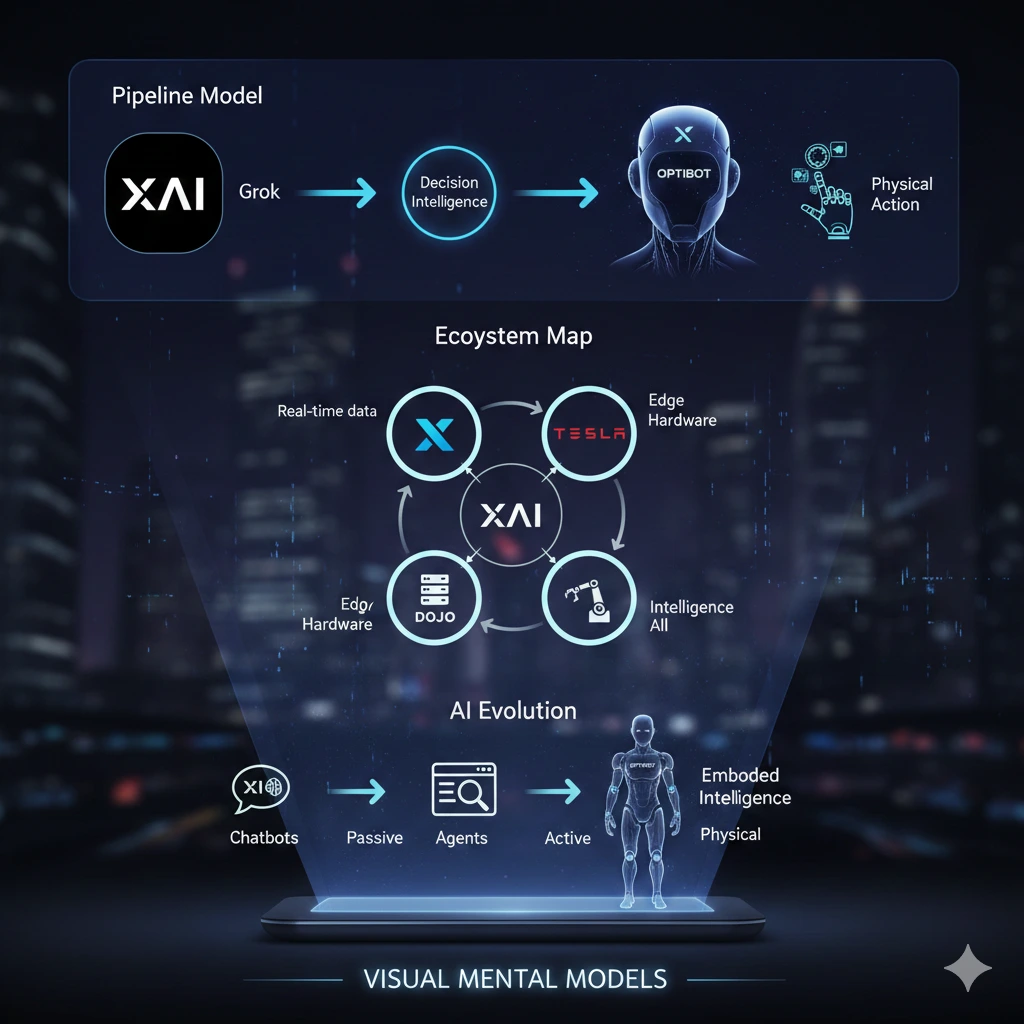
In short, the most elementary way to visualize this is by thinking of it as a pipeline:
Grok (reasoning) → Decision Intelligence (intelligent decision making) → Optimus (robot that physically operates) → Physical Action (doing)
This sequence represents a significant development of AI; examples would be:
Chatbots (text-based conversational agents) ➞ Agents (agents that have neural networks) ➞ Embodied Intelligence (AI capable of functioning within a physical environment). Musk wants to develop AI beyond just providing answers to a given question to full autonomous capability.
Challenges and Opportunities
Challenges
- Scaling physical robots safely with AI
- Constraints on hardware and sensors
- Guaranteeing dependability within dynamic settings
- Establishing robust public confidence with ethical protections
- Mitigating excess expenditures associated with creation & deployment
Opportunities
- Revamping and revolutionizing productive operations and transportation.
- Automating mundane & hazardous responsibilities.
- Improving household & day-to-day living through smart appliances and devices.
- Encouraging inventive solutions for healthcare & service areas.
- Developing a seamless artificial intelligence platform in conjunction with robotics & software.
Ensuring public trust and defining accountability remain major challenges as AI moves from virtual models to physical robots, raising critical questions about liability in generative AI systems.
How Musk’s AI Strategy Differs From Everyone Else’s
Musk’s Approach To Artificial Intelligence (AI): Musk Focuses On Implementing AI In The Real World Rather Than As A Stand-Alone Generative Tool; Whereas Other Companies Focus On Generating Content And Creating User Interfaces, Musk Uses Artificial Intelligence Systems (e.g., Grok) As Intelligence Engines To Support Physical Machines, Exhibited By The Tesla Optimus Project (AI For Labor And Movement vs. AI For Pixels).
The Integrated Ecosystem Map Demonstrates This Philosophy: xAI + Tesla + Dojo + X + Robotics
Musk’s AI Stacking Framework Enables Continuous Real-World Learning Through a Combination of Control of Data, Devices, Training Infrastructure, and Deployment.
From Controversy to Creation: Musk’s AI Legacy in Motion
The growing controversy surrounding generative A.I. has not hindered Musk’s ambitions; it has focused his ambitions. Musk believes debate drives opportunities to improve both AI capabilities and the responsibility to develop safely. By integrating AI into virtual intelligence and robotics, he envisions machines thinking and acting purposefully.
As AI merges reasoning with robotics, Musk leads embodied intelligence, turning AI from conversation into real-world action.
By integrating AI across virtual intelligence and robotics, Musk demonstrates a blueprint for gaining a strategic edge in AI, a perspective explored further in our analysis of AI competitive advantage in 2026.
