
For a long time now, India has been using the AI tools that have been built outside of India.
I am talking about payments, logistics, customer support, fraud detection etc. Most of these have been driven by models that have been trained outside of India. Now, these models have been extremely useful and there’s no denying that, but they were never ours. It’s 2026, and there have been some silent yet massive shifts in the Indian AI ecosystem.
Sarvam AI is an Indian startup that is building AI models which are specific to Indian use cases. The goal for Sarvam AI has been very clear since day 1 – build a system that actually understands how Indian languages are spoken, written and mixed in real life.
Recently, Sarvam AI has started appearing in many AI benchmark discussions, quite consistently, alongside big names like ‘ChatGPT’ and ‘Gemini’. If you’ve been following the AI space in the past months, you’ll know that Sarvam AI is surpassing ChatGPT and Gemini in some specific real world benchmarks like OCR accuracy, Indian language speech and context heavy use cases.
Let’s see how Sarvam AI is helping shape up the idea of Sovereign AI India.
From AI User to AI Builder
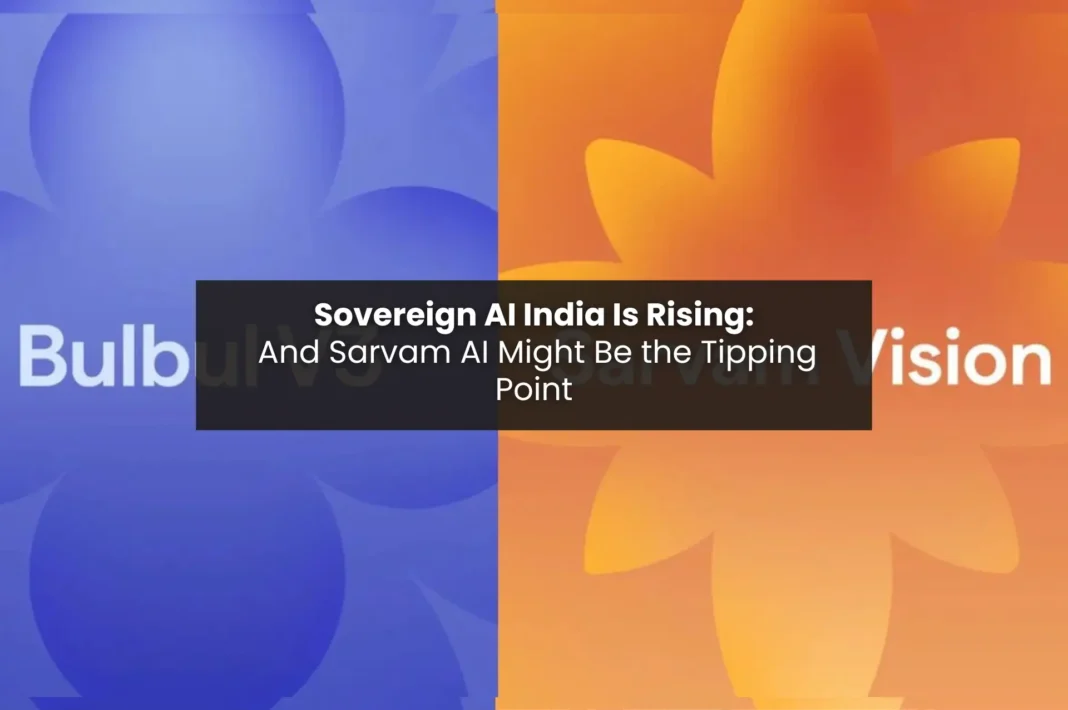
Sarvam AI recently launched its multilingual text to speech mode, Bulbul V3, which is designed for Indian languages and accents.
The system currently supports more than 35 voices across 11 Indian languages. These are designed in a way that they match with how the Indian languages are actually spoken. They also have plans to expand coverage to 22 languages. This one aspect of Sarvam AI sets it apart from other global AI models because global TTS systems often struggle here.
Most AI tools that are used in India today are the adapted versions of systems that are trained outside of India. Meanwhile Sarvam builds its model from scratch from Indian data, for Indian users and across multiple Indian languages. More than the language, it’s the variations in tone and cadence in how these languages are spoken that Sarvam is focusing on.
This move of building locally, rather than using the foreign models is where the idea of Sovereign AI India begins to take shape.
Why This Matters
Startup announcements happen quite frequently and then they slowly fade, but not for Sarvam.
For the first time in a visible way, an Indian startup is building a system’s core infrastructure themselves (models trained for local languages and real Indian use cases), instead of just piling features on top of global AI models.
There’s also the Government backed compute access, then there’s public AI initiatives and the conversations around data governance are steadily reducing India’s dependence on foreign systems. The smaller AI teams that are working on voice tech, document processing and legal research tools, now have proof that building locally is not unrealistic.
Recent AI Launches & the Broader India AI Moment
If you look closely at India’s AI ecosystem, you will see that it isn’t just Sarvam AI that’s operating quietly.
Like the India AI Impact Summit 2026, which is taking place in New Delhi. It has brought policymakers, global AI firms and many Indian founders in the same place to discuss AI governance frameworks.
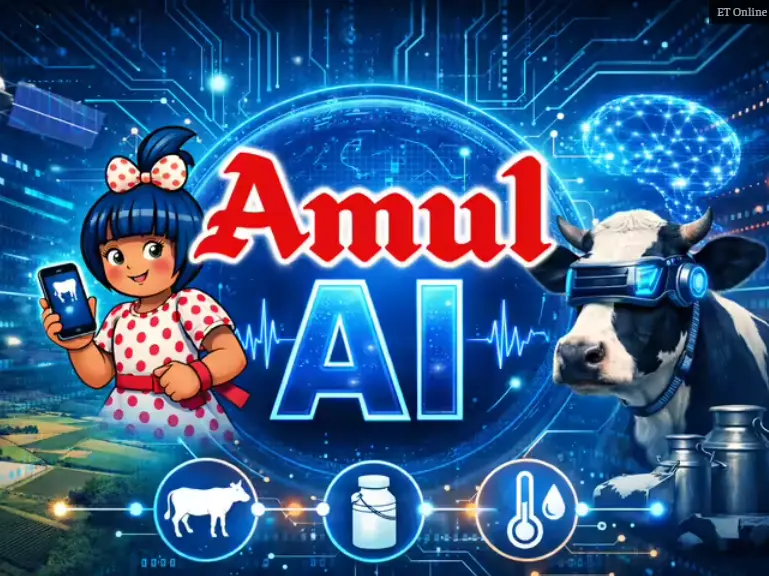
Amul Dairy recently launched its AI tool ‘Sarlaben AI’. It aims to transform dairy farming and support the dairy farmers, with advisory and data insights at the grassroot level, as reported by Economic Times. Systems built for rural contexts is where AI use cases become significant.
This one is exciting because some startups are quietly exploring orbital AI data infrastructure that uses low earth orbit tech. Sounds futuristic, could be even risky, but the intent for exploring the space + AI is what makes it interesting.
Government budgets allocating billions in compute, datasets and skill development programs for for the IndiaAI Mission continue to grow,
Do you see a pattern here? India isn’t only experimenting with these AI tools anymore. The infrastructures, frameworks, policies and real use cases that genuinely matter, are being built across multiple sectors.
Recent AI Launches & the Broader India AI Moment
Sarvam AI is just a preliminary indicator of the broader India AI Moment. These are going to be applied next in the systems people rely on every day.
- AI models in healthcare that are trained on Indian datasets could assist with interpreting the medical scans, determining the urgency of treatments and prediction of disease risks, especially in the rural clinics where doctors are limited. This is a huge leap towards improving the healthcare sector.
- For the Judiciary, where case backlogs stay heavy across the courts, specific AI tools can help them summarize cases, help in the legal research and provide access to necessary documents. This will help in reducing the administrative friction and also help the people working in judiciary to manage the load.
- In the education sector, the Bharat EduAI Stack initiative is a proof that India is pushing to integrate AI in curriculum delivery and adaptive learning systems. In country like India, which has huge classroom size across, these kind of small efficiency gains can be hiked up rapidly.
India’s Structural Advantages for AI
First and foremost, the diversity in language here creates a kind of training environment that only a few other countries have in this world. There’s dozens of languages, hundreds of dialects and major accent switching happening in regular conversations. That complexity, even though messy, becomes part of the training data that the global models struggle with.
Then, there’s billions of users that are interacting digitally in many ways. For example making payments, doing business in e-commerce, education and government platforms.
This generates huge volumes of behavioral data. That kind of massive scale data can become an important asset for training models and refining outputs.
So, the combination of extreme diversity and large scale is a rare combination.
Markets across parts of Africa, Middle East and South East Asia also face similar realities when it comes to multilingual population, bandwidth constraints and tighter cost margins for technology enterprise. So, tools that are built for India’s verbal environment, may connect more naturally to those markets, opening a market opportunity.
Challenges That Could Slow India’s AI Momentum
Even though the momentum is rapidly building for India’s AI ecosystem, there are some potential constraints.
Like the compute still remains expensive. Even with shared GPU infrastructure under the IndiaAI mission, training and taking care of these large scale models requires some serious capital. The access has improved, no doubt, but for smaller startups there’s still a lot of friction.
Even though India has a huge volume of information across languages and sectors, cleaning, labelling and structuring that data for training of the model takes some time and plenty of coordination.
And lastly, India has one of the largest pools of strong engineers. But the advanced AI research skills are in global demand to a large extent. And the foreign companies actually offer better compensation than the domestic startups.
Many policy discussions around AI governance and safety are moving forward but the innovation aspect moves faster than the frameworks. Thus, catching up with that speed is crucial.
From ‘Beat ChatGPT’ to Building Problem-First AI
The early discussions around Indian AI were mainly focused on comparisons of local models and global models. For example, whether local models could outperform ChatGPT on specific benchmarks or could they match the accuracy like that on the global systems.
But a better and more useful approach would be whether these systems actually function well in Indian conditions.
-Do they handle local languages reliably?
-Can they operate within evolving data protection norms?
-Does it work in Hindi, Tamil, Marathi, Bengali, Assamese, etc?
-Are they useful to teachers managing large classrooms, farmers seeking advisory insights, or legal professionals navigating complex documentation?
Sovereign AI India is about designing systems that respond to local needs first rather than competing with Silicon Valley giants. If the foundation is of local utility, the global positioning follows naturally.
Sarvam AI is Just the Starting Point
Sarvam AI showcases an early phase in a larger transition that is still taking shape. There are many small scale AI startups that are experimenting quietly with specific models. Many government programs are also expanding, and the infrastructure funding is increasing.
Various pilot deployments are taking place in sectors like agriculture, education and public administration. The international partnerships are also shaping up quietly in the background, proving that AI in India is not just something to discuss.
Serious changes are taking place, and all of this suggests that Sarvam AI is not just a standalone breakthrough It’s part of a bigger shift in the Indian AI ecosystem.
For the longest time, India has been dependent on foreign models. It’s 2026, and it’s time now to move from the ‘user’ to the ‘builder’ and ‘experimenter’ of AI for India. The efforts towards becoming the AI leader in the long term will depend on how the execution, investment and governance is shaping up in this environment.
