
Most people see LinkedIn as a platform for just showcasing their experience. However, it acts more like a search engine driven by machine learning.
Every day, recruiters search LinkedIn using specific keywords like “AI strategist,” “growth marketer,” or “automation consultant.” LinkedIn’s ranking system evaluates profiles based on relevance and decides which profiles show up first. If your profile isn’t optimized for these signals, you won’t appear, even if you have the right qualifications. LinkedIn Talent Solutions also states that recruiter tools depend on AI-driven recommendations and skills-based matching to highlight relevant profiles. This means your profile is being analyzed, categorized, and ranked. Not just viewed.
And that matters because recruiters aren’t manually browsing Linkedin profiles at random. According to the Jobvite Recruiter Nation Report, 87% of recruiters use LinkedIn to find candidates, making it one of the primary sourcing platforms in modern hiring.
Additionally, recruiters do not spend several minutes studying each profile. An eye-tracking study found that recruiters scan a resume for about 6 to 8 seconds before deciding whether to continue reading. LinkedIn profiles are assessed in a similar quick scan, starting with the headline, then the recent role, followed by quick indicators of relevance.
TLDR, visibility on LinkedIn happens in two layers:
The algorithm determines whether you appear.
The recruiter decides in seconds whether you’re relevant.
Optimizing your LinkedIn profile affects both layers. If your headline, skills and experience are unclear, the system may not show you. If your positioning is vague, a recruiter may decide to move on within seconds. Optimizing your LinkedIn profile is no longer just about sounding impressive. It’s about making your expertise clear enough for both machines and people to understand right away.
Why isn’t my LinkedIn profile showing up in search?
Your LinkedIn profile might not be appearing in search because it lacks relevant keywords, organized skills, or clear positioning. LinkedIn’s algorithm ranks profiles based on how relevant they are to search queries. Recruiters usually scan profiles quickly, so clarity is vital for visibility.
How LinkedIn’s Algorithm Ranks Profiles
LinkedIn has confirmed through its Engineering Blog that its search ranking and recommendation systems depend on machine learning models to assess relevance. These systems examine structured profile data, including:
- Headline keywords
- Listed skills
- Job titles
- Experience descriptions
- Profile activity
When a recruiter searches for a specific role, LinkedIn assigns relevance scores to profiles based on how closely they match the search query. Profiles with clear keyword alignment rank higher. Profiles with vague descriptions rank lower. This is why two equally qualified professionals can have very different visibility.
The 4 Real Reasons Your LinkedIn Profile Isn’t Showing Up in Search
If your LinkedIn profile isn’t appearing in search results, the issue often isn’t your competence. It’s about the strength of your signals. LinkedIn’s system tries to understand your professional identity and where you fit within the platform. When that interpretation is unclear, the system plays it safe, and you simply don’t show up. Here are a few common reasons this happens.
1. Your Headline Is Too Broad to Be Searchable
A headline like “Consultant” or “Marketing Professional” may be true but is too broad to be useful. From an algorithm perspective, it doesn’t create a strong category. It’s like labeling a book “Business” but not specifying whether it’s about AI strategy, performance marketing or SaaS growth.
Now compare that with: AI Growth Strategist | Automation | SaaS Scaling.
This version narrows the focus. It tells LinkedIn exactly where to place your profile in its internal expertise map. It also helps recruiters quickly understand your domain.
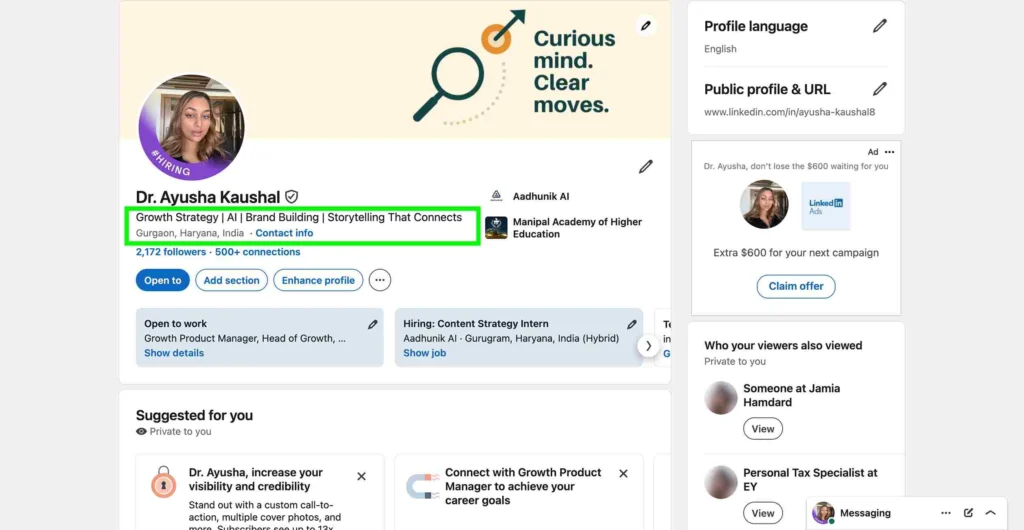
A simple structure works in this situation:
What you do + your focus + your domain
The clearer your headline is, the easier it is for the system to match you to search queries.
2. Your Skills Don’t Reinforce Your Positioning
People often underestimate the skills section, but LinkedIn sees it as structured, filterable data. Recruiters often start their searches by filtering for certain skills before even reviewing profiles. If someone filters by “AI Strategy” and that skill isn’t on your profile, you won’t appear in that filtered result, even if you do that work every day. Your skills also need to align with your headline. If your headline places you in AI but your skills focus on generic terms like “Leadership” and “Management,” the signal becomes inconsistent.
Consistency strengthens categorization. When your headline, skills, and experience all point in the same direction, LinkedIn is more confident about where you belong, which increases your chances of appearing in relevant searches.
Tip: Specific terms in the skills like “AI Strategy,” “Machine Learning,” or “Prompt Engineering” are far more useful for discovery than broad labels that apply to almost any position.
3. Your Experience Lists Activities Instead of Outcomes
This is where many strong professionals weaken their profiles unintentionally.
Many experience sections describe responsibilities: “Led marketing initiatives.” “Managed strategy.” “Worked on AI projects.”
These statements explain what you were assigned to do but don’t clarify what changed because of your work.
Now compare:
– Increased organic traffic by 300% in eight months
– Scaled user base to over 100,000
– Reduced operational time by 50% through automation
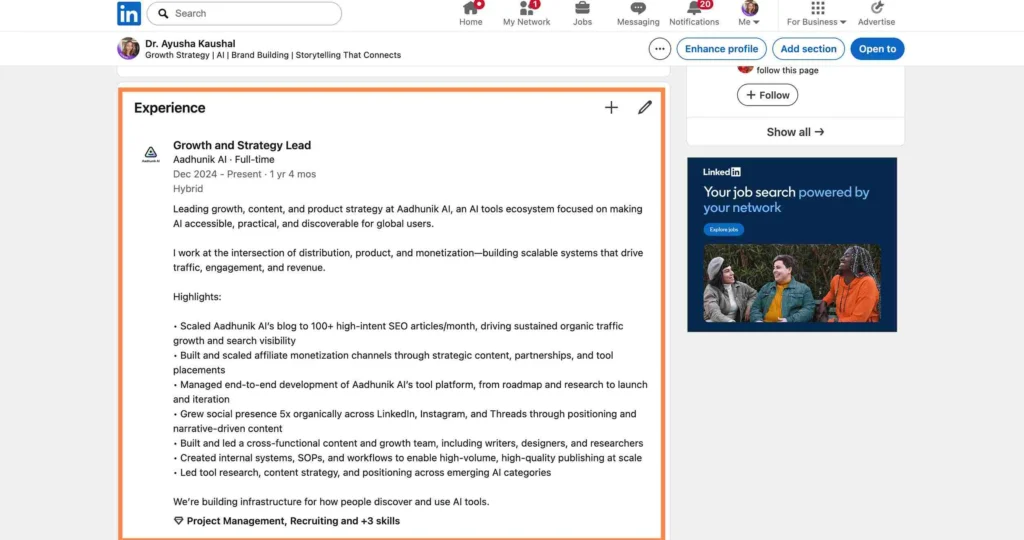
The difference lies in the numbers. Numbers can compress credibility into a form that can be understood instantly. Given that recruiters only spend a few seconds scanning before forming an initial impression, clarity of impact matters far more than detailed narratives of tasks done.
4. You’re Not Reinforcing Your Position Through Activity
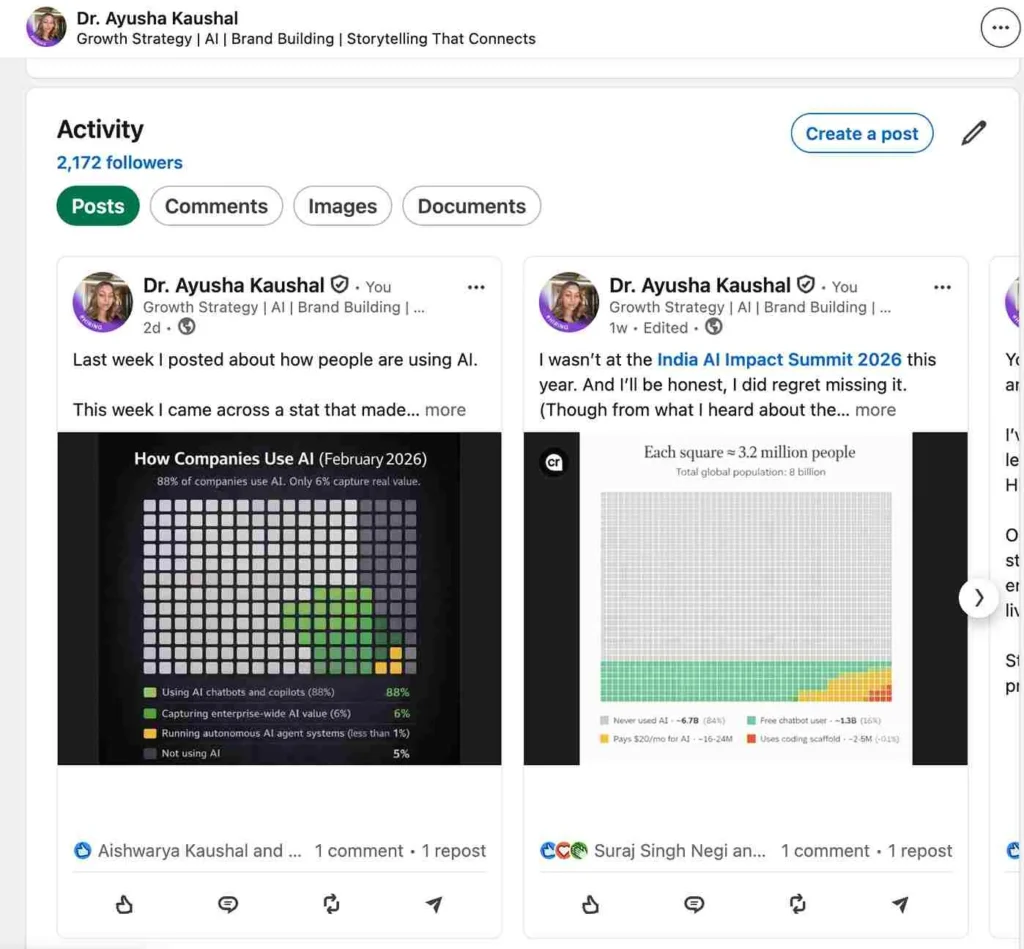
LinkedIn doesn’t evaluate your profile by itself. It also learns from your activity on the platform, including what you post, comment on, and engage with. If your profile claims expertise in AI strategy, but your activity is quiet or unrelated to that topic, LinkedIn lacks evidence to connect you with that area. Over time, this weakens how confidently the system categorizes you within a niche and you don’t end up showing in LinkedIn search results. This doesn’t mean you need to post every day, steady signals are usually enough. Thoughtful comments, occasional strong posts, and regular interactions in your field help reinforce your position. If staying consistent feels tough, some tools can help organize your activity. I recently tried one called Yooz AI, which helps create posts and comments that match your position while keeping a human tone.
Learn how to generate posts using Yooz AI.
5. Bonus Tip: Make Your About Section Authentic
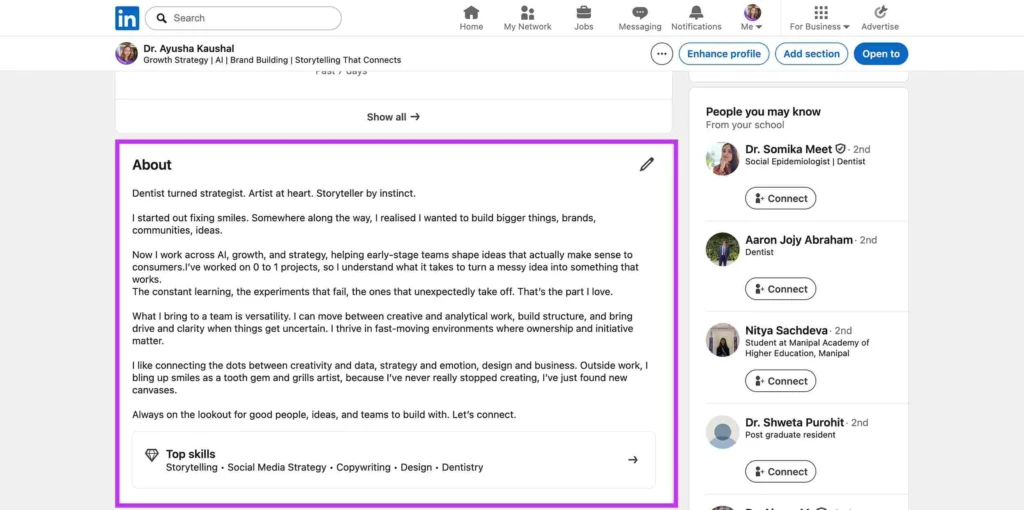
Your About section is one of the few sections on your LinkedIn profile where the algorithm is less important and the reader or recuriter is more important.
A recruiter will often read this section after looking at your headline and your experience to get a sense of how you think about your work. Many people write their About section like a bio, full of buzzwords and vague statements. Unfortunately, this does very little to help. A stronger About section will help the recruiter get a sense of your path, your perspective, and your focus.
For example, instead of listing your achievements again, you could write about:
- how you got started in your field
- what problems you like to solve
- how you work with teams or ideas
Authenticity is a powerful way to make your profile more memorable.
LinkedIn Profile Optimization Is All About Clarity
If there’s one main theme of this entire article, it’s that visibility on LinkedIn depends on clarity. The platform is always trying to understand what a profile means and where it fits in its professional landscape. Profiles that communicate this clearly are easier to categorize, easier to match to search queries, and more likely to show up when someone is looking for a specific skill or role.
A helpful exercise is to open your own profile and view it as an outsider would.
If someone spent five seconds on the page, would they immediately understand what you do and the area you work in? If the answer feels uncertain, LinkedIn’s system is likely facing the same confusion. This may be why you are not showing up on Linkedin search results and missing opportunities in a world where search visibility increasingly shapes career mobility. Act now!
