
The rise of women professionals in India’s AI revolution
Something exciting is happening in the Indian tech industry. Many more women are experimenting with AI tools in their day-to-day work; they are discovering how useful AI is for processing tasks such as report writing and analyzing data more quickly.
Women in AI India is an organization that fosters the presence of female professionals as India transforms into a digital, technology-driven economy. As a result, thousands of women are using AI in their everyday jobs. The growing use of AI by female users creates a new talent pool for companies seeking qualified engineers and data analysts.
With more women now using digital tools, they have much more comfort using those same tools and have taken on greater degrees of responsibility at their places of employment, resembling those of skilled AI practitioners.
What’s driving this change?
- Greater availability of AI tools and resources in the workforce
- Increased interest in developing digital skills
- Businesses are giving employees opportunities to try new things with AI
Why are women professionals in India adopting AI faster than expected?
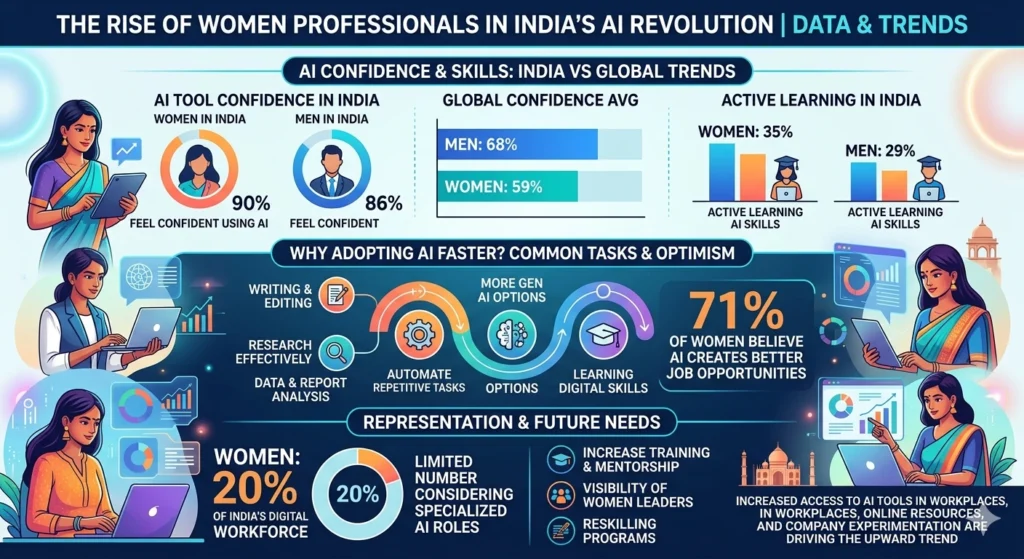
New insight into the world of work reveals an unexpected trend with women professionals in India, exhibiting a higher degree of confidence than their male counterparts regarding AI tool usage (at 90% vs. 86%). This indicates that many female professionals are using AI to find ways to assist them with everyday tasks on the job.
Instead of perceiving AI as being a threat, many professionals consider using it as a way to improve productivity and save time. These factors contribute to a larger community of women in AI within multiple industries.
Reasons for this increased adoption of AI-based tools:
- Tools/applications that automate repetitive tasks
- Access to more Generative AI platform options
- Renewed focus on learning/expanding digital skills.
How is AI helping women improve their career opportunities?
Acquiring AI skills is increasingly becoming a critical component of career advancement. Many women across different industries are using AI tools to increase their productivity. They view AI-related knowledge as a critical tool to help them remain competitive in today’s job market.
According to the findings of the Workplace Survey, 35% of women are currently learning skills related to AI as opposed to 29% of men. In addition, 71% of women believe AI can create better job opportunities for them.
Some of the common activities performed by women using AI include:
- Writing and editing
- Performing research more effectively
- Analyzing data and reports
Through the process of gaining experience in these activities, many professionals can ultimately transition to a similar position as an experienced professional who uses AI technologies.
Why does India show a different gender trend in AI adoption?
Across many countries, men appear to exhibit higher confidence than women when it comes to using AI tools. Overall, around 68% of men report feeling confident about working with AI, while only 59% of women respond similarly. In India, however, there is a slightly different trend.
Experts suggest that this trend arises because many job functions provide access to AI tools. When more people have access to AI tools, it increases the number of people willing to try them out, which contributes to increased engagement of women in AI India.
These key elements are helping both men and women professionals adopt AI faster:
- Improved access to AI resources in the workplace: Gives employees at all levels of employment the opportunity to use AI for basic job functions such as writing, researching, and analyzing.
- Availability of online training materials for both male and female professionals: Both male and female professionals are utilizing the internet to take courses to gain new skills relevant to the complexities of using AI.
- Constructive working environments: Companies that encourage their employees to try out AI in their day-to-day jobs also tend to have more female employees use this technology sooner, therefore allowing male and female employees equal access to this technology.
- Examples: Workplace tasks being made easier by the use of AI motivate employees of both sexes, especially female employees working in industries where there is little or no involvement in technology.
How are everyday workplace tasks encouraging women to use AI?
AI has become popular among many professionals due to its ability to simplify tasks. Examples include document summarization and drafting emails. These types of tools help save time, and many users will continue to use them regularly after experiencing their benefits.
Women who work in marketing, human resources, and research often rely heavily on AI for general day-to-day task simplification. They are using this technology in their everyday lives, providing them with the opportunity to learn about and be comfortable with it as a result of their regular use.
Some common applications of AI in the workplace are:
- Writing reports and emails
- Conducting quick research
- Summarizing large documents
Over time, these types of applications have helped develop skills among professionals similar to the capabilities that have been developed by seasoned AI professionals.
Many professionals start using AI because it makes work easier, and this excitement around AI isn’t limited to individual jobs. You can also see how industry events like the Robotics and AI Summit India are helping professionals stay updated on the latest trends and tools in AI.
Which women leaders are shaping India’s AI ecosystem?
Women entrepreneurs are vital to developing India’s AI ecosystem. Leaders like Ashwini Asokan, Geetha Manjunath, Prukalpa Sankar, and Bindu Reddy have created successful AI companies.
These women founders are producing solutions across sectors like health and wellness, retail technology, and data platforms, demonstrating how Women in AI India have an increasing impact on the tech ecosystem of Indian startups.
Contribution:
- The establishment of AI-driven companies
- The development of industry-specific AI solutions
- The enhancement of India’s global technology footprint.
Why are women still underrepresented in AI technical roles?
Despite the increased interest in technical roles of AI, women are still greatly underrepresented. Only 20% of India’s digital workforce is made up of women, which translates into a limited number of women considering specialized AI roles.
This gap matters because representation can influence how AI systems are designed and trained. We explored this idea further in our article on Why Women in AI Isn’t a Diversity Issue but an Engineering Flaw.
Experts agree that increasing access to training and mentorship would have an impact on increasing the number of women pursuing careers, and the number of technical skills will also be crucial.
There are several barriers to increasing the representation of women in specialized AI roles:
- Limited opportunities for technical training
- Fewer opportunities for mentorship in the field of AI
- Lack of visibility of women leaders in deep technology
The growth of support in the areas listed above could lead to more women receiving recognition as AI professionals.
What risks could AI create for women in the workforce?
AI considerations include how jobs will be impacted by technology. Analysts predict that jobs in the admin and support sectors (i.e., women-dominated professions) will see more transformations than other sectors through automation.
Expert recommendations for the workplace include reskilling and digital training, which will help individuals gain new skills and be prepared for today’s changing work environment.
Some possible solutions to help women find their voice in tech include:
- Reskilling programs that teach digital tools
- Training for workers on how to use AI/automation technology
- Encouragement from female/male employees to consider moving into tech jobs.
These ideas help women become skilled and qualified AI professionals for the future workforce.
Why the future of AI in India could belong to women professionals
Many women are trying out the tools available to them to learn about and use AI with confidence and curiosity. This is going to cause a rise in the number of women in AI in India.
On top of this, there is now much greater access to learning materials for AI than ever before, making it easier for professionals to develop new skills. More women will likely pursue careers in technology based on this new level of accessibility to training.
In the long term, more women will help create better technology that is more inclusive. More women professionals will also likely have a huge amount of influence on the direction of AI development in India.
