
I will start with a very simple and common example here. Imagine there’s an AI system and this system is trained to detect cardiac arrest. But there’s a catch here – the system’s training data comes mainly from male patients. So for males, the model is highly accurate. But for women, who experience symptoms of any condition a little differently, heart attacks for example, the system obviously misses the critical signals.
Before you think this is made up, a study was done for the same, as published on jmir.org. This is not a breakthrough study. Since the beginning of time, even before AI, things were constructed by keeping men as the target market. The most common example of this is the crash test dummies used in vehicles. For the longest time, these dummies were designed basis the average male body.
Literally many forms of this kind of scenario play out across the healthcare AI, hiring algorithms, facial recognitions and financial credit models in real time. And while there might not be any wrong intent behind this, the people building these systems are not entirely being inclusive of the actual group of people using them.
“If women make up roughly half the world’s population, but hold less than 30% of AI roles globally, and far fewer in the leadership area. The systems built, by definition, are built on incomplete data. This is an engineering flaw and not a diversity problem.”
This was the core idea that pushed the ‘AI by her’ sessions at the AI impact summit 2026. This forum included conclusive female founders, investors as well as innovators in AI. To think that the sessions only included conversations about women’s inclusivity, just for the sake of it, would be wrong. Because if you go through the sessions by yourself, you will realise that these sessions were more of a reminder to the world that when women are actually a part of these powerful rooms, wonders can be done.
What Does It Actually Mean for AI to Have an Engineering Flaw?
When it comes to software, a flaw isn’t always a bug. A flaw here sometimes could also mean a gap in the construction of that software that can sometimes lead towards wrong outputs under some conditions.
AI models that are trained on datasets reflecting a small part of human experience – mainly males, western and economically privileged. So the outputs from these datasets carry those blind spots and start reflecting at scale making them less accurate, less safe and also less unbiased.
At the surface it might look like it’s nothing or you probably might not even have thought about this but the consequences of this are measurable. Go back to the picture I showed you right at the start of this article. Another very common exhibit for this would be the facial recognition systems. According to a study done by AIAAIC, facial recognition systems have been shown to misidentify darker skin tones and on women.
There’s another example that the natural LLM’s sometimes misinterpret the speech patterns from dialects that are not well represented in training data. This is one of the biggest problem’s faced by Indians that do not speak English, but rely only on regional dialects to communicate. For them the usage of AI becomes very limited because of this specifically.
Similarly, the credit scoring AI’s are unfavourable for women. A report published by womens world banking found that the financial history required to get credit is linked to property ownership. Property ownership is something that since the beginning of time, the women have always had less access to it.
When there’s a diverse team in the building process, they ask different questions, flag edge cases that non diverse teams might miss. They also bring context to data labelling during the building phase. This in turn lets the AI system generate a much better and accurate output.
Who Said Women Only Build Soft Tech?
The most common stereotype that exists about women in technology is that they lean towards consumer apps, UX or social platforms. Also knows as the ‘soft’ side of the coin. But the AI impact summit 2026, has demolished that myth completely.
Building Drones for the Indian Armed Forces
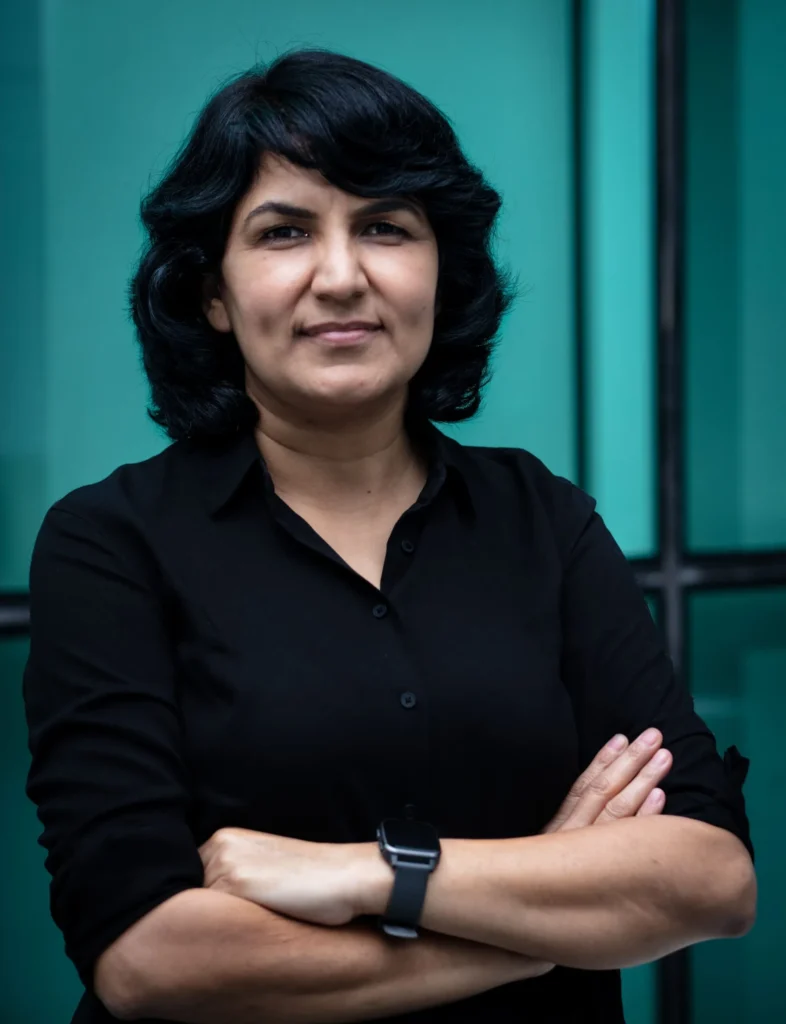
Dr. Sarita Ahlawat, the co-founder of BotLab Dynamics, spent a lot of time building without a salary in one of the most challenging hardware environments. Since India’s supply chain for the advanced electronics parts is still in the maturing stage, her team couldn’t simply order them. So they did something different.
They built their own electronic hardware pile – all from scratch.
The result afterward was truly amazing. Her team flew 900+ drones in a synchronised display at Rashtrapati Bhawan. They then proceeded to escalate this by creating a world record by flying 5,500 drones in a single coordinated swarm.
Today, BotLab Dynamics is now delivering their drone swarm technology to the Indian Army, Navy and Air Force. This has become far from a consumer software system and moved towards sovereign defence infrastructure. A system built by a woman who refused to wait for the ecosystem to catch up.
Going 300 Metres Underwater
Gouthami T S co-founded Aquarex Autonomous Systems right after graduating from engineering. Her company builds India’s only autonomous amphibious drones and hovering underwater vehicles. These vehicles are capable of diving 300 metres to inspect oil and gas pipelines. This kind of work previously required human divers operating in extreme life threatening conditions.
Beyond eliminating safety risks, Aquarex’s approach towards this also cuts the carbon emissions that are associated with traditional inspection methods by up to 80%. This is the kind of deep tech and high stakes engineering that seldom gets associated with women founders.
And that’s exactly why it matters that Gautami’s name is attached to this.
When Empathy Becomes a Competitive Advantage
The problems that affect smaller, harder to reach, or less prosperous populations, almost always tend to get disregarded. This is exactly where empathy driven solutions start making sense. And the same appeared consistently across the AI impact summit 2026 – AI by her, sessions.
Turning Grief Into Preventive Neuro Care
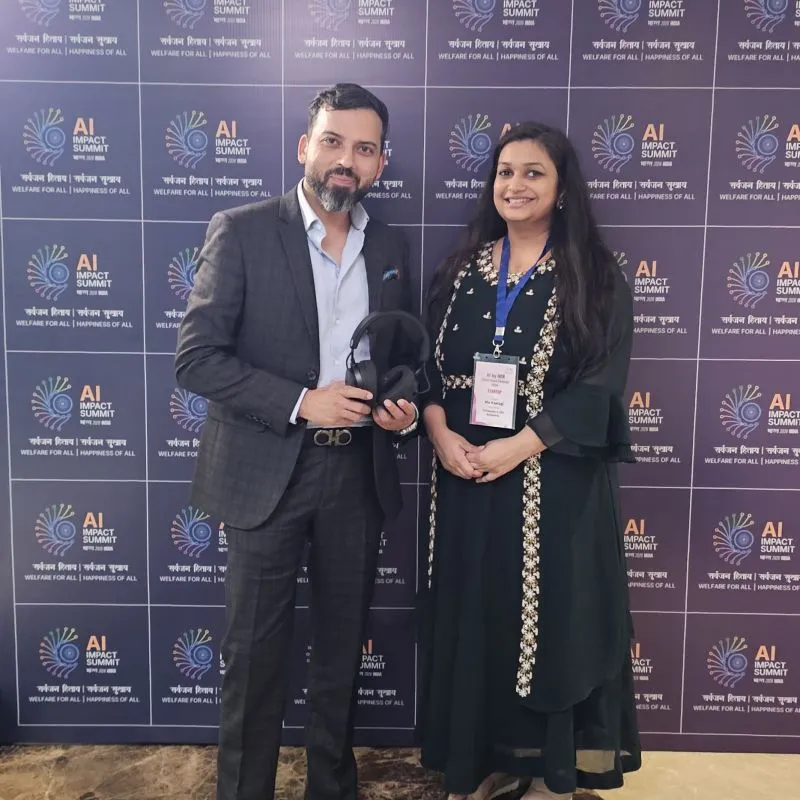
Ria Rostagi,the founder of Psyched, has a heart breaking story behind it. Ria lost her sister to a meningitis infection. It was an outcome she believes could have been prevented with earlier detection. Driven by the loss, she built an AI powered neuro wearable headphones that read brainwaves and heart rate data to detect stress, anxiety, and also sleep disruption before they intensify into a clinical crisis.
Psyched moves neurological care from reactive treatment to continuous, preventive monitoring. This is a paradigm shift the mental health sector desperately needs.
A Voice First AI That Makes Fisherwomen Carbon Accountants
11 million metric tons (and more) of plastic makes its way to our water bodies every single year. The cleanup of those depends on the low level workers, who are most often women. They collect and sort the waste, and despite doing such important work, there is no formal system to keep a record of their contribution.
So Divya Hegde, the founder of Baeru thought of a solution. She solved this problem with a voice first AI platform. This platform is designed specifically for the fisherwoman in the coastal communities.
This allowed the users to track the recovered plastic only using their voice in their native language. In India, this is a game changer. Baeru has smartly reduced the difference between the frontline environmental work and the corporate recycling mandates that fund it.
The good news is that since the launch, the fisherwoman who started using Baeru have seen a rise in their income by 133%. Solving environmental impact and economic upliftment, that’s delivered through a voice interface built with genuine understanding of the user is definitely a game changer in a country like India.
Can AI Close the Rural Education Gap for Girls?
Language barriers, literacy gaps and limited internet access are just some of the huge barriers in the rural education sector. These systematic barriers (with others) also become a hindrance when it comes to women’s participation in AI.
Shweta Sinha, who works through Dharma Life, and her initiative Roshni AI – they are positioning their AI powered learning companion in rural areas specifically for young girls in rural India. But why is it different and making an impact? It’s because the companion operates completely through voice. The best part? The platform also operates in local Indian languages which has removed the literacy requirement.
Gen Z Women Aren’t Waiting to Build the Future
Perhaps the most striking signal from the AI by Her summit was the presence of high school students. There are girls who haven’t yet taken their first college exam but have already built and deployed AI models solving real problems.
Turning Discarded Clothing Into Trackable Digital Assets
Donna Chhatwal, the founder of Eco Threads, has built an AI powered system that converts recycled plastic clothing into trackable digital assets. We can now scan our clothes and see exactly how much plastic waste and water was saved in production, making sustainable fashion quantifiable, fashionable and shareable.
Predicting School Zone Traffic Emergencies
Nora Chhatwal, who built Redline Delhi, which is a traffic management AI that predicts and prevents dangerous congestion outside schools. The model is designed to ensure safe passage for both students and emergency vehicles. This is a problem that urban planners have struggled with for decades, now approached fresh by someone who still experiences school zone traffic as a student herself.

Catching Illness Trends Before They Become Outbreaks
Paavani Kapoor’s platform VVitals monitors health data from school infirmaries to detect early micro trends in student illness, flagging the statistical signatures of seasonal outbreaks before they escalate. Schools can prepare proactively rather than reacting after the fact.
How Do Women Actually Break Through the Funding Ceiling?
Women can actually break through the funding ceiling by networking, fixing the internal monologue and having conviction in their ask. The women led startups receive approximately 18% of venture capital in India. This figure clearly showcases the systematic discrimination in investor networks, underrepresentation in the boardrooms and also investors that tend to fund what they’ve funded before.
And this is what the women founders talked about at the summit. They offered a playbopok on how to overcome these limitations for the future women founders.
Be Shameless in Networking
Kanika Tekriwal, the founder of JetSetGo, which is India’s leading private aviation marketplace, puts it very simply: You have to put yourself out there shamelessly. What could the worst outcome be? A ‘NO’.
But the best outcome? A door opens for your dreams and visions to come to life. Honestly, the stakes with this one are high by being extremely shameless. Our social conditioning as women trains us to wait for permission to enter rooms. Tekriwal’s advice? Stop waiting.
Fix the Internal Monologue First
Rucha Nanavati, who is the Chief Digital Transformation Officer at Mahindra & Mahindra, identifies a specific pattern with women founders.
Women often hesitate to ask for help. Why? Because their internal voice tells them what conditioning has taught them: ‘I am not quite ready yet’ or ‘I am not qualified’ or ‘ I am not enough.’
But Rucha insists that the women identify the internal monologue, then correct it, then show up prepared, and then ask. She noted that if approached with clarity and confidence, the people are actually eager to help.
Capital Is Not the Problem
The leaders at the summit were consistent on one point despite the funding gap: there is no shortage of capital in the world. To get the capital though, there should be depth of conviction in whatever value you are proposing as a founder. There should be a willingness to reach out eagerly. And most importantly the ability to articulate very clearly and simply that whatever solution you’re bringing – it matters.
The Architecture of a Fairer AI Future
The AI by Her sessions at the AI impact summit clearly demonstrated what women leaders in AI are building. It also showcases what has already come into existence with women as leaders in AI. From drone swarms to health prediction tools – all the technology that was showcased at the summit is a fact that women don’t need to wait for the ecosystem to be ready for them.
The inclusion of women should come from the grassroot level when building an AI or any technology that includes all people, and not just men. If the teams are not diverse, the outputs will be incomplete and incomplete teams build incomplete solutions.
What we have to understand is that the cost of the incompleteness starts showing in biased medical diagnosis, unfair life building decisions and also AI tools/solutions that stall half the people they claim to serve.
