
Why real-time insights matter on X
On X, trends change faster than ever before. A hashtag that is popular today could be irrelevant tomorrow in a different digital world. For creators and marketers, of course, time and relevance are winners or losers when it comes to visibility. That is where Grok has come along: an AI-powered tool built right into X, where it gives users real-time data to help them stay ahead of the curve.
When creators use Grok, they can quickly see what is trending, what people are reacting to, and how to best tailor their content to maximize their content reach. This article shows readers how to boost engagement on X using Grok’s intelligent analytics, starting with finding trending topics and high-engagement hashtags and adapting their overall strategy.
Understanding Grok and its capabilities
Grok is X’s integrated AI assistant designed to optimize content creation. Rather than researching popular content manually, Grok provides instantaneous data on trendy topics, viral hashtags, and the current activity of an audience.
The main tools are:
- Real-time analytics about content performance.
- Trending topics to identify viral conversations.
- Hashtag performance to enhance visibility.
- Audience engagement metrics to show what works best.
By leveraging these tools, creators and marketers can make data-driven decisions versus making guesses about the next trend.
To explore how different Grok models work and which one best suits your needs, check out our detailed Grok AI Models Guide.
Finding trending topics on X
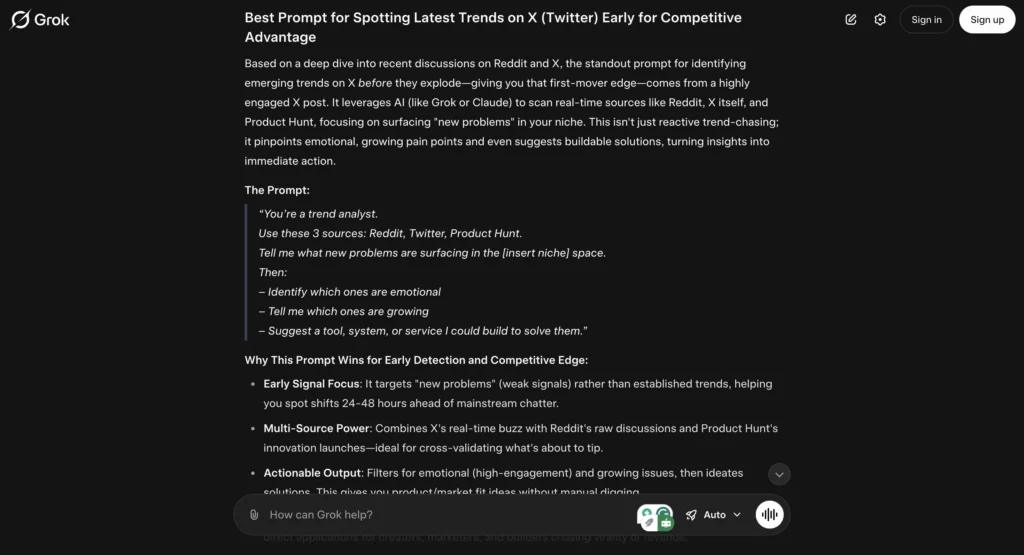
In order to raise engagement on X, creators should post about things already being discussed. Grok makes this simple by finding trending topics for your audience and interests.
Here’s how to effectively find engaging topics:
- Open Grok and ask for “What’s trending on X right now?”
- Identify which trending topics fit your niche or brand.
- Post a relevant conversation early. Timing matters.
Once you are trendy, your visibility will increase, and you will receive more impressions, comments, and reposts.
How to find high-performing hashtags with Grok
Hashtags allow users to find interesting content, although content creators should refrain from adding too many irrelevant hashtags. Being relevant is more important than just adding popular hashtags.
Use Grok to find hashtags related to a particular topic and audience, and compare them with hashtags that are already used in current discussions.
For instance, a technology content creator may ask Grok:
“Suggest relevant hashtags for an X post about AI productivity tools. Prioritize hashtags that match the topic and audience.”
Users should also test their hashtags over time. If a particular hashtag is inefficient in attracting the relevant content, substitute it with a more precise one.
How to analyze your best-performing X posts
Understanding how your audience interacts with your content is crucial when determining how to get better engagement on X. Grok provides deep analytics into engagement metrics like likes, retweets, replies, and impressions.
Content creators should:
- Find out which posts have the highest engagement rates.
- Learn what type of content, images, polls, threads, etc, performs best.
- Change your frequency and/or timing of posts, based on when your audience is most active.
By collecting this data, you can better shape your future programming decisions, so each post aligns with your specific audience.
Optimizing your content strategy with Grok
Grok’s AI analytics are invaluable for individuals who are trying to plan impactful posts, threads, and even campaigns. Users now have real-time data to help them understand when their audience is most engaged, schedule messaging around peak times, and even pivot messaging to embrace whatever is trending and relevant at the moment on X.
All content strategies need to identify a good balance of trend-based content and a consistent brand voice. Riding on trends increases visibility and followers; being yourself builds trust and credibility and can result in sustained engagement. Grok’s insights will enable creators to do both, ensuring content is timely and relevant while still in your voice and your identity.
How to use audience insights to improve X engagement
Creators can enhance their strategy by analyzing what resonates with their audience. Effective indicators consist of replies, shares, likes, impressions, and discussion-generating topics.
Notice the trends in your best-performing posts.
Ask:
- What subjects lead to the highest amount of replies?
- What posts get the most shares?
- What formats draw attention?
- What hooks make readers continue?
- What topics are frequently discussed?
Once the creators detect these patterns, they can create more content based on the topics that are of real interest to the audience instead of trying out new flat ideas all the time.
How to use Grok to find the best time to post on X
No single posting time works for every X account. Your audience’s location, activity patterns, and content niche all affect when people engage.
Creators can use their existing performance data to identify stronger posting windows. They can then ask Grok to analyze those patterns and suggest a testing schedule.
For example:
“Based on these post-performance results, identify the strongest days and times and suggest a posting schedule I can test.”
Test different time slots for several weeks and compare the results. This approach works better than following a generic “best time to post” recommendation.
Maximizing visibility and driving organic growth
Your success on X depends on timing, consistency, and audience comprehension. Grok assists creators in identifying the best times to post and the types of content that perform well.
To achieve organic growth:
- Participate regularly during peak engagement times.
- Consistently post with relevant hashtags.
- Review your analytics weekly and revise your strategy.
With Grok, the creator can grow their audience organically and not just pay for ads/post boosts.
Also see how Paytm’s new AI-powered ‘smart wallet’ update is redefining user experience and engagement.
Grok’s real-time access to X: A game-changer for AI conversations
Grok, an AI chatbot launched by Elon Musk’s xAI, differs from typical AI models like ChatGPT because it has real-time access to X (formerly Twitter). While traditional AI is based on static training data, Grok is continuously in the middle of live interactions, news, and what is trending at that time. It can deliver timeliness to current events, synthesize current events, and even conduct real-time analysis to help determine public sentiment. Journalists can use Grok to track developments in real time, while marketers can study the moods of an audience. Grok is your live assistant researching what matters right now.
This functionality is more than just basic fact analysis. Grok leverages sentiment analysis and contextual analysis to understand how people feel about the trending topic of the day, a product launch, or a political event, and uses its tone, developed by the raw, unfiltered environment of X Grok’s responses feel more human and conversational. From the perspective of business, this live intelligence and full understanding of audience engagement present the opportunity to leverage consumer decisions and make sophisticated data-driven, and AI decisions relevant every second.
Best Grok prompts for increasing engagement on X
Specific prompts usually produce more useful results than broad requests. Creators can adapt prompts like these to their niche:
- “Find current conversations on X about [topic] and explain why people are discussing them.”
- “Give me 10 original X post ideas based on current discussions about [topic].”
- “Analyze these posts and identify the hooks that encourage engagement.”
- “Turn this topic into five X thread ideas for [audience].”
- “Suggest three original angles for discussing [trending topic] without copying existing posts.”
- “Rewrite this X post to make the opening more specific and engaging while keeping my original message.”
- “Suggest questions I can ask my audience about [topic] to encourage meaningful replies.”
Creators should treat Grok’s output as a starting point rather than publishing it without editing.
Grok vs X Analytics for content performance
Grok and X Analytics serve different purposes.
| Tool | Best use |
|---|---|
| Grok | Research, current conversations, content ideas, summaries, and analysis |
| X Analytics | Measuring post and account performance |
| Grok + X Analytics | Combining performance data with AI-assisted interpretation |
Creators should use X’s native analytics to understand actual account performance. They can then use Grok to interpret those patterns and develop new content ideas.
This distinction also prevents creators from assuming that Grok replaces X’s dedicated analytics tools.
Turn insights into engagement and growth on X
Grok turns assumptions into a strategy. Creators and marketers can now use data to increase engagement on X, rather than just luck.
With Grok, active users can track trends, discover high-performing hashtags, and optimize their posts for higher reach. The idea is simple: analyze, post, and increase engagement.
Discover how Grok’s viral emergence began in our detailed analysis of why it went viral.
FAQs
Grok can help users explore current topics and conversations on X. Results can vary depending on the topic, available information, and how users phrase their prompts.
Grok can help creators research topics, develop content ideas, analyze patterns, and improve posts. It cannot guarantee engagement because audience response depends on factors such as content quality, timing, relevance, and existing audience interest.
Give Grok a specific niche and audience rather than asking only for general trends. For example, ask it to identify current conversations about AI marketing among small businesses.
Grok can help users analyze available posts and conversations. For detailed account-level performance metrics, creators should also use X’s native analytics tools.
Grok is better suited to research, brainstorming, and interpreting conversations. X Analytics is better suited to measuring actual account and post performance. Using both can give creators a more complete picture.
