
Finding a job is much more than just applying for open positions: you need to choose what jobs to apply for, browse many different platforms for postings, go through the job ad, adjust your CV, prepare cover letters, get in touch with recruiters, network, prepare for interviews, negotiate offers, and document everything along the way.
As you can see, this is quite a complicated procedure in which the same actions are repeated again and again.
Here is how AI may come in handy: if used wisely, it can help with such repetitive tasks as comparing your CV with the job description for a certain position, creating your cover letter, managing your job search, and preparing for a conversation with a recruiter.
While AI cannot guarantee you a job, take the diligence and judgment of a people out of the way.
Note: The bullet points in this article are prompts. They are formatted this way for clarity and easy reference.
What kind of job should I actually be searching for?
Make sure you know what you are looking for before you start looking. A lot of job hunters fail to see that limiting themselves to a single job title could keep them from many potential opportunities.
AI can help you cast a wider net without losing your focus. You can even feed it your CV or a brief summary of your background and ask it to work backwards based on your skills.
- Based on my resume, what job titles am I qualified for that I might not have considered?
- List adjacent roles to [current job title] that use similar skills but sit in different departments or industries.
- Identify my strongest transferable skills from this resume and suggest three career paths where they would be valuable.
- Compare these two career paths for someone with my background: [path A] and [path B]. What does each require that I don’t currently have?
- Given my experience in [industry], which other industries commonly hire for similar roles?
- Rewrite this job title into five alternative titles companies might use for the same role.
Think of this stage as research, rather than decision-making. The point is to end up with a broader and more informed shortlist of possible jobs.
How can I build a smarter job search?
After determining what job you want to find, you can spend hours manually browsing your five favorite job boards online. Luckily, the power of AI job search prompts makes this process much easier.
Using AI instead of conventional job hunting techniques can be a game-changer when it comes to developing your search strategy.
- Write a Boolean search string I can use on LinkedIn to find [job title] roles in [location] at companies with under 500 employees.
- Build a list of 20 companies in [industry] that are likely to be hiring for [role] based on recent growth or funding news.
- Turn this job description into a Google search query I can use to find similar openings elsewhere.
- Create a weekly job-search schedule that balances applying, networking, and following up, based on 8 hours a week of availability.
- Suggest search terms I’m probably missing if I’ve only been searching for “[job title]” so far.
This is not about finding just one perfect job opening. Instead, you should focus on creating a system that you will be able to replicate every week.
Is this job actually worth applying for?
Not every job opportunity has to be considered, even though it refers to the job title of interest. This is the part many people overlook, and this is ultimately what makes a search feel tiresome and unproductive.
You can use AI here. It will be enough to copy-paste the job description into the application and let AI do its filtering.
- Compare my resume with this job description. Separate the requirements into skills I clearly meet, skills I partially meet, and skills I currently lack. Then tell me which parts of my experience I should emphasize.
- Which requirements in this listing are likely “must-haves” versus “nice-to-haves,” based on how they are phrased?
- Does this job description contain any red flags in tone, structure, or expectations that I should be cautious about?
- Rank these three job postings by how strong a match they are for my background, and explain the reasoning.
- Based on this job description, is this a role I should prioritize applying to this week, or is it a lower-priority option?
This step will save you from wasting hours on creating a great resume for a position you shouldn’t have even been dealing with.
How can AI make my resume stronger?
A resume evaluation is another good opportunity for AI, provided you instruct it. The risk with this method is that AI might believe in bogus information and provide it, so you will need to be very precise about it.
- Compare this resume against this specific job description and tell me which three bullet points I should move higher or emphasize more.
- Which keywords from this job description are missing from my resume, assuming I genuinely have that experience?
- Rewrite my summary section to speak directly to this job description, without adding anything I haven’t actually done.
- Reorder these bullet points so the most relevant ones to this job appear first.
- Do a final check: does this tailored resume still sound like me, or does it read as overly generic?
Never accept AI output without reviewing it. AI is good at improving the way we express ourselves but should never be used to generate new data about your career.
How can AI help me write an application that doesn’t sound generic?
Cover letters and application inquiries are probably where most AI-generated content fails. The biggest reason behind this is people asking the AI to write a complete letter and copy-pasting it without making changes. Use the AI only for making an outline and getting a draft, but you have to edit it after.
- Draft a cover letter outline for this role, based on my resume and this job description. Keep it under 300 words.
- Answer this application question in a way that avoids generic phrases like “I’m passionate about” or “I would be a great fit.”
- Rewrite this cover letter draft to sound more specific to [company name], based on what I’ve told you about them.
- Suggest three different opening lines for this cover letter that avoid clichés.
- Review this application answer and point out anywhere it sounds like it could have been written for a different company.
The best thing you can do with AI here is to use it as an editing tool, but not as a ghost writer.
How can I use AI to improve my LinkedIn profile?
Hiring managers turn to LinkedIn first before taking a look at other sources. When a candidate falls short in their LinkedIn profile, their resume may take a hit.
- Help me reword my LinkedIn headline, so that it properly communicates my desire to get a position of [position] based on my qualifications.
- Turn the summary of this resume into a more personal yet meaningful About section of my profile.
- Help me add certain skills and abilities to my LinkedIn profile to improve the chances of getting a job.
- Please make this excerpt more results-oriented by using only the data I provided.
- Does my presence on LinkedIn indicate that I am seeking a new opportunity, or does it rather seem inactive?
How do I use AI to network without sounding awkward?
Networking is an area where many job hunters get stuck since they are uncertain on what to say. AI is your best option to assist you in finding the right words to use without sounding robotic.
- Write a LinkedIn connection request to someone who works at [company] in [role], mentioning that I’m exploring opportunities there.
- Draft a message asking a former colleague for an informational interview about their current role at [company].
- Suggest three conversation starters for reaching out to someone who works in [industry] I’m trying to break into.
- Write a follow-up message to someone I met at an event two weeks ago, referencing the conversation we had about [topic].
- Draft a message asking a connection if they’d be willing to refer me for a role at their company, without making it sound like I’m only reaching out for that reason.
How can AI help me contact recruiters?
Recruiters have many messages to respond to, so being specific is more important than being polite in this case.
- Write a brief message to a recruiter who has shared a particular job description that you know something about.
- Write an effective follow-up message to a recruiter who was supposed to get back to you after some time.
- How to reply to a recruiter who contacted you about a position that is not suitable for you, but you still want to keep the communication going?
- Write a brief message inquiring to a recruiter whether the process is over after some waiting time.
- Write a thank-you letter to a recruiter after your initial screening call.
What should I do when I get an interview?
This section of the job hunting motif deserves careful scrutiny of its own, and this site already has it. Once you make it to the interview level, you have the opportunity to design your own AI-enabled interview process, including simulations, providing the right background knowledge. Check out our full guide on ChatGPT prompts for job interview preparation.
How can AI help me negotiate the offer?
Preparation, rather than confidence, is key to succeeding in negotiations. AI can help you better organize your thoughts and formulate your request, but it is always advisable to double-check your figures.
Whatever job offers you might have in front of you, make sure to carry out a proper comparison between them based on their salary, benefits, and opportunities of advancement.
- Please assist me in identifying the negotiation possibilities unrelated to salary I could utilize when dealing with the job offer.
- Please write a formal letter requesting a higher salary sitting on the base of the job offer you’ve got as well as the data I’ve gathered.
- What questions should I ask before accepting this offer that I might not have thought of?
How can I use AI to keep track of my applications?
A sloppy job tracker is among the lesser known factors that lead job hunts to come to a halt. The power of AI is that it can recognize patterns in dozens of rows of data that you would take an hour to do on your own.
| Company | Role | Applied | Contact | Status | Follow-up | Notes |
|---|---|---|---|---|---|---|
| Example Co | Marketing Manager | Jul 12 | J. Patel | Interviewing | Jul 30 | Second round scheduled |
- Review this application tracker and tell me which applications are overdue for a follow-up.
- Based on this tracker, which companies should I prioritize contacting this week?
- Summarize this tracker into three tasks I should complete before Friday.
- Which companies in this tracker haven’t I researched yet, based on the notes column?
- Are there any patterns in this tracker, such as certain industries or role types responding faster than others?
What can I do if I’m applying but getting no results?
An unsuccessful job hunt can be uninspiring, and there can be a lot of reasons. AI can assist in identifying trends in all the data it is given, but nobody knows specifically why one application is not picked up other than an employer. Thus, during this stage, use it to recognize patterns, not facts.
- Analyze the job descriptions in which interviews were granted against job postings for roles for which one was not interviewed at all. What are the differences?
- Based on the list of applications and results, is it possible to find some repeating skills missing from the applications?
- Prepare a short-term plan to acquire the missing skills, and activities can be either free or affordable.
- Examine your job searching strategy and recommend two changes based on your findings.
How should I use AI throughout my job search?
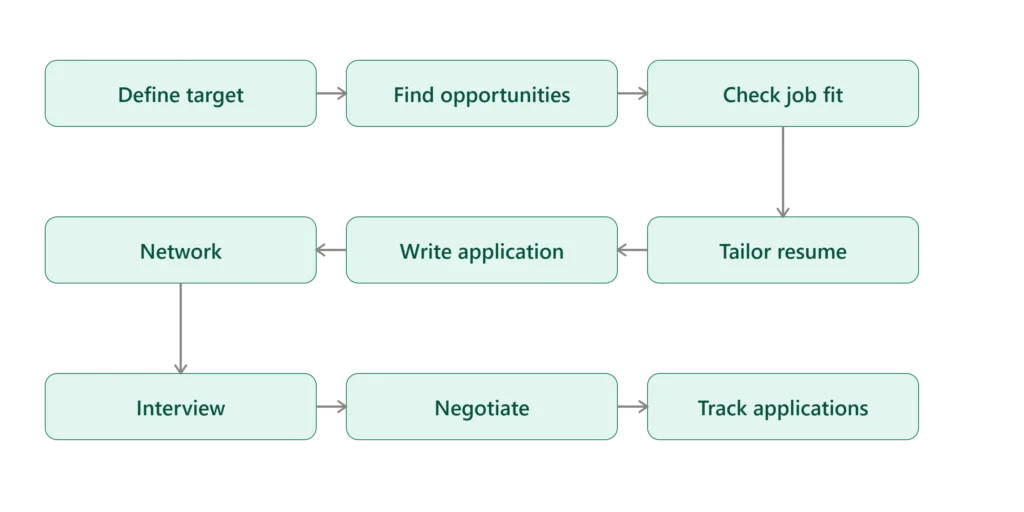
The entire procedure involves the following steps: setting the target, searching for possibilities, ensuring the compatibility of the job, formulating a CV, writing a request, connecting with people, going for an interview, negotiating, and monitoring the process.
Using artificial intelligence solutions in job hunting is only effective when it is used as an assistant. Clever technology can help generate documents, compare information, sort and analyze information, but cannot choose the applicants’ targets in job hunting or justify their experience.
Key takeaways
Artificial Intelligence is most beneficial as a job search tool when it is seen as an instrument for minimizing repetitions and not for taking decisions on your behalf. AI can be handy during almost all stages starting from identifying the job types you would like to pursue and ending with writing the letter to negotiate the job offer.
However, the final accuracy of your resume, honesty of your job applications, and decisions on job offers must always be yours. Always crosscheck any time-sensitive information, like salary specifics, with up-to-date information and make sure that you had a look at whatever the AI generates before passing it to the potential employers.
