
Zero-click search has reached a critical juncture. Over the years, publishers have witnessed Google retain more and more of their material on its results page rather than redirecting visitors to their websites. Now some of the largest players in digital media are preparing to carry out a certain move that would have seemed unthinkable two years ago: blocking Google altogether.
Cloudflare, which provides hosting services for around one-fifth of all the world websites, has put an ultimatum to Google. The ultimatum implies that starting from September 15, its default settings will not allow any “multi-purpose crawlers” to function on any ad-supported page until specified by the site owners. In other words, any bot whose job is to extract content from websites both for indexing and for training AI will be automatically blocked.
This action alone illustrates how high the tensions around the zero-click search issue have escalated.
Why are publishers finally pushing back against Google?
For years, getting a good rank on Google was the entire objective. Traffic generated through search was frequently a website’s leading source of income and readers, so nobody wanted to lose it.
This thinking is undergoing a change. As traffic generated through referrals is dwindling, producers are not afraid to lose that traffic.
According to Cloudflare chief strategy officer Stephanie Cohen, the company is looking for a technical solution that would allow publishers to be found without sharing their work for free. The problem is that Google has only one web crawler that fulfills two functions: crawling pages for search and collecting data for AI. Blocking that crawler would mean that a publisher has to either accept both the functions or refuse both the functions and vanish from Google Search.
Google has offered a workaround called Google-Extended, which is meant to help publishers avoid being used for training AI models. However, according to the managers of two media companies, publishers are not sure that this tool will not harm their visibility in search on a quiet note.
How are Google AI Overviews and AI Mode changing search?
AI Overviews feature above regular blue link results by providing a user with direct response consisting of material coming from the publisher’s content, meaning there is actually no need to click. Based on research, publishers’ suspicions have all along been correct.
Some facts worth noting:
- A Pew Research Center study sampled 900 Internet users in the US and measured the 8% of clicks on results of traditional search queries featuring AI Overviews. When compared with 15% of clicks on traditional search results without AI summary.
- The same research revealed remarkable gap in browsing session ending metrics. With 26% of AI Overview searches terminating browsing session vs. 16% in the situation where no AI Overview is available.
- Seer Interactive research showed huge decline in organic click-through levels for queries involving AI Overview. With CTR plummeting from 1.76% to 0.61%.
This is the way zero-click searching mechanisms work: the answer appears directly on the search results page. Hence, the clicks that would have been made to reach the website in order to find the answer do not take place anymore.
Why is Cloudflare’s move such a big deal?
Cloudflare has a significant portion of the Internet in its possession, thus, the configuration made by it is important. Beehiiv, a newsletter platform, has struck a deal with Cloudflare and provided its network of creators with the opportunity to prohibit the Google crawler.
USA Today Inc., the owners of USA Today and a comprehensive network of local news pages, are thinking about following the same steps in the words of its CEO Mike Reed. The news site has maintained a stable level of traffic due to utilizing newsletters, social media, and events and has gathered around 1 billion pageviews every month for the last three years. The monetization of its AI solutions is based on contracts that were signed previously with Meta, Microsoft, and Amazon.
USA Today Co, like all publishers, has been busy diversifying its traffic sources and updating its traffic-and-ads-focused business model, reported the Rebooting.
Regulators follow the situation too. In June 2026, the UK Competition and Markets Authority was said to instruct Google to let publishers choose whether to use its AI tools or not without prohibiting.
Google responded by testing a new Search Console control in the UK that separates AI feature participation from ranking.
What does this mean for publishers and website owners?
The awkward situation arises from the fact that, according to SEO consultant Lily Ray, giving up Google Search would have usually meant death for a business in the past. As the search engine is an indispensable source of audience. She observed that it’a rather difficult choice since some publishers have managed to cut off OpenAI’s crawlers. Until they can come to some kind of agreement, but Google surely has much more power due to the number of users.
| Choice | What you keep | What you risk |
|---|---|---|
| Allow the crawler | Search visibility and organic traffic | Your content may be used to train Google’s AI with limited compensation |
| Block the crawler | Greater control over how your content is used | Reduced visibility or exclusion from Google Search results |
| Use Google-Extended | Partial control over AI training while remaining in Search | The long-term impact on search rankings remains uncertain |
Each of these few options seems suboptimal. One media player was reported calling the current state of things a lose-lose. Succumbing to Google’s demand for free access would damage the media business, while opting out provides no benefits in return.
However, a media executive who has been working with Google pointed out that the publications she collaborates with contribute to people’s online experience with generative search many times a day. The contradiction between exercising power and becoming irrelevant explains the stalemate in the process.
What does this mean for the future of SEO?
SEO experts now need to adapt to a search engine that increasingly provides answers rather than directs users to other pages. SEO is not dead; on the contrary, it is more focused.
Obtaining a first page rank is still important for AI Overviews as Google extracts its summary from the leading websites. But ranking only doesn’t ensure visits anymore. This discrepancy between the presence in the results and an actual click is what should be evaluated now.
Publishers are likely to start viewing Google traffic as one of the channels rather than the only way to reach people. Newsletters, direct traffic, applications, and AI companies’ licensing deals are increasingly seen as alternatives rather than plans B.
What should businesses do next?
It is not smart to just wait for Google to solve this issue for you. There are a few steps you can take right away:
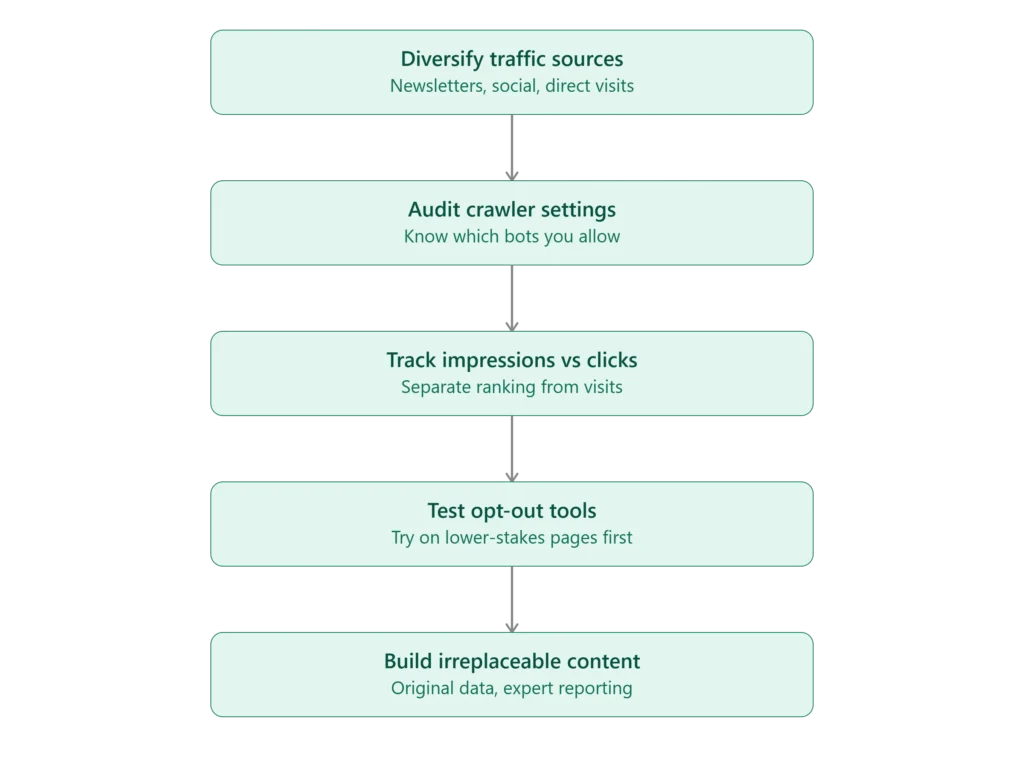
- Get traffic from several sources rather than relying on just one source. Use newsletters, social media, and direct traffic to your site to lessen the reliance on one SEO algorithm.
- Audit your robots.txt file and your crawl settings. Be sure you know exactly what bots you are allowing into your site rather than just accepting default settings.
- Track impressions and clicks separately. A page may rank well but may receive almost no traffic since the answer is simply an AI Overview.
- Pay close attention to the Google-Extended and Search Console opt-out tools. As you may want to test these tools out on less important pages before making major decisions about your whole site.
- Create content that AI summaries can’t replicate easily. Data, expert opinions, and primary sources are harder to summarize into a three-sentence response.
If you’re rebuilding your SEO workflow around this shift, these AI SEO tools can help automate keyword research and content optimization so your team spends less time on manual audits and more time on the content AI Overviews can’t easily replace.
Zero-click search is not simply a short-lived decline, it marks a fundamental change in the operation of Google Search. And that the fact that publishers have already contemplated quitting the platform that generated their business means that this is a very serious issue for the industry today. Companies that adjust their SEO in reaction to this change instead of waiting for Google to respond to this development will be in a much better position when the dust settles.
