
There is a story inside your head. The only thing left to do is find the AI chatbot that will get the work done without diminishing your voice. The art of AI novel writing has moved past the “will it sound too mechanical?” phase. The relevant question today is which approach is good concerning story development and character portrayal.
The three contestants, Claude, ChatGPT, and Grok, can create fiction but do it differently. Each attempt was put to the same test: to write an intro chapter, a character appearance description, and a script of conversation.
What is AI novel writing?
When writers use an AI to write their novels, it means using a language model to create or edit parts of a novel manuscript. LLMs can be used to create outlines as well as drafts of scenes, dialogues, and ensure that the story remains the same throughout the length of the book.
Such an immediate relevance of AI writing in novels can be explained by the fact that grammar-wise the gap between the AI models has decreased dramatically, while the gap concerned with the quality of judgement has significantly increased.
How does each AI actually handle a fiction prompt?
All three models were given the same scenario: a rainy small-town setting, a narrator hiding a secret from her sister, and a dialogue scene where the secret almost slips out.
Claude opened with a small, specific image and let the tension sit under the dialogue instead of naming it outright. ChatGPT wrote a clean, well-paced scene that hit every beat the prompt asked for, in the order you’d expect. Grok moved fastest and took the biggest swing on tone. Leaning into a wry, informal narrator voice that either fits your book or fights it, depending on what you are writing.
None of them did a poor job in writing. It was a start, all they needed was a direction and a tone. Because none of them can assume what you want your book to sound like unless you tell it.
Claude vs ChatGPT vs Grok for novel writing: which one handles narrative voice better?
This is where three options for AI novel writing become different from each other.
Claude
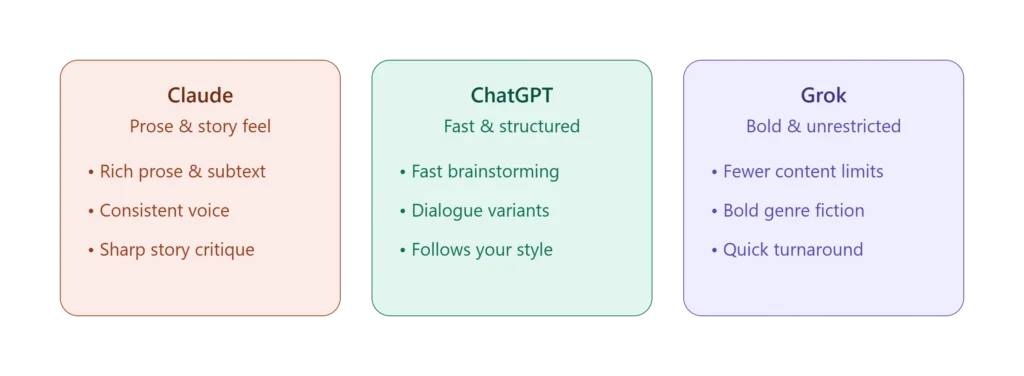
Claude seems to be a writer who has remarkable knowledge of what has been published in terms of variety of literature style. The AI can see underlying themes, allow readers to grasp the meaning by themselves and does not interfere too much. Claude Fable 5 has been created particularly for the purpose of working with fiction. This is an AI that can keep the same tone throughout the long text, unlike other AIs that sometimes fail to do so. Claude Sonnet is a more practical choice for writers who need an AI for working with short stories or short texts. As it is cheaper than the other two.
ChatGPT
ChatGPT performs like a highly-skilled writer; however, GPT-5.5 is the best of the other three programs. It is quick, it complies with long instructions consistently. And it does very well in the brainstorming process of ideas for new stories. Its drawback is taking risks in the creative process where it has not been asked to do so.
Grok
Grok stands out due to having a more creative and original touch. Most importantly, it has fewer limits when it comes to the content of the stories. It produces plot structure and continuity well. Also, this software writes quickly, but its main downside is that it rarely comes up with unique ideas.
| Factor | Claude | ChatGPT | Grok |
|---|---|---|---|
| Prose and subtext | Strongest of the three | Solid, but more literal | Personality-driven, though it can feel generic without clear direction |
| Following a voice profile | Very strong, especially with Fable 5 | Strong, responds well to custom instructions | Moderate, often needs frequent reminders |
| Long-book continuity | Excellent, especially with a project workspace | Good when supported by organized notes | Good, but may drift over very long outlines |
| Content flexibility for dark or mature themes | Most restrictive | Restrictive | Least restrictive |
| Best use case | High-quality prose, revisions, and story critique | Fast ideation, dialogue variations, and structured drafting | Genre fiction with mature themes and quick scene generation |
Which AI handles dialogue and character voice best?
Choose any character, and assign to him a character profile, as well as make a description of his wound, want, and tic. The distinction is the way of expressing the same character described in various scenes.
- In the case of Claude, it is able to recreate the behaviour of the character in question so that its speech patterns will be maintained without you repeating the character notes countless times.
- In the case of ChatGPT, it can create a reliable character for the entire project or according to the given command before switching to another case.
- Grok creates powerful dialogues without much effort but sometimes risks losing uniqueness in plots, as different characters would sound very similarly unless you say otherwise.
Unswervingly true to the principle that works for each model, one should never let the tool create a character’s voice completely independently from the scratch.
Which AI handles risk, dark themes, and creative boundaries?
This difference is the most important one when it comes to genre fiction writers.
Claude and ChatGPT tend to be more careful with everything connected to violence, adult content, and morally ambiguous scenes, which often leads them to modify or reject scenes even if they definitely can find a place in a published novel (like horror or thriller). Grok, on the other hand, applies fewer restrictions automatically, making it the go-to choice for numerous writers when they want to write an unflinching scene.
But that does not mean that any of these options gives you a free reign. All three tools have their limitations, and asking a model to write around the limitations rather than honest creative framing usually leads to unoriginal literature anyway.
Have any real authors published novels using AI?
AI-augmented authors can come from a range of backgrounds including some of the most respected novelists to prolific self-publishers.
The case of Japanese writer Rie Kudan illustrates how AI can help with crafting award-winning literature. As she has recently won a prestigious literary award after, while she did admit that a small part of her novel (5%) was written with ChatGPT, while most of the dialogue was crafted using her own hand.
On the contrary, some authors like Coral Hart proved that AI can radically change the publishing scene, as they have been producing hundreds of novels in just one year with the help of AI tools, reported Futurism.
Still, many authors use AI mainly to conduct their research, create outlines, and edit their works, rather than rely on AI for writing the complete paper. In fact, the most important thing about the work of AI is that the author must remain responsible for the final draft.
What are the best AI tools for writing fiction outside these three?
Claude, ChatGPT, and Grok are general-purpose chatbots first and fiction tools second. If you want to see how they stack up on blog posts, marketing copy, and other non-fiction writing, our Claude vs ChatGPT vs Grok content writing comparison breaks that down separately. A few dedicated platforms exist specifically for novel writing, and serious authors often pair one of the big three with one of these:
- Sudowrite is one of the best tools for writing fiction. It offers resources like the Story Bible, a scene generator with prompts, and rewriting capabilities which fit a novelist’s job rather than a chatroom-style interaction.
- Novelcrafter is specifically for the purpose of creating long pieces of writing in an organized manner. Offering features such as a codex that will keep track of characters, places, and events across the manuscript or across the whole series, which is not something that general chatbots do. If you’re a beginner, start with this tool as it offers a 21-day free trial.
- NovelAI is a tool best for Anime art and stories. Right now they have a 5 year NovelAI anniversary contest which you should definitely check out.
- Gemini is a capable generalist that has a wide context window. Making it useful for users that already work within the Google framework.
- Jasper is a tool which is more for writing copy for advertising than for noveling. But some writers still manage to write blurbs, synopsis, and back cover texts.
In most cases, writers do not just choose one tool. The common approach is to use Claude or ChatGPT for the creation of a text, and a platform like Novelcrafter for maintaining thematic coherence. Along with a special writing environment like Sudowrite in the cases when a writer needs some kickstart for his work on the text.
What is the best AI for novel writing right now?
With regards to prose quality and in story evaluation, Claude takes the lead among the three, and this can be attributed to its writer-specific creativity model.
In terms of speed, brainstorming capability, and drafting with rules of professionalism in place, ChatGPT is the overall more effective product.
For genre fiction that needs fewer content restrictions and quick turnaround, Grok is the practical choice.
There is not one definite winner for all scenarios. The ideal Ai for fiction writing depends on specific genre preferences, the extent of editing required, and content limits.
How can beginners start using ai to write a book?
Using AI to write a book works best as a structured process, not a single long chat. Start with a clear idea of what you want to write. Don’t expect the AI to come up with ideas on its own. If you do, you’ll get basic, generic answers like everyone else.
- Take time to create a sample text in your own style. This can be a 200 to 300 words paragraph written in your personal way.
- Formulate your rules of style and copy them before launching every new session.
- Keep a record of your characters and other details for each session.
- Use the results produced by AI as rough draft.
Key takeaways
Claude, ChatGPT, and Grok have different skills when it comes to writing novels. Claude has the greatest strengths in terms of the natural flow of language and consistency of long writings. While ChatGPT excels at speed and organized brainstorming. Meanwhile, Grok is the best AI for writing creative novels. Whatever option you choose, you will still need your own writing style and the ability to determine your story’s worth.
