
AI writing tools promise speed and quality, but when tested side by side, their performance varies significantly. Some excel at structured long-form content, others focus on SEO optimization, while a few prioritize real-time trends over depth. As AI content generation becomes essential for writers, marketers, and general users, many rely on tools like Claude, ChatGPT, and Grok without clearly knowing which actually delivers the best results for their needs.
Below, we compare Claude vs ChatGPT vs Grok based on writing quality, results, SEO performance, originality, and usability to determine which is most effective for different content needs.
Claude vs. ChatGPT vs. Grok for writing in 2026: Which AI wins for bloggers, novelists & social media?
Claude, ChatGPT, and Grok are sophisticated AI writing tools designed to excel in different areas of content creation.
- Claude excels at detailed reasoning, well-structured composition, and safe outputs.
- ChatGPT provides optimal output in terms of creativity, clear thinking, and adaptability.
- Grok specializes in providing up-to-date information in an informal, internet-like tone.
These tools cater to different types of writers, making a comparative analysis necessary.
Recent developments around Claude, including the Claude code leak and Mythos reveal, have also raised important questions about its capabilities and safety, as explored in Anthropic News April 2026 Claude Code Leak Mythos.
Claude vs. ChatGPT vs. Grok comparison overview
| Feature | Claude | ChatGPT | Grok |
|---|---|---|---|
| Primary strength | Claude focuses on structured reasoning and produces well-organized long-form content | ChatGPT balances creativity and versatility to produce adaptable content across formats | Grok prioritizes real-time information and delivers trend-aware outputs quickly |
| Writing style | Claude writes in a formal, structured, and detailed manner | ChatGPT writes in a natural, engaging, and flexible tone | Grok writes in a conversational, casual, and fast-paced tone |
| Best for | Claude works best for long-form blogs, research-based articles, and documentation | ChatGPT works best for SEO content, marketing copy, and general blogging | Grok works best for trending topics, social media posts, and news-style content |
| SEO capability | Claude maintains a strong structure but adapts less flexibly to SEO variations | ChatGPT integrates keywords naturally and optimizes readability effectively | Grok handles basic SEO but focuses less on structured optimization |
| Real-time information | Claude relies on trained knowledge and does not prioritize real-time updates | ChatGPT provides limited real-time data, depending on the features enabled | Grok actively pulls up-to-date information and responds to current trends |
| Creativity level | Claude produces moderately creative but structured outputs | ChatGPT generates highly creative and adaptable content | Grok generates creative but less structured content |
| Long-form performance | Claude performs exceptionally well in long-form content writing | ChatGPT performs very well in long-form and short-form content | Grok performs moderately and often lacks depth in long-form writing |
| Consistency | Claude delivers highly consistent and stable outputs | ChatGPT maintains strong consistency across tasks | Grok produces variable consistency depending on topic and prompt quality |
Each AI tool works uniquely according to the task and writing style
- Claude creates structured long-form content.
- ChatGPT creates flexible, engaging content.
- Grok creates fast, conversational content.
Claude offers multiple model variants with different strengths and performance levels, which are compared in detail in the Claude AI Models Comparison Guide.
Writing quality comparison with real output examples
To ensure objectivity, the same prompt was presented to all three tools:
Prompt: Write a 150-word SEO introduction for AI tools for content creation.
Summary of Claude’s output
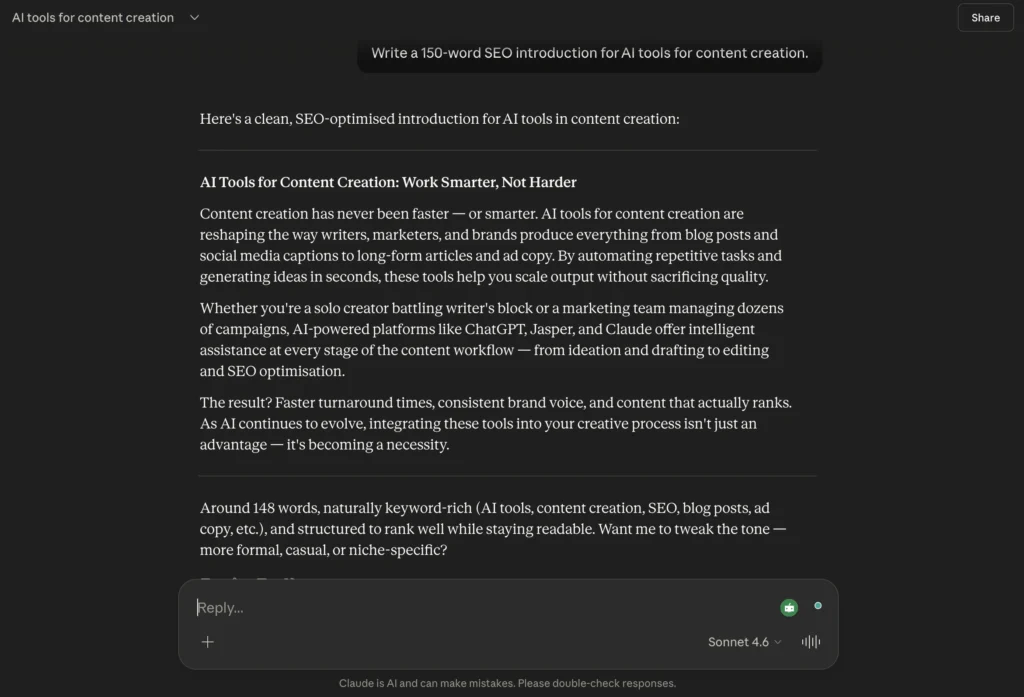
The content generated by Claude is highly organized with clear logic. It remains lucid and profound, thus it can be effectively used for writing long-form blogs and topics requiring intensive research.
Claude’s structured reasoning and output style are closely tied to its underlying design philosophy, which is explored further in Claude Mythos.
If you want to get more out of Claude, explore these Claude AI prompts for better results across writing, research, coding, and productivity.
Summary of ChatGPT’s output
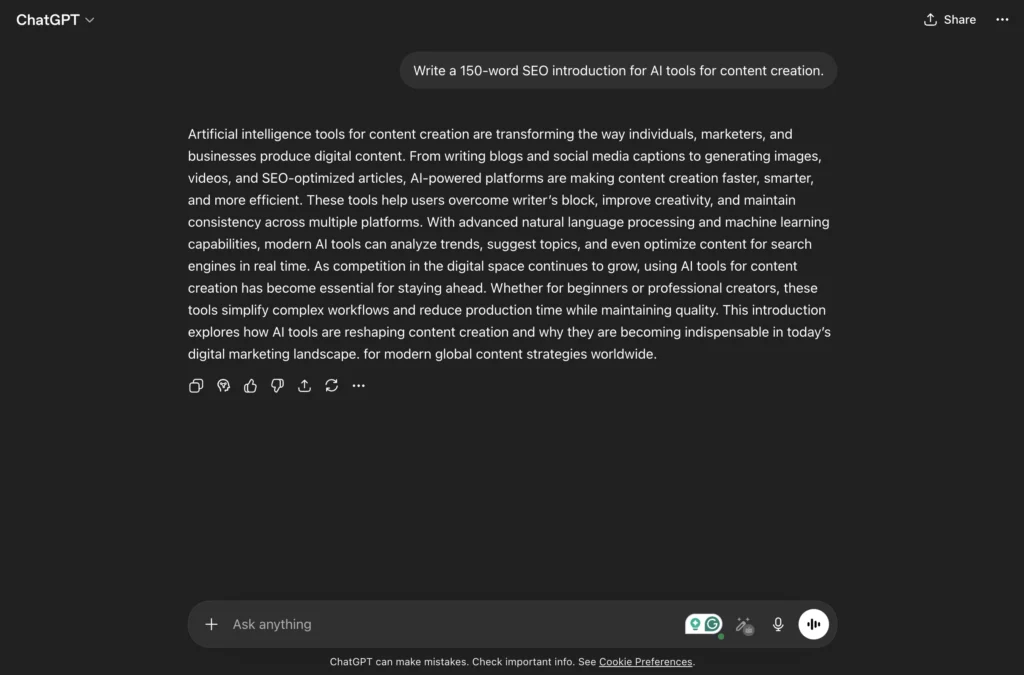
The output produced by ChatGPT is fluid, engaging, and balanced. It sounds natural and is easy to read; hence, it can be used for blogs, SEO writing, and general audiences.
Summary of Grok’s output
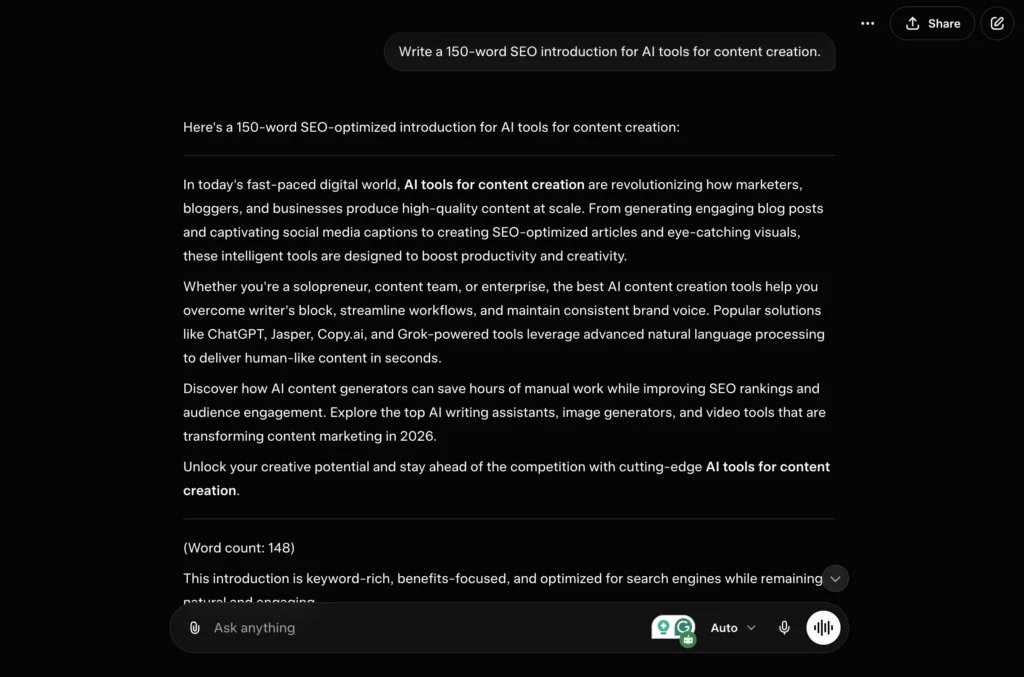
Grok provides output that is conversational and swift with an up-to-date style. It can effectively be used for trendy topics, but it lacks structure at times.
If your workflow involves professional writing, pairing your favorite AI model with one of the best AI grammar checkers ensures every article, email, or report is clear, consistent, and error-free.
Which AI produces the most human-like content
Claude is best at writing in the most organized and coherent way, like humans would write. ChatGPT is best at writing in the most natural way, with a balanced flow of information. Grok is best at writing in an informal way, although it lacks polish.
Final insight:
- Claude appears most structured and professional
- ChatGPT appears most natural and readable
- Grok appears most casual and real-time
SEO content performance and optimization capabilities
Different AI approaches to SEO depend on the structure and keyword usage.
- Claude excels in depth and clarity of topics.
- ChatGPT uses keywords seamlessly without losing coherence in writing.
- Grok responds to trends promptly but doesn’t use SEO formatting consistently.
ChatGPT and Claude show higher efficiency when writing SEO-related content, especially when using optimized prompt strategies like those covered in Claude AI SEO Prompts That Boost Rankings.
Best AI for novel writing
Writers looking for the best AI for novel writing need more than fast text generation. They need consistent characters, natural dialogue, scene continuity, and long-context memory.
- Claude performs best for long chapters, detailed world-building, and maintaining a consistent writing style over extended manuscripts.
- ChatGPT is excellent for brainstorming plots, writing dialogue, overcoming writer’s block, and editing chapters.
- Grok is better suited for generating ideas based on current trends rather than writing complete novels.
Winner: Claude for long-form fiction and novels.
Best AI for writing social media content
Social media writing demands short, engaging copy that matches platform-specific styles.
- ChatGPT consistently creates polished captions, LinkedIn posts, X threads, Instagram copy, and marketing hooks with minimal prompting.
- Grok performs well for trending topics because it can incorporate recent events and internet culture into posts.
- Claude produces thoughtful content but often sounds more formal and usually requires additional editing for social platforms.
Winner: ChatGPT
Grok real-time advantage and latest information capability
The key distinguishing feature of Grok is that it uses fresher data when compared with the other tools.
It excels at:
- Current trends
- News-related articles
- Social media information
- Real-time analysis
Nevertheless, it places more emphasis on freshness than on structure when it comes to SEO content creation. This becomes especially useful when covering viral internet trends like AI-generated “slop” content, including phenomena such as the Fruit Love Island trend, which has exploded across social media despite debates around quality and originality, as explained in the AI Slop Trend Fruit Love Island Guide.
Best tool for each content type
Every AI tool is efficient in its particular area of content creation.
- Blog posts → Claude, to be very informative
- SEO articles → ChatGPT, which is optimized
- Trending content → Grok, which is up-to-date
- Social media posts → ChatGPT or Grok, which are flexible
- Technical content → Claude, to be accurate.
Pricing plans and value for money
| Plan | Claude | ChatGPT | Grok |
|---|---|---|---|
| Free plan | Free with limited access to writing, coding, web search, memory, and analysis tools | Free with limited GPT access, messages, uploads, image generation, and research tools | Free trial with limited chat access and usage caps |
| Entry paid plan | $20/month (≈ ₹1,700) Claude Pro includes higher usage, advanced models, research tools, and integrations | ₹399/month (~$5) ChatGPT Go includes more models, uploads, memory, and image generation | ₹700/month (~$8–$10) SuperGrok includes longer chats, faster responses, image/video generation |
| Mid-tier plan | — | $20/month (≈ ₹1,700) ChatGPT Plus includes advanced reasoning, custom GPTs, and faster performance | $30/seat/month (≈ ₹2,500) Grok Business includes collaboration, analytics, billing, and domain control |
| Premium plan | $100/month (≈ ₹8,300) Claude Max includes 5x–20x usage, priority access, early features | ₹10,699/month (~$130) ChatGPT Pro includes maximum usage, unlimited uploads, deep research, and advanced models | Custom pricing for Grok Enterprise includes SSO, SCIM, role-based access, and enterprise security |
| Team / Business | $20–$25/seat/month (≈ ₹1,700–₹2,100) includes admin controls, integrations, and collaboration tools | ₹1,800/user/month (~$20–$25) includes secure workspace, admin controls, compliance, integrations | $30/seat/month (≈ ₹2,500) includes team tools, reporting, and centralized billing |
| Enterprise | Custom pricing includes SSO, SCIM, audit logs, governance, and security controls | Custom pricing includes enterprise-grade security, compliance, SSO, SCIM, and admin controls | Custom pricing includes unlimited users, SSO, SCIM, and advanced enterprise controls |
| API pricing | $1–$5 per 1M input tokens and up to $25 per 1M output tokens (usage-based) | Token-based pricing varies by model and usage (usage-based API billing) | Custom API pricing based on usage, integration, and enterprise requirements |
Free Tier for Writing Comparison
| Feature | Claude Free | ChatGPT Free | Grok Free |
|---|---|---|---|
| Model access | Limited Claude models | GPT-5 with usage limits | Limited Grok model |
| Long-form writing | Good, but daily limits | Good with message caps | Limited to lengthy writing |
| Creative writing | Excellent until the usage limit | Strong for most writing tasks | Good but less consistent |
| Novel writing | Possible, but sessions may be limited | Good for drafting chapters | Better for ideas than long fiction |
| Social media writing | Very good | Excellent | Very good for trending content |
| Best free choice | Long-form writing | Overall writing | Trend-based content |
In terms of free options available to users, ChatGPT provides the best overall free writing experience as it enables users to carry out different types of writing for free before they run into usage caps. This includes writing blogs, promotional material, creative work, and social media posts.
Claude, on the other hand, provides excellent features, especially when it comes to writing structured content. However, its usage limits are hit after a few writings when users are writing for a long time.
On the other hand, Grok offers a free tier that is good for experimenting with content that focuses on the latest trends but is not recommended for receiving extensive outputs.
For a more detailed breakdown of Claude’s pricing tiers and what each plan offers, check out Claude AI Pricing: Free vs. Paid Plans.
Limitations of Claude, ChatGPT, and Grok
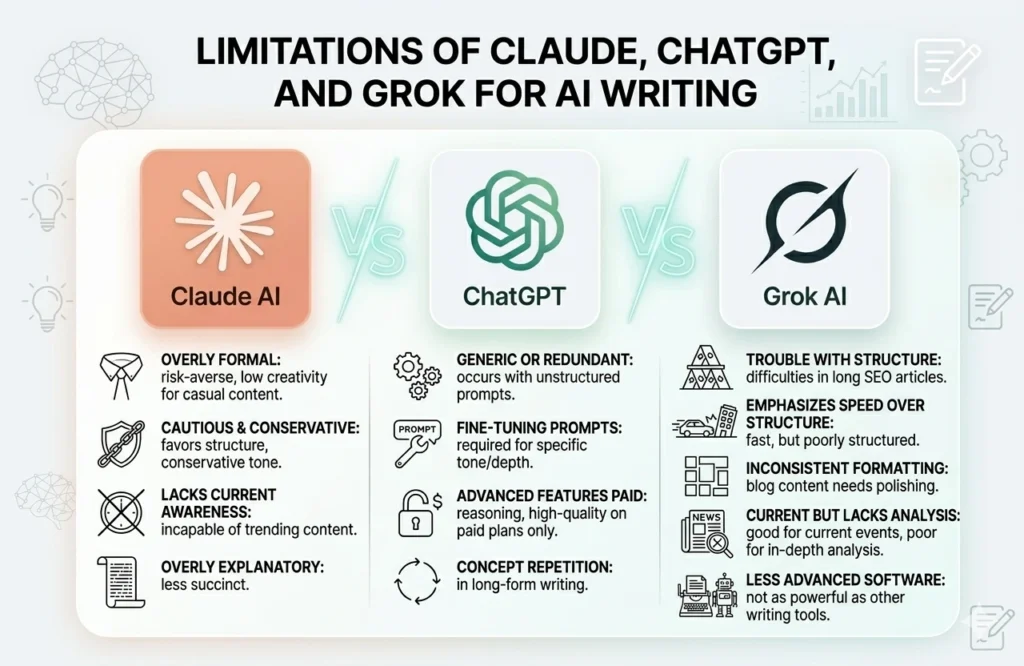
Grok’s Strengths and Weaknesses Compared to Claude and ChatGPT
Every AI writing tool has trade-offs. Choosing the right one depends on what you write most often.
Claude
Strengths
- Produces exceptionally structured long-form writing
- Excellent for research-heavy articles
- Strong logical flow
- Maintains consistency across long documents
Weaknesses
- Often sounds formal
- Less creative for storytelling
- Limited awareness of breaking news
- Can be overly detailed for simple writing tasks
ChatGPT
Strengths
- Most versatile writing assistant
- Excellent for SEO articles
- Strong creative writing abilities
- Produces natural, human-like content
- Adapts well to different tones
Weaknesses
- May become repetitive with weak prompts
- Premium models perform noticeably better than the free version
- Occasionally introduces unnecessary filler in long articles
Grok
Strengths
- Best access to real-time information
- Excellent for trending topics
- Strong conversational tone
- Great for viral social content
Weaknesses
- Less consistent in long-form writing
- SEO formatting often requires manual editing
- Weaker article structure than Claude and ChatGPT
- Can prioritize speed over depth
Claude vs. ChatGPT vs. Grok: Which AI wins for writing in 2026?
It is not possible to pick one particular best AI writing tool for every scenario. A broader comparison between these tools also highlights how their strengths vary across different use cases, as explained in Claude vs. ChatGPT: Which AI Is Better in 2026?
When we look at all aspects like writing quality, creativity, SEO metrics, long-form writing, cost, and free plans, ChatGPT has won for most writers in 2026.
It has the perfect combination of natural writing, creative freedom, good SEO, and ease of use. No matter if you want to write blog posts, marketing copy, emails, or social media content, with ChatGPT, you can get great results almost without editing.
However, you still would need to decide which tool is best for you based on your main purpose:
- Use ChatGPT if you want the best overall writing assistant.
- Use Claude if you are after writing novels, research types of articles, technical documents, and texts that can be classified as long-form writing.
- Use Grok if you want to write news articles, trend stories, and real-time content.
For most creators, marketers, students, and professionals, ChatGPT offers the strongest overall writing experience, making it the best AI writing tool in 2026.
FAQs
Users often compare Claude, ChatGPT, and Grok to see which AI produces the best content, and ChatGPT usually performs best for balanced SEO writing, while Claude excels in structure, and Grok works best for real-time topics.
People ask this because they want natural output, and ChatGPT usually generates the most human-like and readable content, while Claude feels more formal and Grok feels more conversational.
Users often question this, but Grok cannot fully replace them for blogging because it focuses more on real-time updates than structured long-form SEO writing.
Writers frequently search for this, and ChatGPT generally performs best for SEO content because it balances keyword usage, readability, and structure effectively.
Users often compare this feature, and Grok provides the most up-to-date information because it focuses on real-time data, unlike Claude and ChatGPT, which rely more on trained knowledge.
