
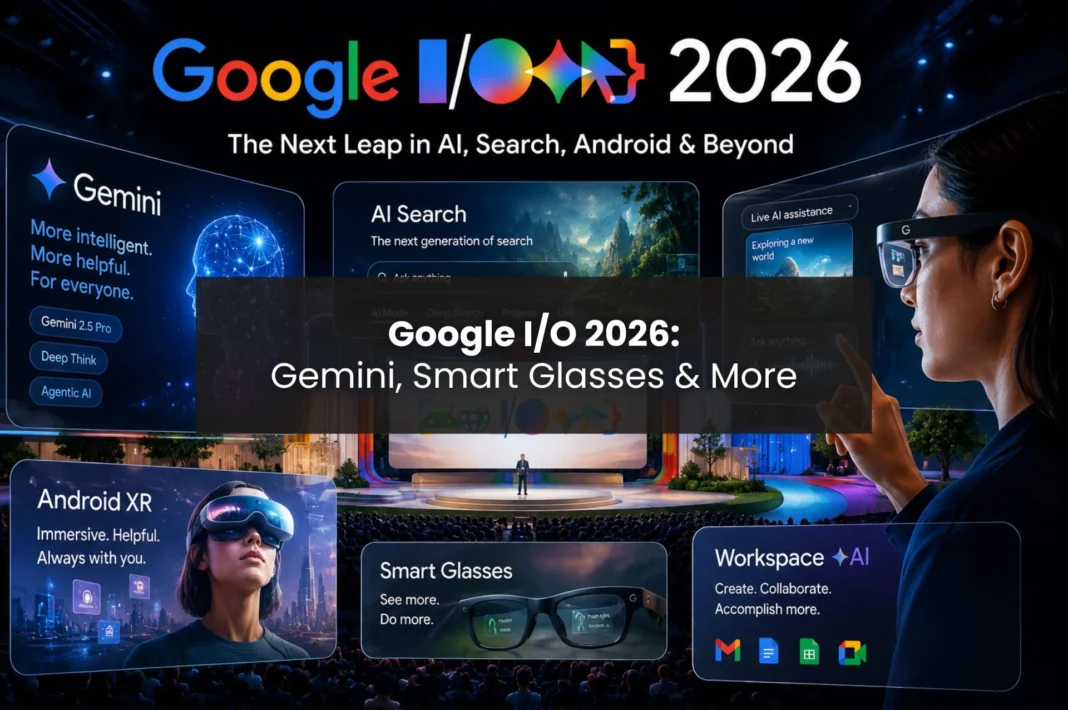
How Google I/O 2026 introduced Google’s AI-first future
Google I/O 2026 made one thing clear: Google is turning AI into the center of its entire ecosystem. From Gemini and AI Search to Android XR and smart glasses, nearly all announcements had an overarching theme of making AI more useful, connected, and integrated into people’s day-to-day lives.
CEO Sundar Pichai emphasized the larger vision behind what Google is trying to do: create AI that will be more personal, proactive, and available naturally across all devices/products.
This article breaks down the biggest announcements from Google I/O 2026, including Gemini AI updates, AI-powered Search, Android XR, smart glasses, upgrades to Workspace, and new tooling for developers.
Why Google I/O 2026 felt different from previous years
- Google chose to focus on AI as the core of its ecosystem rather than as a feature.
- Most product announcements were centered around the use of Gemini AI.
- Google changed from a search engine company to an AI ecosystem company.
- Gemini was incorporated into Search, Android, Workspace, Chrome, YouTube, and wearables.
- The event featured a focus on AI agents and automation rather than applications.
- Google focused heavily on proactive AI that can complete tasks, not just answer questions.
- With Android XR and Google smart glasses, Google introduced the concept of ambient AI and spatial computing.
- Competition with OpenAI, Microsoft, Anthropic, Apple, and Meta was emphasized at the keynote.
- Google demonstrated its emphasis on AI personalization, memory, and multimodal capabilities.
- Google showcased AI as part of users’ everyday experience rather than a chatbot interaction.
Gemini AI updates became the biggest focus of the event
Google upgraded its Gemini with better reasoning capability, memory, and multimodal features.
Gemini is capable of simultaneously analyzing and understanding text, images, voices, and videos. This leads to more accurate and context-aware answers.
Google upgraded Gemini Live and changed the communication to a more natural way. Users can speak to Google AI and also share their screen, all while the AI is getting the live context.
Besides just answering questions, Google introduced an agent that gets work done for you. So basically, now Gemini by Google is helping you not just with answering your questions but also with trip planning, scheduling, and managing your workflow.
Google has deeply integrated Gemini into its products Gmail, Docs, Chrome, Android, and Workspace.
AI Search entered a completely new era
Google has made changes to Search, making it AI-first. Whereas Search used to display just links, it now creates answers, summaries, and explanations. Users can converse with Search.
To deal with queries requiring reasoning and comparisons, Google introduced Deep Search. This makes Search better at understanding user intent and delivering well-structured insights.
Search also assists with shopping, travel, and decision-making through AI-based suggestions.
This shift also reflects how AI browsers and conversational search platforms are starting to reshape online discovery and SEO strategies. Readers interested in this transition can explore how AI browsers are changing the future of SEO.
The Google smart glasses and Android XR stole the spotlight

With Android XR smart glasses, Google took a major step toward ambient computing, where users can access AI assistance, navigation, and real-time information seamlessly through wearable devices.
The glasses will also provide users with real-time assistance via Google Gemini by showing the user live translation/interpretation, navigation directions, and contextual information, all directly in the user’s line of sight.
With Android XR powering these products, Google combines the benefits of augmented reality with the capabilities of an artificial intelligence (AI) engine to create a new layer of computing that sits on top of your smartphone.
Google has partnered with various hardware companies to develop these products and compete against Apple and Meta in the spatial computing market.
Google has not yet revealed pricing for the Android XR smart glasses, though some analysts predict that audio-only models will likely compete in the range of $300 to $800 for premium smart glasses, depending on features and hardware partnerships.
The rollout will begin with the release of Android-powered intelligent eyewear made by Google, in collaboration with Samsung and Qualcomm, in the fall of 2026, as both audio-centric and AR-display glasses that come in a variety of fashion-oriented styles. These products will be released in phases, with initial releases focusing on audio + AI capabilities prior to introducing full AR wearable experiences.
Android became more intelligent with built-in AI
Android has become a smarter and more intuitive operating system thanks to Gemini.
Now notifications, messages, and phone calls are automatically summarized by Android, and the operating system suggests options based on what it thinks is most suitable to do in a situation, such as replying to someone, scheduling something, or saving something.
Google has improved how quickly AI can be processed on devices as well. Many of these AI features now run directly on devices, improving speed, privacy, and offline functionality.
Instead of being a separate assistant, Gemini has been integrated into the central part of Android. There is no longer any separate AI; it has become a part of the Android operating system.
Google Workspace received major productivity upgrades
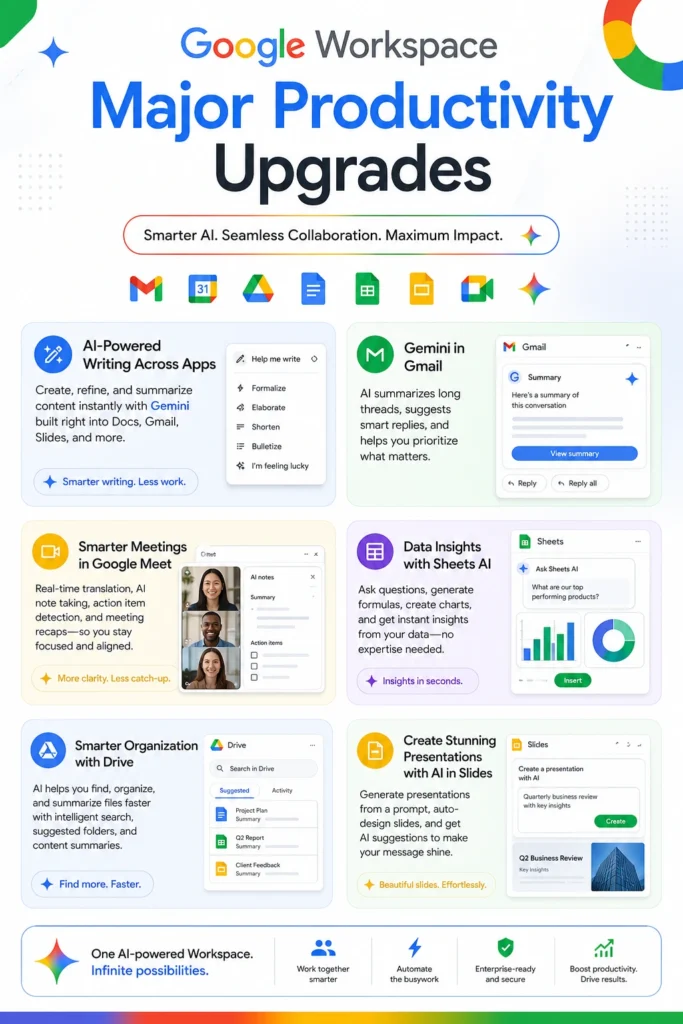
At Google I/O 2026, Google Workspace received numerous enhancements in AI productivity. The AI enhancements are helping to provide better automation in Gmail, Docs, Sheets, Meet, and Drive.
Gmail will now automatically write emails based on what they are suggesting you write, based on the context and emotion. Docs will now be able to create assistive structured documents based on the previous context of your writing and the purpose of your writing. The same goes for Calendars and Sheets, as they will be creating summaries and action items for you to follow up on in your meetings.
All these AI enhancements to Google Workspace will save you time and make you more productive at the same time.
These upgrades allow users to spend less time on repetitive tasks and focus more on productivity and decision-making.
These upgrades also highlight how AI tools are changing modern workflows, especially for teams and creators looking to automate repetitive tasks. Readers exploring similar solutions can also check out these best AI productivity tools.
Developers received powerful new AI tools
Google added more powerful AI features to its developer ecosystem.
Gemini APIs were updated, and AI Studio was enhanced to enable rapid production. Programmers are able to design AI agents, automate operations, and develop multimodal applications with minimal work.
Google decided to make things easier for startups. Small groups are capable of creating sophisticated AI-driven applications through the Gemini platform.
This strategy helps Google grow its ecosystem by encouraging developers to build directly on top of its AI platform. Moreover, this growing focus on real-world AI integration also mirrors broader industry efforts to scale AI infrastructure and deployment across businesses, similar to initiatives like OpenAI’s DeployCo venture.
YouTube, Chrome, and other Google products also gained AI features
Google enhanced its ecosystem using AI technology.
The Chrome browser assists users in understanding websites by providing summaries and context. It also makes web browsing more efficient by minimizing information overload.
On YouTube, AI technology is used to enhance recommendations based on user intent and behavior.
Though each of these enhancements appears small, there is one thing that becomes clear from them: all Google products use AI technology.
Everything Google introduced at Google I/O 2026 at a glance
| Product / Feature | What Google introduced |
|---|---|
| Gemini AI | Multimodal intelligence with ~1M token context (advanced), improved reasoning & memory |
| Gemini Live | Real-time conversational AI with ~20–40% lower response latency |
| AI Search | Conversational, AI-first search reducing query cycles by ~30–50% |
| Deep Search | Multi-step reasoning across sources in a single flow, improving research efficiency |
| Android XR | Mixed reality platform enabling hands-free spatial computing with Gemini integration |
| Google smart glasses | AI-powered wearable assistant; expected pricing ~$300–$800+ depending on the model |
| Android AI features | On-device automation handling ~40–70% of routine actions locally |
| Workspace AI | Productivity automation saving ~30–60% time across Gmail, Docs, Meet |
| Gemini APIs | Faster app development cycles, enabling ~2–3× quicker prototyping |
| Chrome AI | Smart browsing with summaries reduces information overload by ~20–30% |
| YouTube AI | Personalized recommendations improved using intent-based ranking signals |
(Source: 9to5Google Google I/O 2026 coverage.)
What these Google I/O 2026 announcements mean for everyday users
- Search will feel more conversational instead of simply showing answers.
- Gemini will allow a user to complete tasks rather than just get an answer.
- Android devices will automatically provide smarter suggestions and summaries.
- AI tools in Gmail, Docs, and Meet will make repetitive tasks quicker.
- Google smart glasses will make AI assistance more available during day-to-day activities.
- On-device AI processing will enhance both privacy and the sensors’ response time.
- Google introduced Gemini 3.5 Flash for fast, agent-based tasks like coding and automation, along with Gemini Omni, a multimodal model family for image, video, and generative capabilities.
My insights on the biggest trend from Google I/O 2026
Google isn’t just making features powered by AI; it is creating a whole AI operating layer.
Gemini is the one that ties all Google products into a single system. This changes the way we compute, moving from interacting with apps to interacting with AI.
This dominant trend now is the competition of ecosystems. Moreover, Android XR and smart glasses are further indications of the long-term move to ambient computing, in which AI is always present but invisible.
Why Google I/O 2026 announcements could shape the future of technology
Google I/O 2026 made it clear that the company is building an entire AI-first ecosystem: Gemini AI, conversational search, Android XR, smart glasses, etc. These announcements showed Google’s vision of making AI the primary way users interact with technology. Google is trying to combine all of its apps and devices in one smart ecosystem.
Moreover, this event demonstrated a trend in the industry where companies are not only involved in the competition of building better chatbots but also in developing complete AI ecosystems combining software, hardware, search, productivity, and wearable technologies.
If Google continues expanding Gemini across Search, Android, Workspace, Chrome, and XR devices, Google I/O 2026 could mark the beginning of AI-first computing.
FAQs
The biggest announcements included Gemini AI updates, AI-powered search, Android XR, Google smart glasses, Workspace AI features, and new developer tools.
Google improved Gemini’s reasoning, memory, multimodal understanding, personalization, and task automation capabilities.
Google showcased AI-powered smart glasses built on Android XR with features like live translation, navigation, and real-time AI assistance.
Google developed Android XR as its mixed reality platform for wearable and spatial computing devices. It combines augmented reality with Gemini AI to provide contextual information and hands-free assistance.
Google’s new AI features will make Search more conversational, automate repetitive tasks, improve productivity tools, and create more personalized experiences across devices and apps.
